My only real exposure is from brief coverage by Dower in "War Without Mercy". The picture painted there is of an occupying force that came in preaching pan-Asianism, and initially even offering improvement, but quickly falling into a racial superiority complex and lording over the local population as inferior children. I'd love to know more specifics though.
I have never heard about that book, but it is correct. Japan came when the people of Indonesia was suffering under Dutch, so at first their arrival and subsequent chasing out of the Dutch was welcomed as if they were Gods.
On 9 March 1942, lieutenant general Ter Porten signed a declaration of (submission? surrender? ^not ^sure ^of ^the ^English ^term) to lieutenant Hitoshi Imamura in Kalijati, Subang, West Java. The declaration brought about a brand new era of... revoltingly worse colonialism.
At first, Japan seemingly offered the protection that Indonesians so much craved for. Here's the list of their propaganda at the time:
Gerakan 3A (3A movement). Here's the propaganda poster at the time. Basically Japan promoted itself as the Light of Asia, Protector of Asia, and Leader of Asia (hence the three A). Here's another poster example.
Named itself as Indonesian's old sibling.
Japan came to free Indonesians from the evil tuan kumpeni.
Formed the PUTERA Organization.
Japan formed many troops such as Youth Troops and Homeland Protector Forces under pretense of teaching Indonesians military, but in reality used the troops to wage war for Japan.
The 3A Movement was led by an Indonesian named Syamsudin KH. It was not very effective after a while, which led to its dissolution at 1943. To replace the old movement, Japan formed the Pusat Tenaga Rakyat Org or abbreviated as PUTERA (People's Power Force), led by the Big Fou which were Soekarno (first president of Indonesia), Mohammad Hatta (first vice president of Indonesia), Ki Hajar Dewantara (the education figure who opened free school for Indonesians), and Kyai rHaji Mas Mansyur (the leader of Islamic organization Muhammadiyah). Ironically, the forming of PUTERA later backfired because Bung Karno used the organization to gather nasionalists and plan for independence.
During the Pacific War, Japan formed many troops in Indonesia under pretense that they would teach Indonesians military and war strategy to protect the country from further West colonialism such as:
Seinendan (Youth Troops)
Heiho (Japan Military Helper Troops)
PETA (Homeland Protector Forces)
Fujinkai (Woman Troops)
Gakutosai (Student Troops)
Keibodan (Police Helper Troops)
Jibakutai (Suicide Troops)
Kempetai (Secret Police Forces)
These troops were used by Japanese to fight the Pacific War as well as to keep Indonesians in check, especially Soekarno and Hatta who slowly but surely revealed themselves as dangerous foes, which led to Soekarno's banishment to Rengasdengklok. (Although Soekarno was protected by PETA during this time. The plan for declaration of independence was created during this time.)
When all propaganda more or less became rather ineffective, Japan started their true mission.
First was the rules that Indonesians had to do Seikerei (saluting Japan Emperor by bowing towards the rising sun) every morning before prayer. Given that at the time most of Indonesia was Muslims, this act was considered as worshipping another entity aside from Allah. This rule resulted in several rebellions led by Kyai Haji Sainal Mustafa in West Java which lasted a year from 1943 - 1944. (KH Zainal Mustafa was arrested and executed, he was buried in Ancol area, Jakarta)
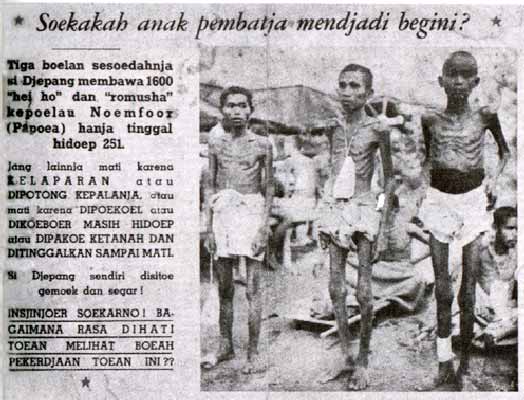
Second, Japan created romusha (corvee labor). Millions of romusha forces were sent to force labor camps around Indonesia and Japan's other colonies, but the most well-documented (in Indonesia, at least) was the forced labor camps around Sumatra, mainly used to clear the thick forests and build railways. So many romusha's lives perished during the feat which earned the railways its notorious title 'The Deathly Railways'. Romushas were recruited by luring youths that they would be either educated or enlisted to Heiho / Gakutosai / Seinendan. Starting from 1943 though, Japan issued a new rule that necessitated farmers to serve as romusha for a period of time similar to conscription.
One of the former romusha able to live until modern days was Suratman, who came from Wonosobo, Central Java. At eighteen, he was recruited by the Japanese. He was promised to be educated in a special Japanese school, but instead was sent to West Sumatra to build the railways from Padang to Pekanbaru, Riau Province.
Equipped only with minimal supplies, the romushas were force to clear forests and scrape the many rock hills dotting Sumatra's landscape. During the process many romushas died from untreated disease, malnutrition, or accidents during work. Food for romushas were only a fistful of rice flavored with salt and nothing more for a day. The clothes they wore were made from burlap sacks and tree barks, and it had to be worn until it resembled clothes no more before being replaced another burlap sack shirt.
If a romusha fell sick, he had to find for medicine himself. Any other romusha who helped the sick romusha looking for medicine was punished by beating. Romushas who seemingly worked less than the others or tried to escape but failed were tortured and executed in front of the other romushas as a warning.
The book The Sumatra Railroad even stated that 80% of the romushas perished during 1943 - 1945.
Not only Indonesians were made romushas, though. Data collected by George Duffy stated that about four thousands Dutch war captives, a thousand English soldiers, two hundreds Australians and fifteen Americans were also worked as romusha. From this amount, about seven hundred perished due to untreated disease. Sumatra at the time was a vast and virgin jungle who hid all sorts of maladious disease and plague within its thick foliage after all.
There's a video about him who told of his experience, unfortunately it is in Indonesian.
Fun fact: a romusha story from the building of Burma - Thailand railroad was screened as The Bridge of River Kwai. Although happened in another country, the experience was similar.
The romusha suffering prompted other rebellions, especially from Indramayu, West Java, led by Haji Madriyan. The rebellions were easily subdued, and for punishment, everyone involved in the rebellions were publicly tortured for warnings.
Thirdly, Japan necessitated every farmer to submit most of the crops mainly rice, corn, and cattle to Japan, leaving the farmers impoverished and unable to provide food for their families. Farmers were also obliged to plant castor oil plant (Jathropa) to be used as weaponry lubricants.
Fourthly, Indonesian girls were forcefully taken from their homes and families to be employed as comfort women (or rape dolls as we name it). Indonesians, if you ever read this comment, you have to read the book Perawan Remaja Dalam Cengkeraman Militer by Pramoedya AT. It is a horrifying, nauseating story comparable to the Rape of Nanking by Iris Chang.
During 1942 - 1945, Girls were taken forcefully or tricked into believing that they would be educated in Tokyo while in reality they were shipped to the various comfort houses to satisfy Japanese soldiers' lust. Those forcefully taken were raped in front of their family before being spirited away. Pregnant girls were forced to do abortion, while those who fell ill were let to die without care. Many died from suicide, torture, or disease. After Japan's surrender in 1945, these girls were abandoned in their posts. The author of the book traced the remnants of Javanese comfort women in Buru island, where girls who were abandoned after the war had no choice other than becoming prostitutes.
Fifthly, the notorious Unit 731, whose victims weren't only Indonesians.