In short: It was great. Literally.
The expansion of Islam happened so quickly, that quite often the Muslim rulers were minorities in their newly conquered territories. To make their position safer, they had the Pact of Umar, a document of Islamic law that governed the behaviour of dhimmi, which translates to "people of the book", meaning Jews and Christians.
The laws of the Pact were strict, but they were not created to enforce religious discrimination. Rather, they were there to maintain a social hierarchy, and therefore the rules were not applied equally throughout the Muslim world, but instead were adapted to suit the communities in which it was enforced.
This meant that in places with a strong Muslim presence, like Egypt, Christians and Jews were often prohibited from practicing their religion in public, or repairing religious buildings, like churches and temples. They were not allowed to evangelise to Muslims, or display crosses or bibles. Even in places like Egypt, these rules were not necessarily enforced. In one instance, a Jewish funeral procession in Egypt was attacked by Muslims, and the Caliph, rather than imprisoning or killing the Jews who had breeched the Pact, pardoned them. This action suggests that the importance of the Pact was in keeping the peace between the Muslims and other groups.
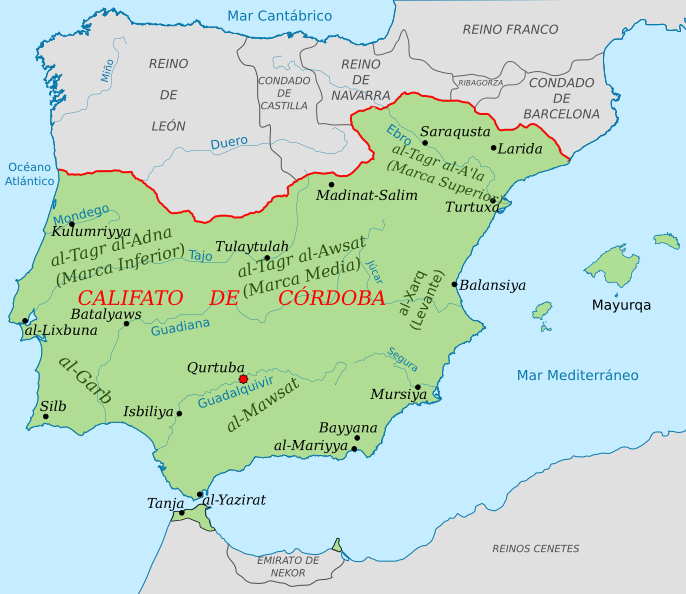
In Spain, this was especially true. Muslim Spain was surrounded by Christian regions. This map shows the various Christian territories in Spain during the time of the Cordoban caliphate. The Pyrenees are all that separates France from Spain, and beyond that lies the rest of Europe, all Christian. The various Muslim rulers there worked to keep the community peaceful, so that the Christian Kings beyond their borders wouldn't be incited to invade. One of the prohibitions of the Pact of Umar was that the dhimmi could not hold government positions, yet in Spain this rule was largely ignored. In the case of the Cordoban caliphate, it was recognised that those best suited to run the local government, were the locals.
At the same time, there was the tax applied to all dhimmi, called the jizya. It was an annual tax for the dhimmi to pay to their Muslim rulers. It was paid as usual in Spain, however, it was largely offset by the economic benefits brought to Spain by the Muslims. The ruling class demanded luxurious goods unavailable in Spain, and when they were imported, anyone could purchase them. This was because Muslim traders couldn't go via European ports, while Jews could pass freely through the Mediterranean harbours from east to west and vice versa. The caliphate's demand for these luxuries meant that the Jewish merchants prospered by importing the desired goods, and the Christians and Jews of Spain gained access to them.
Religious freedom was also recognised, both to appease the Christian rulers surrounding Spain and because there were more important matters. The royal court required translators to transcribe texts from Muslim and European lands. In this, choice was limited and religious persuasions were put aside in favour of intellectual prowess.
These decisions by the Muslim rulers meant that the Pact of Umar was largely swept aside in favour of a more culturally and economically successful territory. And this tolerance of Jews and Christians was indeed profitable - the portions of the Spanish peninsula under Muslim rule flourished, with learning, culture, and the economy booming during their rule.
I can't answer the population segment of your question right off the top of my head, but I'll try look into it.
Sources:
Mark Cohen, Under Crescent and Cross: The Jews in the Middle Ages.
Albert Hourani, A History of the Arab Peoples.
Jane Gerber, The Jews of Spain: A History of the Sephardic Experience.
Norman A. Stillman, The Jews of Arab Lands: A History and Sourcebook.