For a country that was conquered almost more often than Sicily, had very little in the way of land or natural resources, Britain sure did well for itself. I realize they were a strong empire due to a powerful navy and many colonies, but how exactly did they get both those things? Was it a series of big events and wars, or just really smart policies and luck?
This is a very expansive question, and one which is probably better served by a book such as David Scott's Leviathan (itself named after Thomas Hobbes's own work). A wide variety of factors gave Britain an advantage in the seventeenth through nineteenth centuries, not least the fact that it was an island and hence able to prioritise its navy over its army, a key factor in the trade (not to mention international naval) dominance which it had achieved by midway through the eighteenth century. Beyond this, the strength of its fiscal-military state (and the reliability of funding which the Bank of England's bond-based system, nowadays fundamental to most governments) was also an important factor; while France was forced out of war by its bankruptcy several times in the eighteenth century, Britain was far better able to maintain its strength.
That said, there are a far wider range of reasons than I can adequately supply, and for a comprehensive answer books on Britain's growth as a world power - another being Brewer's "The Sinews of Power", probably the most famous in terms of the topic in the eighteenth century. Here are a few other threads covering the issue:
http://www.reddit.com/r/AskHistorians/comments/27z04r/why_was_the_british_empire_able_to_become_so/
http://www.reddit.com/r/AskHistorians/comments/13jqia/why_was_the_british_empire_a_superpower/
I hope this is informative!
Slightly out of my wheelhouse but let's give it a go.
Britain was pretty restricted in the North American theater for the 17th century. Spain was still the dominant colonial/European power (but rapidly declining in European prominence) and honestly the wealthiest power still though because of that American dominance; however, rapidly declining. Britain, along with just about everyone else, particularly in this case the Dutch, would scramble for control of both Caribbean (which the Brits got a firm hold on), European trade lines (which the Dutch convincingly had), and Indian Ocean trade (British/Dutch conflict persistently).
So with that in mind I would certainly place the conflict between these two powers in the 17th century for this wealth as the main actor of the rise of Britain; specifically the first three Anglo-Dutch Wars and the Glorious Revolution.
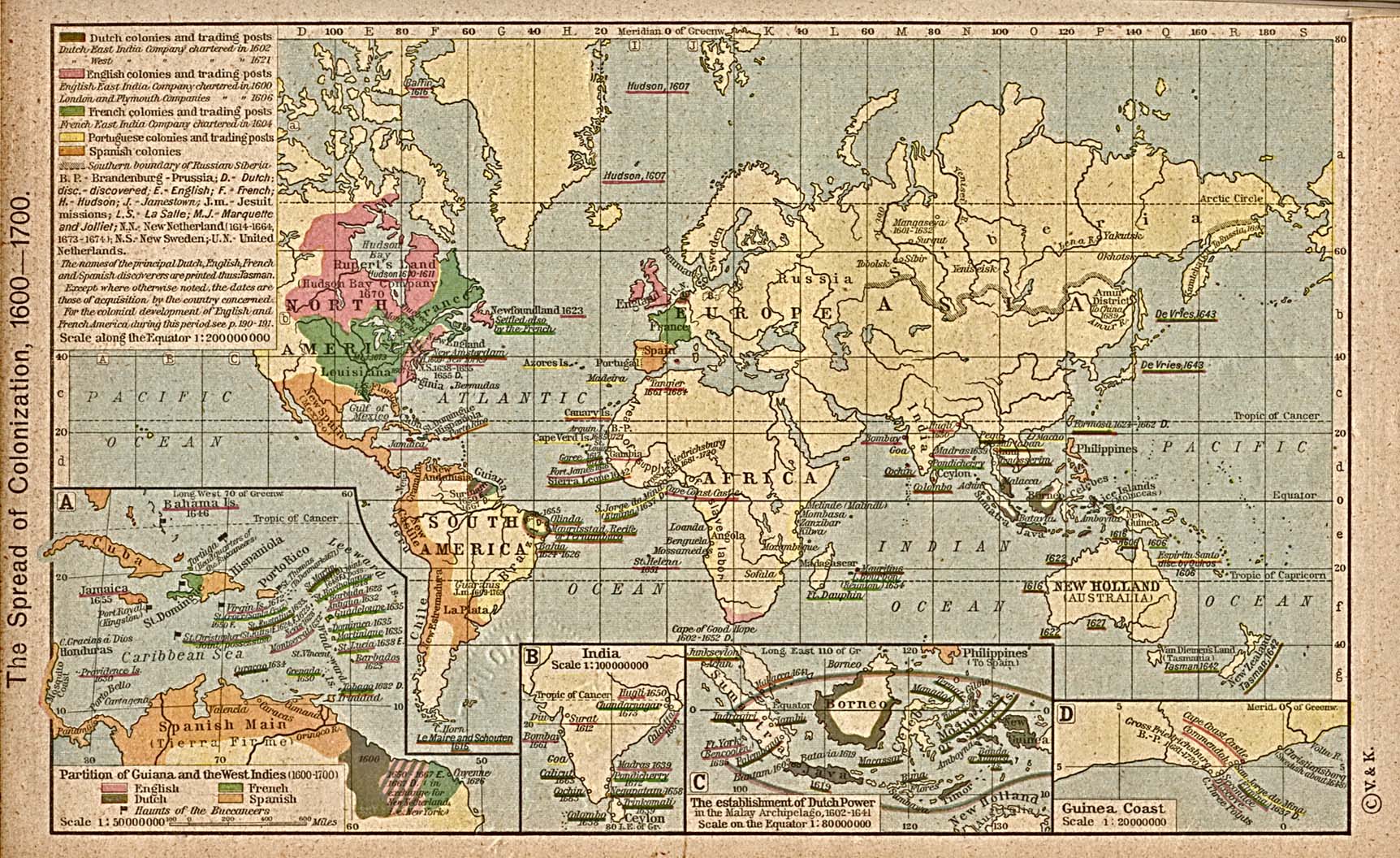
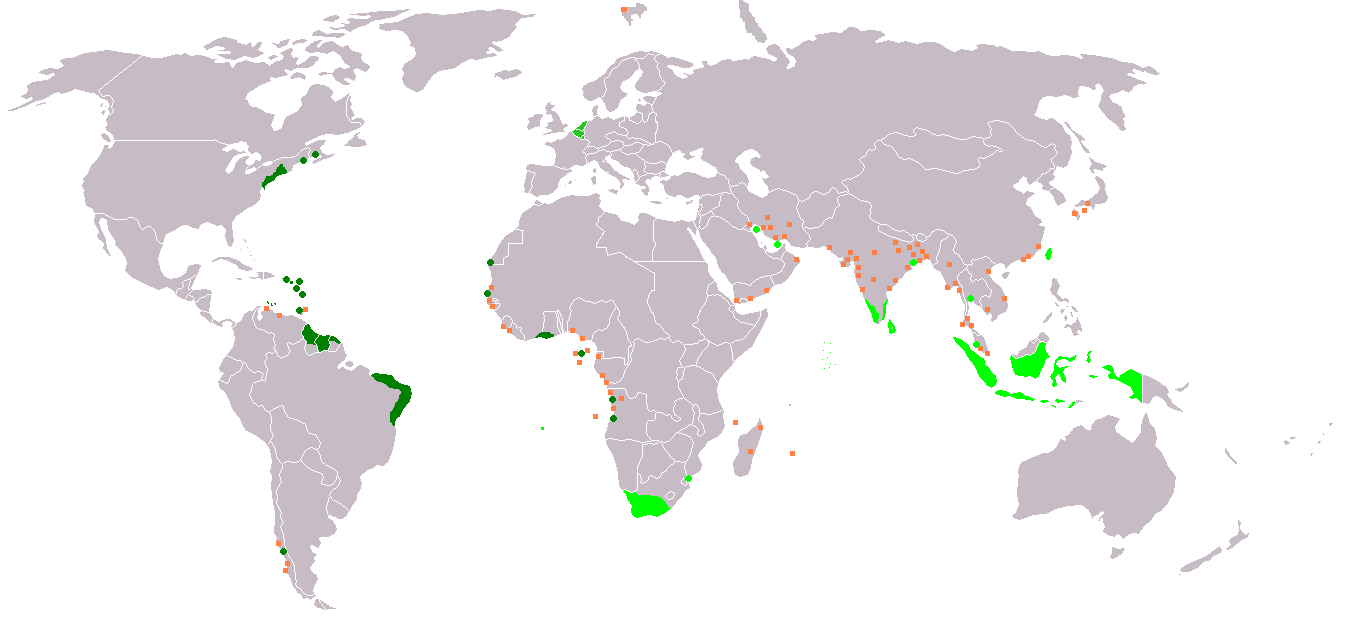
Between 1652 and 1654 and totally fought at sea. Basically by this point, believe it or not, that small little coastal nation had the largest mercantile fleet in the world and was in the conversation for top militarily powerful fleet as well. The Dutch, as you can see in the first map, basically expanded her reach quite much into the former Portugese Indian territories...in direct conflict with the British trading posts (and therefore the East India Trading Company). The early 1600's would essentially see the Dutch seizing all of Portugal's Indian/Asian territories and generally forcing the British out. The Dutch also were, as I said, the largest mercantile power in Europe...which was in the North Sea primarily; Britain's back yard. Tack onto this that the Dutch had just achieved independence (1648) and thus no blockade and even without that were selling the same goods cheaper than the British and, well, a trade war was simmering under the surface. Combine this with the English Civil War and the need to reel in the colonies and you have the perfect storm which leads the English to feeling they need to rapidly build up their navy and to fix this Dutch problem.
The conclusion of this war was not much of a conclusion but it basically put the Dutch down and gave the British temporary dominance over the North Sea and the Channel but, as you can tell with three more freaking wars, it was not over yet. There was also a bit about William III of Orange, who had a claim on the English throne but was like 2 years old, to not be allowed to ascend to that position or hold the position of stadthholder^1 of Holland. May be important later or something maybe kinda.
Between 1665 and 1667. Basically Britain started the war again to cripple Dutch economic dominance. They took some shit in North America (mainly New York) but ultimately lost. Not a hugely important war other than it pissed a lot of British people off.
Britain would be begrudgingly dragged into war by treaty to help France when Louis XIV got a boner for gloire and wanted Flanders. They would get their tails whooped four times in a row in battle trying to even blockade the Dutch let alone invade them. This is kind of a big deal because primarily with the French at the gates the Dutch said "fuck you secret treaty" and in a panic, along with a bunch of political maneuvering, made William III stadtholder after he won the day.
In 1688 this is when shit hit the fan. Know that William III of Orange guy? The guy who was stadtholder and shit? Yeah he married an English chick and now he had a claim to the English throne. The Dutch would, with the assistance of Parliamentary factions, actually invade Britain (!!!) and seize the throne for William from James II. However this wasn't a devastating war, it was more like a political coup de'tat..it happened, it was over.
This was a big fucking deal and in my opinion the turning point I talked about before. The Dutch and British were united and the Dutch made the junior partner. Those extremely wealthy Dutch merchants who dominated the world? London was their new home, not Amsterdam or anywhere else in Dutch lands. All Dutch fleets would be under direct British command, thus in essence, combine the two strongest mercantile and military fleets in the world. With the Dutch ideals of free trade and open commerce^2 dominating these extremely wealthy lands now wealth creation would flourish especially in India and the Caribbean replacing British agrarianism and military focused dominance.
Yeah there would be a brief spat in the 1780's when the Dutch tried to rise up one final time after a hundred years of steady economic decline and Britain taking basically all their business it would end even more horribly with the British solidifying what was already apparent -- they ruled the waves and the Dutch were old news. Add in slave trade ramping up in this period, the union between England & Scotland in 1707 along with the textile goods of India (given to English control) vastly overtaking the spices of the East Indies (given to Dutch control) and you get a very pretty picture of British economic dominance coming out of seemingly nowhere.
While there are three separate 'British Empires' to historians^3 this first one would lay the foundations for the last one. This first one would lay the foundations of Britain's strength where it would take seats with the other great powers (and arguably eclipse them). Their wealth accumulated in this period would be what they would use to essentially pay Europe to constantly go to war with Napoleon and fund Napoleon's enemies throughout with massive, well, donations. After this, after Vienna and Pax Brittanica, Britain's strength became absolute: They were accepted as the world naval power, India would become the "jewel of the empire"^4 and the wealth from it would explode.
But without naval hegemony (both militarily and w.r.t. trade) there can be no Pax Brittanica post-Vienna, without the massive wealth from India (textiles) and the Caribbean/America (tobacco/cotton/furs) and the Slave Trade^5 there is no money to fund Napoleon's enemies into essentially 20 years of constant war to create the conference which gave them those powers de facto. Without the Anglo-Dutch conflicts, neither of those conditions would have really been met; we would see a very different world today if the Dutch beat the British in what were essentially 3 series of naval clashes and then a coup de'tat. They would still have had a significant foothold in America (New York, primarily), India, and dominance over the Indies along with being the center of trade and wealth in Europe.
TL;DR:
Dutch and British fought over Asia over the 17th century. Trade in Europe was centered around the Dutch and the Dutch, esp. in the 1610's and 1620's seized a shitload of Indian territory from the Portuguese. English got tired of their shit and slapped them around a few times and got slapped around a few times back but by the end of the Third War it was still entirely inconclusive but the Brits had edged out some level of (slight) naval superiority. In a scheme of bullshit and confusion William III of Orange united the two warring states, made England the dominating party, and then that was really it.
Better TL;DR:
Britain and the Dutch were competing parties for Asian trade/European naval trade hubs. Britain got North America in war, got India through basically a coup de'tat (which ended up being much more profitable than what the Dutch thought they were stealing away from Britain), and got their entire navy. Get super fucking rich without any naval competition now that Spain is no longer a 'great power' as it once was and her only other real competitor, the Dutch, are nowbasically her junior partner.
Can TL;DR's get even shorter?"
Dutch were #1, Britain was #2. Dutch guy takes British throne and now Brits are #1. All wealthy people and trade goes to London now and they eclipse the Dutch from both the trade coming into their ports on Britain and through the boom in India in the 1700's.
^1 Basically a de facto leader of the province
^2 In stark contrast with the prior 'kill and steal everything and jack up the tariffs'
^3 1583-1783, 1783-1815, 1815-1914 traditionally.
^4 Again, because the Dutch seized it from Portugal and then the British got it from the Dutch after the Glorious Revolution. At that part it was solidly there.
^5 It should be noted slavery rapidly became not that profitable for Britain, hence their enforcing the ban on the slave trade worldwide in the 19th century
The Rise of the Great Powers 1648 - 1815 by Dereck McKay et. al would be a great source to look at. The Dutch Republic: Its Rise, Greatness, and Fall 1477-1806 by Jonathan Israel is a book I've only skimmed thus far would be another but covers these same topics. The Origins of Modern Europe 1660-1789 by James L. White is also highly recommended.
I'm currently taking a course on Britain from 1714 to WWI so I hope I can provide some insight. You could argue that it was a series of significant events inside and outside Britain that shifted them to a global power. First, there was slow introduction stronger Parliament power following the Glorious Revolution. When Parliament conspired with William III and Mary II to have James II overthrown, one of the conditions was they secede certain powers to Parliament, typically referred as the Declaration of Rights. Again, while this did not grant the power that Parliament currently holds today, it was a beginning to a more constitutional government. In part to these political advancements, Britain enjoyed a period of relative stability which allowed them to focus on their growing economy. Britain was in the midst of an agricultural revolution in which less labor was needed to grow more crops. One thing more crops yield is a surplus which can be sold/traded. This, along with a desire to stop the spread of Catholicism from the Spanish, lead to increased trading and oversea interests. Many of these ventures, while private in nature had government backing as well, which had an advantage. Even at the time, their flourishing economy and stability was noted by such intellectuals like John Locke and Voltaire* who argued that their model of government and higher religious tolerance compared to the absolute monarchies seen throughout Europe at the time were reason for their rise. Combine this with the struggles of revolution happening in other countries such as France, Britain seemed to have an advantage at this time. Another thing to look at in regards to their rising empire would be the trade industry itself. While you may state Britain is only an island with few resources, they had the right ones to help spark a more industrious economy. Water for transport and early power and later, coal, for steam power and producing steel. As for the other resources needed, well, that helped force the nation to expand their empire. Sell desired products such as guns, ammunition, textiles to tribes and kingdoms in Africa in exchange for slaves they could sell in the Caribbean and North America, to produce raw materials they could ship and produce within Britain…ie, the triangle trade. Outside the Atlantic, companies like the East India Trading Company were able to successfully by-pass older, less efficient land transport and subsequently get around tariffs by shipping raw materials from the east, like India, by sea. During this time, the Mughal Empire was slowly losing its power throughout India leaving the East India Co. to begin slowly taking over government and military administration, eventually leading to Britain’s expansion into the East. There is obviously much, much more and many details left out but I hope this provides a somewhat better understanding. *See John Locke "TheBeginnings of Political Society." Voltaire "Letters Concerning the English Nation." Also: "The Western World: Britain and Ireland 1714-1914" from Penguin Publishing.