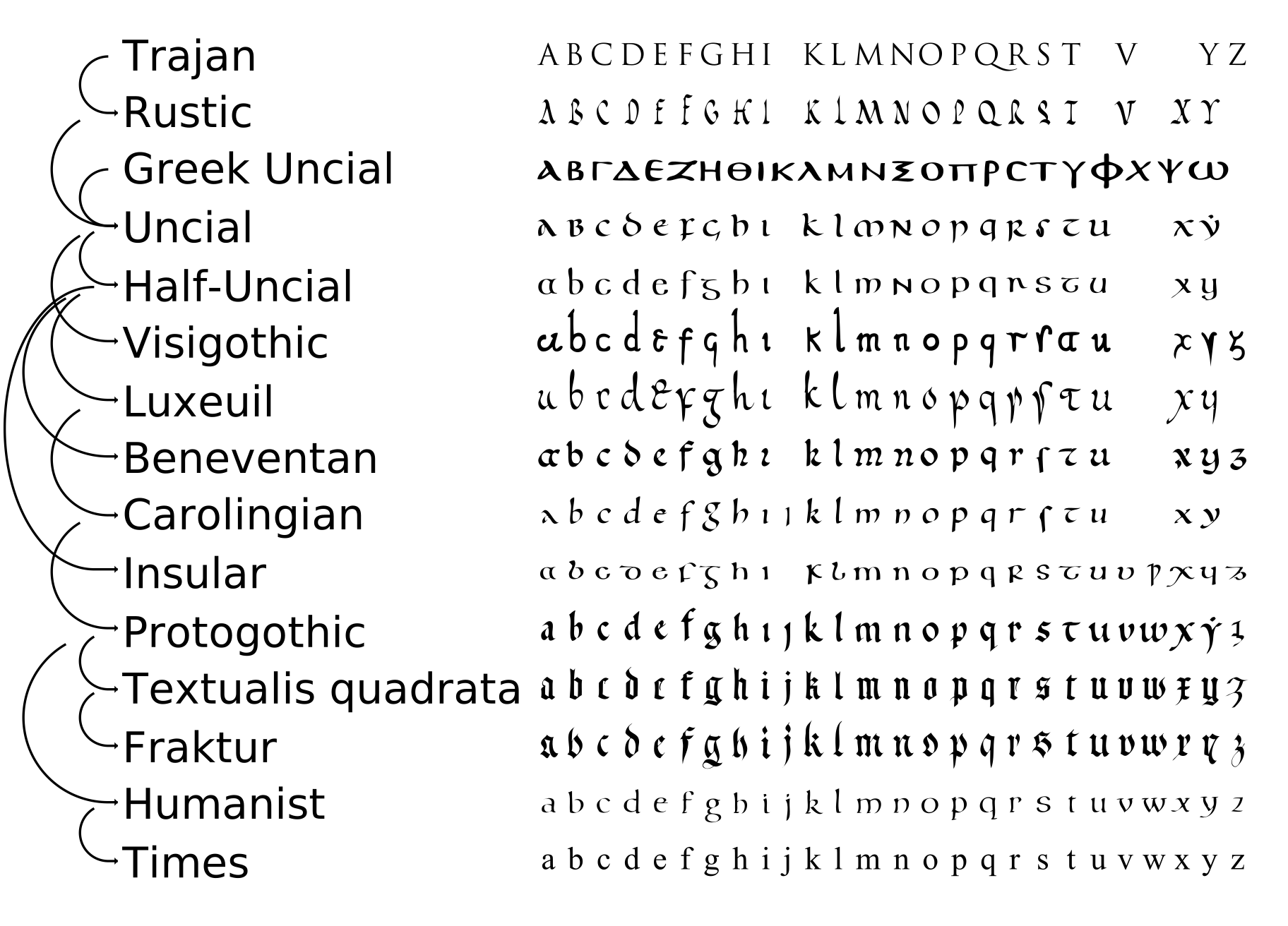
Lowercase (or minuscule, as one often refers to them in calligraphy, lowercase is a term from printing) was developed (or rather, codified) under the rule of Charlemagne. The Caroline Minuscule hand was developed under the leadership of the English scholar Alcuin of York, after coming to Charlemagne's palace in Aachen and establishing a school there. Alcuin's so called Crowd of Scribes (turba scriptorium) were to copy religious texts and disseminate them throughout Charlemagne's newly formed empire, and to do so efficiently they codified rules for the mess that was handwriting and calligraphy in medieval Europe.
Their invention was the caroline minuscule, meant to be easy to read and write, with characters set apart from each other and not joined up (this is called a ligature in calligraphy and typography), and with descenders and ascenders, an innovation taken from the Irish Uncial scripts.
This writing was the forerunner of minuscule, but it was unlike ours in that Majuscule (uppercase letters) and Minuscule didn't appear together. That, however, soon changed, as the scribes at Charlemagne's court soon began to use Roman capitals (which are all majuscule) to make intricate initals and illuminations. That was the first step to signifying importance and hierarchy with majuscule, and a mixed alphabet.
Source: Meggs' history of Graphic Design (2012); recently took a course on the history of typography; practitioner of calligraphy.
Edit: got my empires somewhat mixed up.
According to "A Guide to Western Historical Scripts from Antiquity to 1600" (2002) many lower case forms (among others: a, e, d, g, p, q, r) are found in both Half-Uncial and Cursive Half-Uncial in the "New Roman System of Scripts." These scripts were largely derived from old Roman cursive (mostly used before the 2nd century) and developed between the 2nd and 4th century CE.
Here, in this simplified comparison of early scripts, you can see many minuscule characters.
This image from the Encyclopedia Britannica also illustrates these scripts.
The author goes on to say that "Half-Uncial was to be extremely influential in the development of national hands, in Caroline minuscule and thereby the whole of the Middle Ages." For the more information about Caroline minuscule see /u/jabask's excellent post. My only critique would be that minuscule was "codified" under the rule of Charlemagne rather than "developed" which s/he put in parenthesis anyway.
Minuscule letters started to form between 1st and the 3rd century AD. In paleography this first group are called minuscule cursive, and were completely formed in the s.III. e.g: London, british museum, Pap. Lond. 731, ChLA, III, S. 87 (i'll try to upload some pictures) During the 4rd century this minuscule cursive evolved to a more clear, and comprehensive letter wich is called minuscule antiqua. e.g: Manchester, John Rylands Library, Pap. 472
Before the Caroline minuscule, we can find the half-uncial, the uncial, the merovingic, visigothic cursive, visigothic "redonda" (<- i don't know the term in english), and merovingic, and other locals typographies.
P.d: I had a paleography exam this monday and I saw myself forced to answer this though I'm not very good at english u-u. When I get home I'm gonna upload the powerpoints that discuss this theme, in case that anyone is interested.
**edit: https://drive.google.com/file/d/0B3bnIehMtOYtSWZZN0Y3NmFlazQ/view?usp=sharing There you have it. In the page 41 it's the first example that i've said. (If anyone is wondering, the lenguage on the ppt is catalan.)
Source: my powerpoints :P, wich came from this bybliography (there's none in english, sorry about that) (I'm not sure what is the best so i give you all): -CAVALLO, G (1997) “Entre el volumen y el codex. La lectura en el mundo romano”. En: CAVALLO, G.; CHARTIER, R. (dirs.) Historia de la lectura en el mundo occidental. Madrid, Ed. Taurus, pp. 95-133. -CAVALLO, G. (1995) “Libros y público a fines de la Antigüedad”. En: CAVALLO, G. (ed.) Libros, editores y público en el mundo antiguo. Guía histórica y crítica. Madrid, Ed. Alianza Editorial, pp. 109-168). FEDELI, P. (1989) “I sistemi di produzione e diffusione”. En: CAVALLO, G.; FEDELI, P.; GIARDINA, A. (dirs.) Lo spazio letterario di Roma Antica, vol. II, La circolazione del testo. Roma, Ed. Salerno Editrice, pp. 343-378. HOLTZ, L. (1989) “Les mots latins désignant le livre en temps d'Augustin”. En: BLANCHARD, A. (ed.) Les débuts du codex. Actes de la journée d'étude organisée à Paris les 3 et 4 juillet 1985 par l'Institut de Papyrologie de la Sorbonne et l'Institut de Recherche et d'Histoire des Textes. Turnhout, Ed. Brepols (=Bibliologia. Elementa ad librorum studia pertinentia, X), pp. 105-114. KLEBERG, T. (1995) “Comercio librario y actividad editorial en el Mundo Antiguo”. En: CAVALLO, G. (dir.) Libros, editores y público en el mundo antiguo. Guía histórica y crítica. Madrid, Ed. Alianza Editorial, pp. 51-108.
Can I piggyback on this thread and ask when lowercase letters were added to the ancient Greek alphabet?
hi! you may be interested in the following posts
courtesy of our friends in /r/Linguistics
from this sub
Where did "lower case" letters come from? Why did they get popularized?
Where did lower case letter come from, why, and why did lower case numbers never come about?
Where do capital letters come from? What was their original purpose?
How did Latin script win over Roman cursive in common writing?
and on cursive ...
I know this is late but I will add it anyway. The post by /u/shumpilumpa is the best here. The others that discuss Carolingian minuscule as the origin of lower case letters are interesting but not the right answer for this question. Carolingian minuscule is the origin for the specific letter forms that we use today, but have nothing to do with the origin of lowercase letters themselves.
To expand a bit, the earliest scripts did not really make a distinction between lower and upper case (called minuscule and majuscule), but as they were used more and more and for different purposes different letter forms began to be used for specific purposes. Monumental (epigraphic) scripts in general favored majuscule forms, what we call upper case today but perhaps better thought of as letter forms that are written between two lines, an upper line and a lower line, as in ABCDEF, etc. You can draw a horizontal line across the top of the letters and a horizontal line across the bottom of them. You can see an example on the wikipedia page on Roman Square capitals.
Quick, hasty writing, called “cursive” because it “ran” quickly across the page with few lifts of the pen off the page (or papyrus) is what we call minuscule or lower case, and was written between four lines. some letters, like aeuomn, etc. can be written between two horizontal lines like the majuscules, but many of them (like pqfdtyj) have ascenders and descenders, so that you can draw four lines, two on the top and two on the bottom. These scripts were used for informal writing, notes, comments, grocery lists, etc. You can see an example here from the first century AD, taken from the wikipedia page on Roman cursive.
Both majuscule and minuscule scripts were used in the early middle ages. Here is an example of majuscule script from the Vatican Virgil, written in the 5th or 6th century. You can see in this example that there are no spaces between the words, something not really needed by native speakers who often read aloud. When non-Latin speakers like the Irish and the Anglo-Saxons were taught to read Latin, this cause some difficulty and so the Irish and English scribes began to introduce certain new practices that would help reading. One was spacing between words or at least groups of words. Another was a hierarchy of scripts, where the more formal scripts (majuscules) were used at the beginning of sections and then the less formal (minuscules) were used for the main part of the text. This distinction eventually was used for the beginning of sentences or of words, so that we capitalize the beginning of sentences and some nouns (in English). Today many people are omitting capitalization, but with the ease of reading computer fonts, we really don’t need that visual distinction as much anymore.
As for Carolingian minuscule, it was simply an attempt to standardize the many developments throughout Europe of Roman cursive minuscule. By the eighth century each different center of manuscript production had their own style of script (a few examples can be seen under the broad category of Merovingian scripts.), so that a scribe from ,for example, Luxeuil, would have difficulty reading the script of a scribe from Corbie, and vice versa. Charlemagne and the group of scholars he gathered wanted to standardize the handwriting throughout his empire so that everyone would write the same way.
This was somewhat successful, but it did not spread everywhere. It wasn’t until the late tenth century that a form of it was fully adopted in England and southern Italy used the Beneventan style script for centuries. By the twelfth century Carolingian minuscule had changed in various ways into what we now call under the umbrella term Gothic script, which became more and more diverse and varied until the humanists in the fifteenth century attempted to revert back to the ancient Roman script styles. By chance they mistook the Carolingian manuscripts as ancient and so Carolingian letter forms became the basis for the new Roman and Italic style of scripts (both given names suggesting the ancient Roman empire). The adoption of these new script styles coincided with the spread of printing so that many printed books used this style of font, as we still do today. You can see the similarity between Carolingian and early printed Roman font here.
Hi! The other posts answer your question concisely, but I just want to mention that if you have specific questions about the evolution of typography, which a few comments here touch the surface of, /r/graphicdesign and /r/typography both have very knowledgeable members.