Anyone know anything about the giant wall calendar from HBO's Rome series and how they worked?
It's been a while since I watched the series, but I assume you mean that long ass list of letters that appears briefly in the intro? Edit: See also /u/martiantripod's infinitely better and more useful picture below.
Wall calendars, in Latin called fasti were a common feature of Roman civic life. The name, fasti, comes from fastus, the dies fas, the day of (holy) judgement - i.e. the day on which the praetor would sit in judgement; opposed to the nefasti, the days in which this was not the case. Those days could instead be used for religious ceremonies such as sacrifices.
Livy tells us of the first version of this kind of register of days:
He [Gn. Flavius] made public the legal forms and processes which had been hidden away in the closets of the pontiffs; he exhibited a calendar written on whitened boards in the Forum, on which were marked the days on which legal proceedings were allowed [Livy IX, 46.5].
This would put the first example of such a publicly published calendar in the year 405 BC. So in the beginning, these were simply lists that showed whether a day was suitable for a certain type of business. Later, more and more info was added to these calendars. There are several elements here worth pointing out:
The Capitals A-H you can see in sequence on the left hand side. These are the so-called nundinal letters, which denote the nine-day week starting at A, ending at H (counting the days inclusively, i.e. the ninth and last day is also the first.) Every ninth (eighth) day was market day, the day on which the farmers came to town - which is why any new law had to be hung out visibly for at least three consecutive market days, so everyone had a chance to see them.
Next to it, the count of days and the related month-days, the kalendae at the beginning of the month, the nonae at the fifth or seventh day and the idus at the 13th or 15th of the month (mnemotic device: the months MOMJul had 31 days, so the nones and ides were later). The days were counted as, f.e., "the third day before the kalends of July" (again counting inclusively) = 29th June; PR stands for pridie k/non/eid or "the day before the calends/nones/ides of X".
A letter denoting special days for the citizenship, like a C, which would stand for C(omitiales dies), a day for a comitium or people's assembly. F for fasti dies, N for nefasti dies, NP (ligated, probably for nefas feriarum publicarum or nefas piaculum) for feriae, which were public holidays, days on which no (legal) business, but religious ceremonies were conducted. Ides were all NP days for sacrifices to Iupiter.
Other information concerning the day in question. This could be the name of a god or goddess to denote the days of a temples dedication (the dies natales) or historic events, such as the day of the foundation of Rome (ROMA COND(ita)).
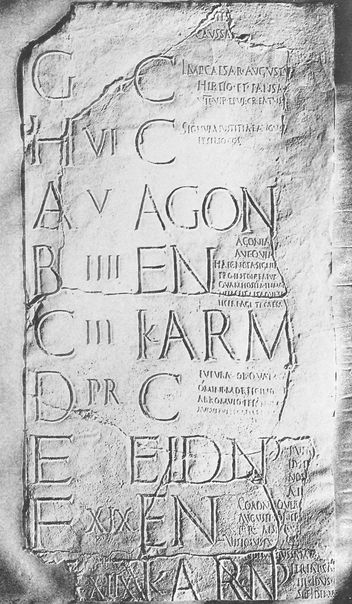
Take this example, from one of the surviving examples, the fasti Praenestini from Praeneste (Palestrina):
http://db.edcs.eu/epigr/bilder/$Gordon_00036_2.jpg
[Note: this is a squeeze, resulting in a negative copy of the inscription. So the elevated areas are incised and vice versa.]
It begins on the 7th of January, which is day G of the nundinal week, the VIIth day before the Ides of January, and a day upon which a comitium could be convocated. It tells us also that this was the first day upon which Augustus assumed the fasces, i.e. he received the imperial power of a magistrate (Imp(erator) Caesar Augustu[s primum fasces sumpsit]) during the consulship of Hirtius and Pansa (7th of January, 43 BC), the dies imperii. This was the way Romans denoted specific years, there were different fasti that listed the consuls for specific years which you could reference. The popular AVC era, ab urbe condita, counting the years from the foundation of the city onwards was not in common use. On the same day, we are told, Tiberius Caesar was made a VIIvir Epulonum, a member of the seven-men college of priests called the Epulones.
The AGON in line three (9th January) stands for Agonalia, a feast in honor of Janus, also sometimes called Agonius, held every 9th January, 20th May and 10th December.
EN in the next line stands for endotercisus. This denotes a dies endotercisus (which is old latin for intercisus), a 'intersected' day which was nefas in the morning and evening and fas for the remaining hours of day. There were eleven of these during the course of a year.
KARM/KAR denotes the day of Karmentalia or Carmentalia, the day of a feast in honor of Carmenta, held on the 11th and 15th of January.
These wall calendars in that way served an important function in civic life. They told the citizens on which days a market was held, whether business could be conducted od or judgment could be asked for. They informed about the dates of feasts and public holidays, about important historic events (which also made them a tool for propaganda) and generally ordered and structured the life of the community. But they could also be a symbol of wealth that rich citizens added to their houses.
Edit: cleared up some grammatical errors. Also, if you have any further questions, ask away!
Picture of the calendar from the set of the series. I have no idea whether such a calendar was in use the way it's depicted, though I would assume for something like this to have been built for the series that there would be adequate evidence to show that something similar was used. Probably in one of the temples.