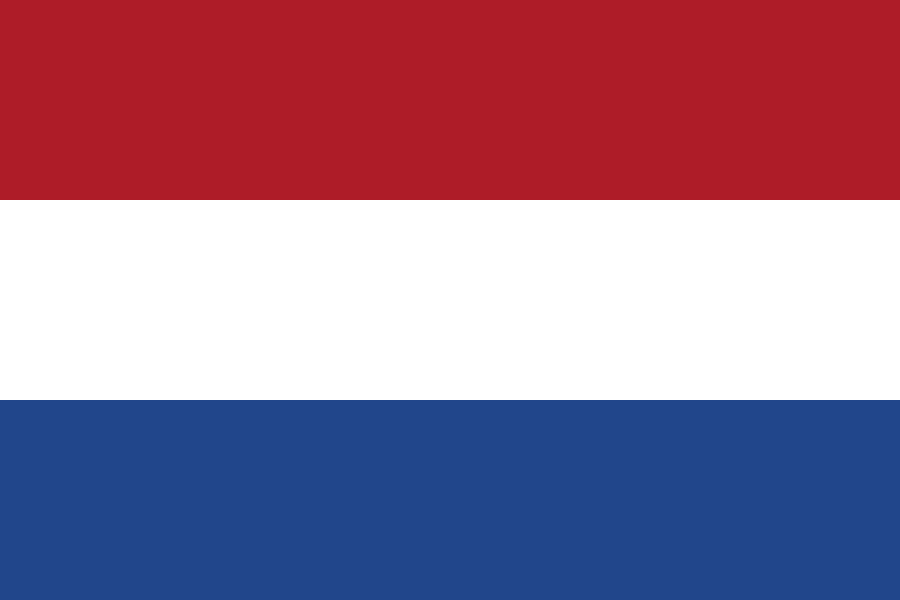
When talking about the Dutch national flag throughout history there are three flags that have found wide use.
During the Dutch revolt the Prinsenvlag became a symbol of the rebellious Dutch, the colours were taken from the livery colours of the Prince of Orange who had been chosen as Stadholder of some of the provinces and was the primary face of the revolt. Changing the Red to Orange on the primary used Dutch flag was part of the struggle between de "Staatsgezinden" and "Orangisten" later in the Dutch Republic. The Staatsgezinden were "Republicans", trying to stop the Prince and the Orange family in their monarchical ambitions. The Orangisten were "Monarchists" supporting the Prince and the Orange family in obtaining more power within the Republic. The Statenvlag became the primary one used during the First Stadholderless Period which started with the premature death of Willem II, who left an heir who was a minor. The Staatsgezinden seized this opportunity and made sure the prince of Orange was barred from the office of Stadholder and Johan the Witt (a Staatsgezinde) was grabbed power. The Prinsenvlag was the symbol for the political rivals of their faction so in 1652 the Prinsenvlag is outlawed within the province of Holland, in 1653 the Navy officially adopts the Statenvlag. From this point onwards the Red, White, Blue has been the only official flag used by the Dutch state. Prior to the law outlawing the Prinsenvlag, the Statenvlag was already in wide use in parts of the Republic. For example the VOC and WIC used the Statenvlag on their ships from the start, and from the records kept by the Navy we know that from 1630 on they used both the Prinsenvlag and Statenvlag. And only after 1663 we see them stop ordering the Prinsenvlag for their ships. When the First Stadholderless Period came to an end, we see Willem III not making any effort to restore the Prinsenvlag.
During the interbellum we temporarily see the re appropriation of the Prinsenvlag by the National-Socialists, but we quickly see a reaction of Queen Wilhelmina on this. She gives out the shortest royal decree in Dutch history: "De kleuren van de vlag van het Koninkrijk der Nederlanden zijn rood, wit en blauw." Translated: "The colours of the flag of the Kingdom of the Netherlands are red, white and blue."
But the Orange is not entirely gone from the Dutch flag, on birthdays of the Royal family and on the appropriate holidays an Orange pennant is flown above the flag.
The first mention of the colors orange-white-blue seems to be in the context of the Sea Beggars, the roaming band of quasi-pirates fighting 'for the Prince' and against the Spanish in the beginning of the Eighty Year's War.
These Sea Beggars were very important to Dutch history, as in 1572 they captured the town of Den Briel, re-igniting the Dutch Revolt which had in the previous years been brutally suppressed by the Duke of Alva, Philip II's regent (landvoogd) in the Netherlands.
While sources are sparce, it seems that the Sea Beggars used pennons in the colours orange, white and blue. Orange, because of the Princedom of Orange and its association with William of Orange, our main 'founding father', and the Beggars' sponsor and issuer of letters of marque. The white and blue appear to have been similarly associated with William of Orange; they were the uniform colours of the Prince's household staff.
The red makes an appearance as early as the 1590s. It is not entirely clear why red replaces orange in this period, but it seems to have been for practical reasons. On the sea, orange was perhaps too hard to distinguish, or was mistaken for red. Also, the price of orange dye may have been an issue.
The States-General made the official change in colour in 1663 during the First Stadholderless Age, when the office of 'stadholder', a powerful military and political office traditionally held by the house of Orange, was vacant. It wouldn't surprise me if they did this to distance the flag from its heavy association with the house of Orange. However, I have no proof for this.
While the Sea Beggar theory is the most prominent, Wikipedia also mentions some sources which I unfortunately can't retrace that appear to link the red, white and blue to the Counts of Holland (so predating the Spanish and even the Burgundians).
As a general note, not much is known about the origin of the Dutch flag, although it's clear that it's been in use since the late 16th century.
Source 1, Source 2 , Source 3 (all Dutch unfortunately). The general history stuff is well-known in Holland (source: I'm Dutch) and it's just off the top of my head, but I've read Jonathan Israel's The Dutch Republic and can highly recommend it.
Piggybacking; why is orange commonly associated with the Dutch?