It depends. Firstly, it depends on how you prefer your coffee to be roasted. Seeing as Revolutionary America was a large and rural country, most coffee was probably roasted just before cooking, on a pan or over a fire in a metal container. The reason for this is that green coffee(that is unroasted coffee) last about half a year, and roasted coffee looses it's quality quite fast. Thus, it would be quite bad to pre roast coffee, and then ship it around in a large and rural country like Revolutionary era America). Thus how the roast turned out would depend greatly on the skill of the roaster, with some coffee houses in the cities probably having a greater skill than some guy living in rural house in the frontiers. Because of this the roast would probably be a bit darker and uneven than the light roasts that are served at some coffee bars toady, and the coffee would taste more "burnt"(think from dark american roast to french roast) and not as floral as a light roast. So if you prefer a dark roast, the coffee would taste quite good, but if you prefer a light roast you would probably not be as happy.
Secondly, it depends on how you you like to prepare your coffee. If you like coffee prepared from a Aeropress, Espresso, French Press, Drip filter or some other modern equipment, you would not find those in Revolutionary era America, and coffee at that time would be prepared by either boiling or infusing the grinds in hot water. What coffee you would be served in Revolutionary era America is hard to tell, as boiling seems to be the most common way to make coffee in the 1700s, but some would also infuse their coffee in Revolutionary era America. Infusing the Coffee instead of boiling it, that is putting the grinds in hot water and letting it seep, seems to have become popular in France and England around the start of the 1700s, and spread to America later. Using a cloth bag as a filter was also invented in France in 1711, and it spread to America from there, but it does not seem to have been adopted by everyone. To sum up: Finding anything other than coffee prepared by boiling outside the cities would be rare, but the coffee houses in the cities might have coffee prepared by infusion.
If the coffee was prepared by boiling it would be more bitter than coffee you are used to, and if it was infused without a bag the coffee would be more cloudy and full. If you prefer your coffee that way, you would be in luck. If not, it might be too cloudy and unfiltered. How much the cloth bag filtered I am not sure, but it would reduce the grains at least, and probably some of the cloudiness, making it more preferable if you prefer a clean cup.
A further point is that at the time of revolutionary era America the coffee would be grown in different areas than today, which might affect the taste of the coffee, as coffee grown in different countries and areas taste different. So if you prefer your Costa Rican coffee over anything else, you might be disappointed by the coffee in Revolutionary era America imported from somewhere else (like Ethiopia or the Dutch colonies)
As for the cream and sugar. You might be in luck there, as there are descriptions of coffee being flavored with sugar and honey in New York in 1668, and cream would probably be easy to get hold of.
Source: Ukers, William Harrison (1922) All about coffee.
To those entering this thread with the intent to answer: Please remember that, in AskHistorians, your answers are expected to be comprehensive, in depth, and such that an historian might give. Your coffee preferences and anticipation of time travel are unhelpful and irrelevant.
Thank you.
I can answer your questions with an extant excerpt from Maria Eliza Kettleby Rundell's book published in 1808! Isinglass chips, for the record, is collagen made from fish and used to clarify wine and beer. Yum! It was also used in desserts like jellies or blancmange that would call for gelatin today.
Closer to the American Revolution, another way coffee was often made using a French Drip coffee pot and a little less, uh, fishy additives. Beans were treated much the same as they are now, in terms of collecting, fermenting, roasting, grinding and brewing. Because of the effort involved, you'd most likely hit up a coffeehouse instead of brewing it at home (unless you're wealthy, four for you ironheart777!).
Sugar wouldn't be the refined beet sugar you're used to seeing today. Fine white sugar from sugarcane at the time came in cones that had to be clipped off and ground, and was pricey. You could also get a less quality grade (you'd recognize it as brown sugar of darker and darker varieties today) for cheaper.
This is all dependent on if you could find coffee at all so close to the Revolution! Abigail Adams wrote to her husband in 1777 to complain to him about how scarce coffee and sugar was in Boston at the time. She even mentions that things were so bad, the women of Boston discovered that a merchant was hoarding coffee - so "a number of females-some say a hundred, some say more-assembled with cart and trunk" and demanded the goods.
This page has some neat info on coffeehouses in Colonial America, with a larger excerpt of Abigail's letter.
tl;dr: Quite possibly, yes, yes and yes!
I don't know if this is allowed but could someone answer the same question in relation to tea?
I don't know about the American Revolution much but I can speak about its early origins.
When Coffee first came from Turkey to the UK it wasn't filtered. The beans were very darkly roasted as well. All of this gave the coffee a very gritty and muddy taste. It doesn't taste much like the refined and perfected coffee most people drink today. However, traditional Turkish coffee pots can be purchased rather inexpensively and coffee can be made in the same manner, albeit using much higher quality product.
The American Revolution was 100 years after the first coffee house opened in London. One of the most famous coffee houses in London, Lloyds, was still operating and starting the insurance industry.
http://publicdomainreview.org/2013/08/07/the-lost-world-of-the-london-coffeehouse/
http://www.lr.org/en/who-we-are/heritage/brief-history/edward-lloyd-coffee-house.aspx
(Sorry for the ugly links. I'm on mobile)
I was going to put this initially as a reply to a question about whether the beans would be ground, but I'm moving it up to top level because I was able to bring a few other useful remarks to the surface:
So first of all, yes. They would have ground the beans.
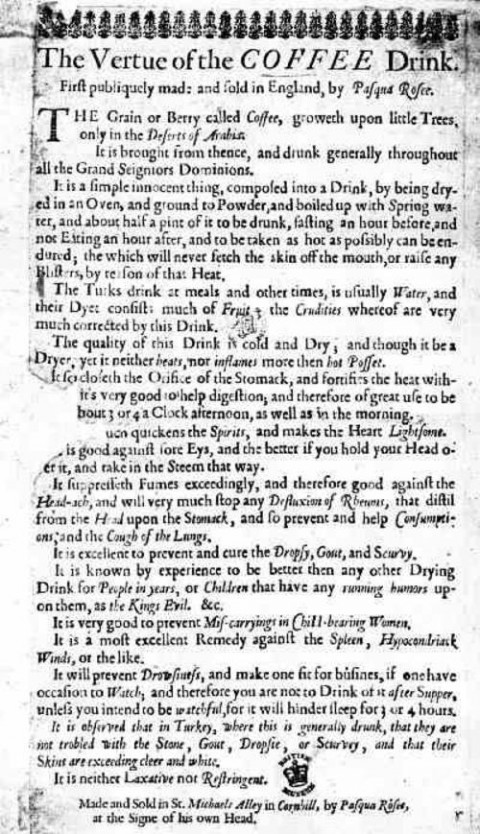
Here's my source. It's not revolutionary America, but rather at the roots of coffee culture in the English-speaking world: http://cdn4.openculture.com/wp-content/uploads/2012/07/vertueofcoffee-e1342378129629.jpeg
This is a flyer from 1660 advertising coffee, in the year after the first English coffee house opened. It has a description of coffee and coffee prep written for an audience for whom the drink was completely alien: "ground into powder, and boyled up with spring water."
I've always read this as preferring a Turkish style of preparation because of the emphasis on the middle east and "The Turks" in the document.
https://www.youtube.com/watch?v=OOaI8JC1_EE
The advantages to a Turkish prep would be that you wouldn't need a consistent bean grind, and you can err on the side of powdered - likely they'd grind the coffee in a mortar and pestle, which would probably leave lots of pulver. Secondly, this is really the only major method of coffee prep I know in which boiling is preferable. Thirdly, Turkish coffee prep allows you to decant the coffee away from the grounds, so you don't need to cowboy filter it. And lastly, the gear is simple, cheap, and accessible - a flask with a handle - even by early-modern material standards.
I read once that coffee used to be poured from the cup into the saucer to allow it to cool, and then sipped from there. Was that really a thing? What about during Revolutionary times?
Another question. I heard during the civil war that one side used Acorns to make a form of coffee. Is that true at all?
Some great comments here. I'll add that you can see what a colonial era coffeehouse may have been like at Williamsburg, as they've added one on over the last few years. Interestingly, the operation was something like the taverns of the day, where there were larger rooms to rent out for an evening, with the masters of the coffeehouse offering service during that time.
You might want to read The Coffee Trader by David Liss. It's got a nice point of view on the early days of coffee drinking.
A great resource for this topic (if anyone is interested) is the book "Uncommon Grounds; The History of Coffee and how it Transformed Our World" by Mark Pendergrast. He covers so much about coffee. Not only is it super informative, it is also very entertaining to read.