My grandfather was going to be sent to the Pacific for the invasion of Japan but was instead sent to Europe because of the bomb. He basically got a free vacation out of the war. He told me that inflation was rampant in Germany after Berlin was divided up because the US printed a bunch of money in order to trade between the different sectors. He said that he could sell a carton of cigarettes for ridiculous prices in Berlin and he sent a lot of that money home where it was still worth the actual amount. Has anyone heard of this? He told this story to me again the other day and I can't seem to find any sources about it.
Hyper-Inflation did exist prior and during the Second World War in Germany based on the restrictions and regulations placed on Germany by the Treaty of Versailles after WW1.
The economy rose slightly once Hitler rose to power in 1933 only to return to a critical state in 1939 - forcing Hitler to use his new military state before all preparations were met. This Hyper-Inflation, in the Wemier Germany, was also a part of the Great Depression felt across Europe. Germany got hit the worst. Money in Germany was essentially useless, paying upwards of 32 million Reichmarks for a loaf of bread, or 1.32 trillion for milk.
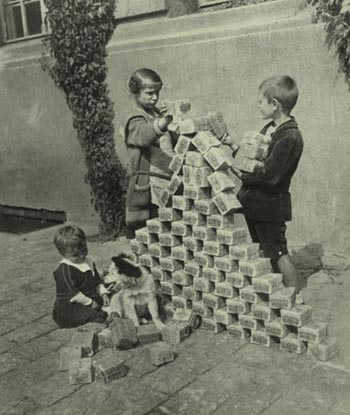
Picture: http://www.usagold.com/images/weimarplay.jpg
This pictures shows how little money was worth. However, in terms of 'making money' on these paper bonds, it was quite unlikely. Following WW2, Germany was basically ripped apart by Britain, US, and France on one side, and Russia on the other (see West Germany and East Germany). The money he would have collected would not have been worth a dime in US dollars. Only after the allies start funding the Western Germany to be a blockade against the Communists to the East and growing their economy would German money have any real value. This also happened in Berlin itself (although it was located in East Germany, see East Berlin / West Berlin).
However, your grandfather may be correct: He did receive a lot of Germany money for cigarettes, but they would not have been worth much back in America.