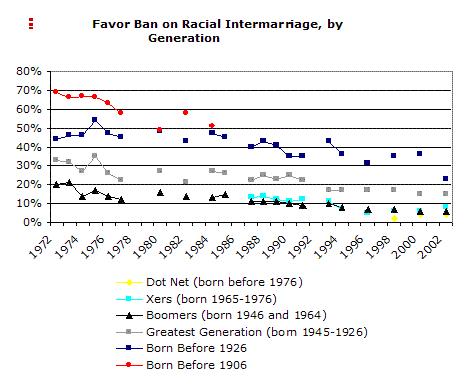
There was some shift among individuals, but the shift was largely generational. Take a look at this chart, looking at the declining American support for interracial marriage (graph 23 from this report), which is based on General Social Survey data (for more on the GSS, see here). Support for banning interracial has declined for every generation (support from Baby Boomers starts at ~20% and gets down to ~%5; support from the Greatest Generation starts at ~35% and gets down to ~15%) but you can see clearly that change over time has as much to do with between cohort change (old people dying and being replaced by young people) as it has to do with within cohort change (everyone becoming more tolerant). This data, unfortunately, comes after the height of the Civil Rights movement (the GSS started in 1972), and there just were fewer polls asking the same questions over multiple years in the 1960's. This chart from Gallup measures overall change starting three years earlier, in 1969 (MLK was assassinated in 1968, for reference), and with this particular indicator ("approval" of black-white marriage), we see only very slightly more rapid change in period 1969-1972 than the remainder of the 1970's. This graph, which goes back to 1958, shows the trend goes back to the 1960's, with only a slightly steeper slope (meaning slightly quicker change) in the pre-1972, so I feel comfortable guessing the same dynamics go back earlier (some of the changes on the right hand side of the graph are driven by the changing racial dynamics of the country as a whole).
If you're asking about the actual participants, rather than changing opininos as a whole, the age of the participants I believe varied by race, with white participants (and leaders) generally being younger than black participants and leaders, though black leaders were not themselves old--Martin Luther King was 26 in 1955, 38 when he was murdered in 1968. Quite possibly, this could have something to do with the fact that many black leaders emerged in the 1950's, while many white civil rights leaders only emerged in the 1960's. If you look at the white participants in, say, Freedom Summer, they were largely very young--but that doesn't necessarily mean that many of their parents didn't still support what they were doing, even without directly participating.
I gave an answer to this question on another post. It's not directly related, but somewhat tangentially so. You may find it interesting