Excluding the notable examples of Fascist Italy and World War II Japan.
And in contrast to dictators that were both head of state and government.
Was Mussolini prime minister but not head of state?
Edit: I asked this in earnest but the original question has now been edited to exclude Mussolini's Italy.
To make my follow-up question more concrete, what was the relationship between Mussolini and the King of Italy? Did the king have any power at all? Was Mussolini's overthrow in 1943 "constitutional" if there was such a thing in Fascist Italy?
Ion Antonescu was a Romanian general who ruled Romania as dictator between 1940-1944. He was appointed Prime Minister on September 5, 1940 by King Carol II, who had assumed dictatorial powers in 1938; these powers were transferred to Antonescu, and Carol II abdicated and was succeeded by King Michael, who became the new head of state, though with very limited powers. Antonescu assumed the title of "Conducator" (lit. "Leader", similar to "Fuhrer" in Germany and "Il Duce" in Italy) and the constitution was suspended.
Antonescu at first shared power with the Iron Guard, a fascist organization with strong antisemitic, anticommunist and Orthodox Christian leanings. In January 1941, the Iron Guard rebelled in an attempt to gain power for themselves; Antonescu, who had the military on his side, crushed the rebellion, banned the organization and formed a new cabinet. Many of his new ministers were army officers, and he ran the country as a military dictatorship until 1944. Nevertheless, throughout Antonescu's regime the King continued to be a prominent political figure, at least officially. You can see this in propaganda films of the time, like these two: 1, 2. The first shows Antonescu participating at an Iron Guard rally in October 1940, the second is a newsreel reporting on the capture of Odessa by the Romanian army in October 1941. In both videos, the King and Antonescu are mentioned in the same sentence, and in both cases, the King is mentioned first, implying that, at least officially, his position was more important than Antonescu's.
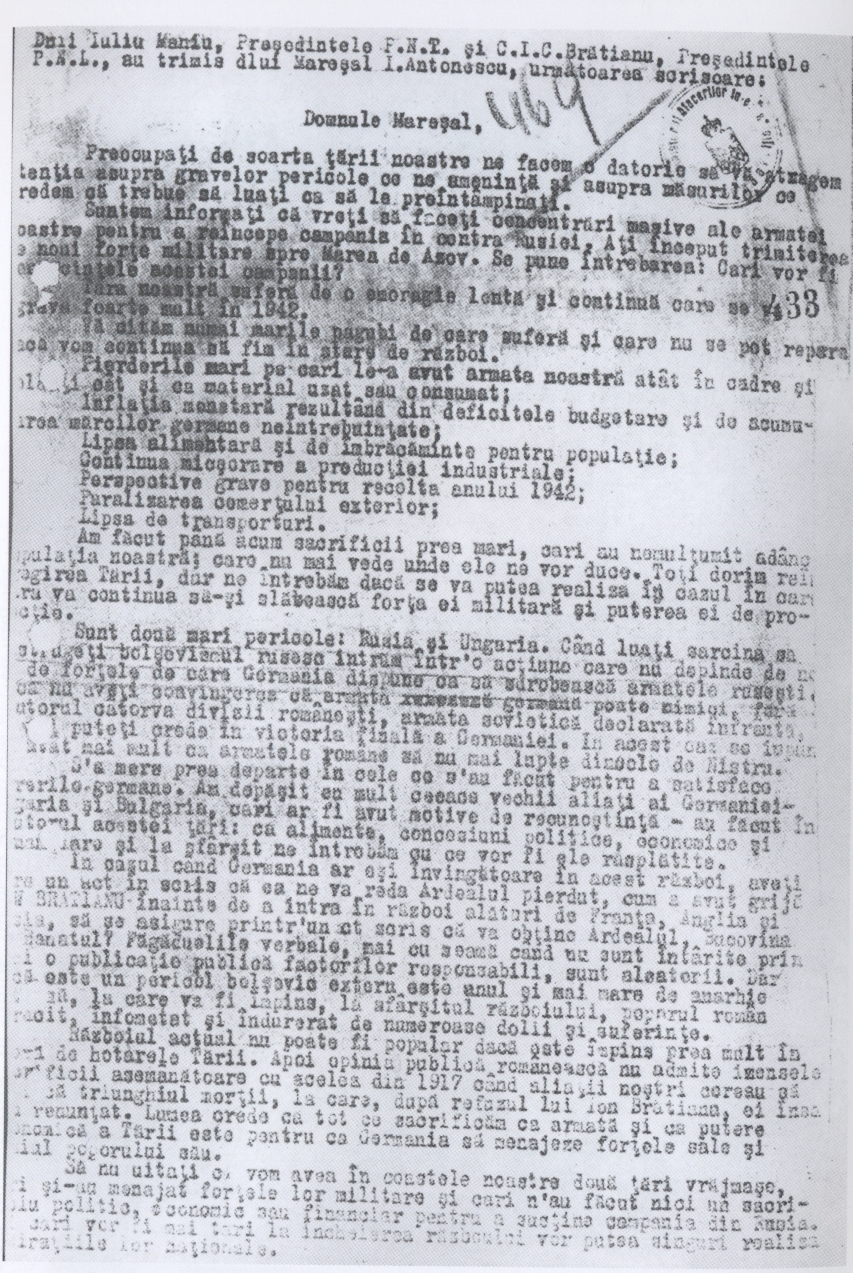
A peculiarity of Antonescu's regime was that even though political parties were abolished and there was no official opposition to his rule, major political figures from before 1938 were still active and somewhat tolerated during this time. For example, liberal and agrarian politicial leaders wrote this letter of protest to Antonescu in January 1942, criticizing his decision to send more Romanian troops to fight Russia on the Eastern Front.
Finally, it's worth noting that as dictator Antonescu relied on the military to maintain power, but his policies sometimes encountered significant resistance from its more politicized segments. Also, the Romanian officer corps actually swore allegiance to the King. This proved to be a crucial factor in August 1944, when King Michael and a number of opposition figures staged a coup and had Antonescu arrested and deposed. Another general, Constantin Sanatescu, was appointed Prime Minister in his stead. The army remained loyal to Michael, and Antonescu loyalists were either arrested or dismissed from their posts.
Source for the final paragraph: Mark Axworthy - Third Axis, Fourth Ally: Romanian Armed Forces in the European War, 1941-1945
edits: phrasing
Ian Smith in Rhodesia (now Zimbabwe) under white minority rule. In contrast to apartheid in South Africa, where elections were a real contest and there was always a real possibility that the National Party might lose, Rhodesia under Smith was a de facto (though never de jure) one party state.
One could make a similar argument about the early Unionist Prime Ministers in Northern Ireland (Though by the time Terence O'Neill came to power in 1963, effective opposition had started to emerge as the nationalists became more assertive and the unionists began to fracture).