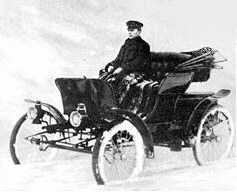
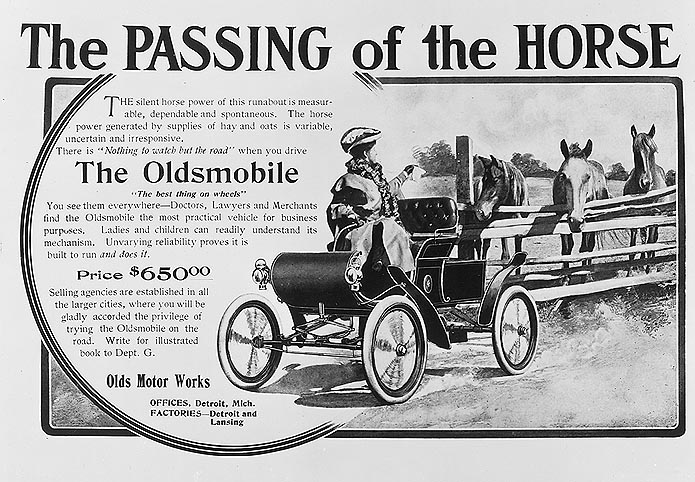
/u/theshowisnottheshow gave a good background. The early automobile market was so flooded with different marques and manufacturers (Over 5,000 marques are listed between 1895 and 1942 in the Standard Catalogue of American Cars - most of them never produced a single automobile or ever advanced beyond a single prototype) that it's difficult to single out a single marque as the "go-to" car for the Rich and Famous. I'd roughly describe the period when cars "started to be popular" as 1895-1914(the year that the Model T began to be produced in immense volume - that year more Model Ts were made than any other car), although one could easily make the case that the automobile was already "popular" as early as 1905.
Early years: The first marque that really became popular with wealthy American was the Winton Motor Carriage Company, although again "popular" is a relative term - Winton only made 22 automobiles in 1898, and slightly more than 100 in 1899, making it the largest manufacturer in the United States. At this time, France was at the forefront of the industry, and marques like de Dion Buiton and Panhard et Levasor began importing to the US around 1900. It should be noted, however, that at this point the automobile was not quite a "status symbol" - although it was certainly only affordable for the well-off, it was seen more as a novelty (albeit one with great potential).
The 1900s The mid 1900s saw the automobile transition from a novelty into an appliance of great practical value - although the process wouldn't be complete until the 1910s. The Curved Dash Olds introduced in 1901 was modestly-priced and mass-produced, although not particularly technologically advanced. As the automobile became a status symbol, certain marques became more valued. Frequently this was tied with success in racing or endurance events - F.I.A.T., Mercedes, Darracq, Locomobile, Bugatti, and many others achieved success this way.
The Brass Era By 1908 or so, the auto market resembled today's, with different marques offering cars at different price points. Packard, Pierce-Arrow, Rolls-Royce and Cadillac were among the the most successful luxury marques, but there were hundreds of luxury firms of various sizes. ALCO and Pullman (famous manufacturers of locomotives and passenger cars, respectively) each had stints in the luxury auto market; Locomobile and Peerless were other well-known marques. For more performance-oriented customers, there were the powerful Simplex and American Underslung, while the Mercer Raceabout and Stutz Bearcat basically invented the sports car.
Hope that answers your question!
The answer to your question lies in part in the fact that the first car consumers were the rich and the famous. Cars were used for racing, thrills, and increasingly for 'touring' - recreational travel/tourism. Indeed, one of Henry Ford's greatest innovations was his early consumer targeting consumers who would use a car for utilitarian purposes; his initial rise to success was through the purchases of rural Americans - only later did he market it to the suburban white collar masses who ate up his Model T so eagerly. One of the reasons they are it up was the symbolism of the automobile, generated by the highfalutin rich folk who first bought and used cars. As Tom McCarthy writes,
The public antics of wealthy young sportsmen in the first automobiles triggered a strong emotional reaction from other Americans- part enthusiasm, part anger, part envy-that soon made ownership of large, fast, powerful automobiles synonymous with successful belonging in middle-class America.
As for type of car, I know less about that. I know they bought european racing models in the early teens, but "The American preference for large, fast, powerful touring cars, especially of the popular open tonneau style with low sides, is a reminder that the point of touring was not merely to see but also be seen." (McCarthy again.)
/u/henry_fords_ghost should really drop the technical knowledge on you, but hopefully my social-context survey helped!
Sources: