Napoleon seems to get very little bad press considering all the shit he started. I understand he wasn't as bad as people like Hitler, but he still caused thousands of deaths and tried to conquer Europe and yet he hasn't been dammed by historians. How come?
Because he didn't start the wars; believe it or not. The Third Coalition War, the first war with Napoleon at the helm, was started by Britain; they paid Austria and Russia to go to war with France, and, from this, we start to see misrepresentations of 'conquering Europe'. Would you call mediatizing Western Europe and unifying them into a friendly state, the Confederation of the Rhine, as 'conquering Europe'? Perhaps in some sense but it was done out of a war where Europe literally declared war upon them for money; a buffer state could be seen not as an act of aggression but certainly as an act of defense and it's very reasonable to assume Napoleon after this war did legitimately want peace.
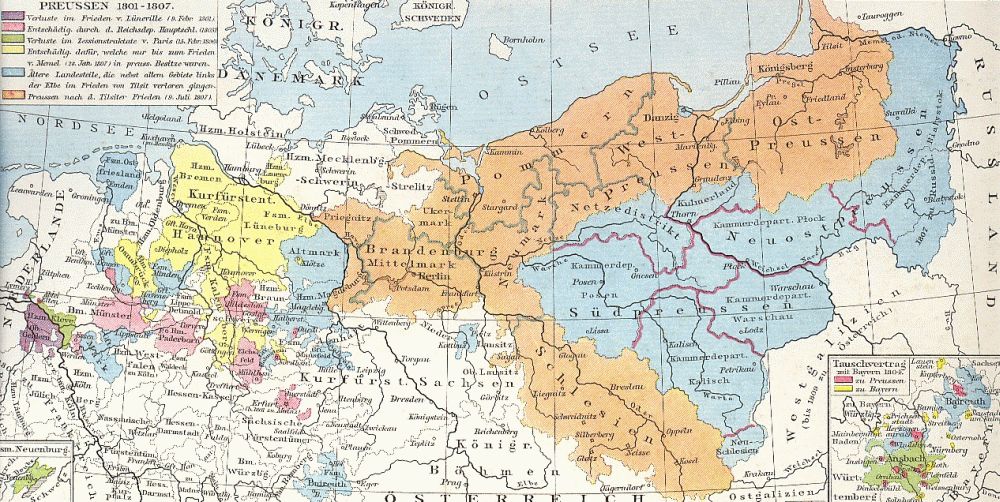
However, immediately after losing the Third Coalition, Europe reforms and then declares war upon him again and Napoleon goes to work again. Yes, he conquers land, this time notably to force Prussia under his wing to curb the German nuisance. Another lightning campaign ensued with the Prussians being beaten decisively at Jena-Austerdadt and the Russians at Friedland. Yes, this war saw expansion, seen here, but most of it was not blatant French landgrab. Jerome Bonaparte got the 'Kingdom of Westphalia' (yellow) and the Saxon king, his ally, got control over the Duchy of Warsaw + other territory (blue), basically an independent Poland. Hell even Russia, Prussia's ally in the coalition, got in on the land grab.
So really, ironically enough, France took significant amounts of territory from European powers either for herself or for her allies in purely defensive conflicts. What territory she did take was not some mindless landgrab of 'conquering Europe' but securing her foothold in Europe from what was legitimately constant aggression; Britain was throwing money into the arms of the Austrians and Prussians in particular to constantly wage war against her. That's not to say Napoleon did not have ambition and he, at times, did not also go a teeny bit too far (cough cough Continental System cough cough) but it's not like he started the French Revolution nor did he start the idea of 'spreading the revolution' and nor was he the one, in general, starting these wars. He was a man who was constantly attacked and used those attacks against him to justify expansion for defense and security and, yes, ambition.
One of the wars France legitimately did start is the Peninsular War, granted, and yes that was a power grab of sorts to put a Frenchman on the Spanish throne, but that along with the invasion of Russia in 1812 are the only two times Napoleon would start a conflict.
We can do this song and dance for the rest of the conflicts though:
Fifth Coalition War? Austria strikes at France, obviously with British support, seeing an opportunity as the Franco-Russian alliance begins to shatter. Sixth Coalition? After France was defeated in Russia, granted by a war she started, the rest of Europe declared war upon her in a final drive to beat down Napoleon. The Seventh Coalition? Napoleon arrived back in France from exile and Austria, Russia, Britain, and Prussia all sent armies to put him down.
So really it's a more nuanced topic than you think. Could Napoleon have handled it better/acted more defensively which would have shortened the wars? Yes of course but then again Britain can be blamed for constantly funding Europe to go to war when, arguably, peace had been attained. Why do we not pin this kind of blame on Britain when they were the ones who blew the first peace and gave Napoleon every justification to begin his attempts to put Europe under his control for legitimately defensive reasons? It's not like he was delusional; they were legitimately out to get him.
To quote David Chandler in his introduction in The Campaigns of Napoleon where he speaks on this directly:
In his defense it can be claimed that he lived in a very war-prone age and that there would almost certainly have been a long series of dire struggles whether he had seized the helm of France or not. The French Revolution, of which he was the product and in some ways the preserver, disseminator and liquidator at one and the same time, had already set the First Republic apart from the rest of Europe while Napoleon was still an unknown artillery lieutenant and colonel of volunteers. The social and economic upheavals that followed the act of political defiance in 1789 implied the end of the Ancien Régime, not only in France but throughout the Continent (although owing to Waterloo the final dissolution did not occur until after 1848 in the case of Germany and 1917 in the case of Russia).
The concepts of Liberté, Egalité et Fraternité, the dictums of Rousseau and Diderot, implied a total upheaval of the old order and liberated immense energy and proselytizing zeal among the French people. Wars, then, were inevitable, and it can be as fairly argued that Napoleon was the victim of a war-prone generation as the “man of blood” responsible for the scale of the holocaust that gripped Europe for so many years. He himself realized this when he remarked at the time of the Peace of Amiens: “Between old monarchies and a young republic the spirit of hostility must always exist. In the present state of affairs every peace treaty means no more than a brief armistice; and I believe that my destiny will be to fight almost continuously.”5 It is possible that this realistic—and possibly slightly cynical—point of view led him to regard war as an inevitable evil and consequently to indulge in it with slightly less travail of conscience than might be considered desirable. But after 1791 France was ripe for an expansionist and ideological war, and it is very doubtful whether Napoleon could have withstood the flood of aggressive energy even had he so desired. To some extent, then, his fatalistic view was justifiable.
And really, I just want to quote this last part from Chandler as I really think it exemplifies why Napoleon is held in such esteem by those who remember him:
Since the 1940s it has been fashionable in some quarters to compare Napoleon with Hitler. Nothing could be more degrading to the former and more flattering to the latter. The comparison is odious. On the whole Napoleon was inspired (in the early years at least) by a noble dream, wholly dissimilar from Hitler’s vaunted but stillborn “New Order.” Napoleon left great and lasting testimonies to his genius—in codes of law and national identities which survive to the present day. Adolf Hitler left nothing but destruction.
In certain superficial aspects, however, the careers of the two men bear resemblances. Both climbed to power through the use of opportunism in an unsettled period that favored the emergence of adventurers and dictators. Both possessed that magnetic appeal of personality that inspired their devotees. Both overthrew an older society, created new laws in an attempt to set up a new social order, challenged the position of the churches, resorted to police-state terror and atrocities to gain ends; both proved incapable of converting a conquered continent into a lasting Napoleonic Empire or a Thousand Year Reich. But there the resemblance abruptly ends. Even though it is difficult to form an objective view of Hitler in our own time, there can be no doubt that he was not cast in the same mold as Napoleon. Despite flashes of lucky intuition, Hitler was no soldier. Hitler’s most lasting perverted achievement for which he will be remembered to the end of history was genocide; Napoleon will always be regarded as a soldier of genius and the creator of modern Europe. The two most devastating “corporals” of modern history therefore have little in common. In the words of Octave Aubry: “This is his [Napoleon’s] distinction, and, if necessary, his excuse. When an achievement lasts so long and bears such fruit, it provides its own justification.”20
So, in conclusion:
Yes, Napoleon was at times remembered for being a warmonger but he is, today, remembered for his achievements. Yes, he fought in a series of extremely destructive wars but that does not change the fact that he brought the centralized, modern state to France that they are built on to this day. He brought a system of law to Europe, the Napoleonic Code, that still exists to this day. Through this feudalism was abolished, special privileges for aristocracy were totally revoked, and laws and punishments to do with heresy, religious persecution, homosexuality, etc were outlawed. It banned ex post facto laws and created a standardized system where judges couldn't just make decisions on a whim and had to follow the constrains of the written law.
As said by Chandler quite aptly: Napoleon was the architect of modern Europe. His mediatization of Western Europe after the Third/Fourth Coalitions can be directly linked to German unification and, as William Carr argues quite well, the rise of a meritocracy and civil/social rights arising in Germany from 1815 onward which can further be directly linked with the rise of liberalism in Europe. For all the horror we give the French for 'spreading the revolution', especially in the First Coalition, they legitimately did and it would be that spread that would, yes, lead to conscription and world wars but would also lead to liberal democracy in a widespread manner, the downfall of feudalism, public education and social welfare. All because of the French Revolution and, in particular, Napoleon's success.
hi! you may find a few interesting posts in this section of the FAQ
In the first chapter of book One of War and Peace, the character of Anna Pavlovna, a Russian socialite in St Petersburg, describes Napoleon as literally the anti-christ.
Would this not be an uncommon point of view of Napoleon during his life?