I'm a huge history geek but one thing I feel like my schooling has really deprived me of while growing up is that empires were around and flourishing well into the early 20th century. From everything I've read and seen, World War 1 seems to be where they start to really dissipate and die out. What happened to the worlds empires that really put an end to them has seemingly caused borders to remain the same globally for so long, and for conquests to rarely take place?
edit: i'm from the US and empires are new found interest (especially the British Empire) so I apologize if I am way off with my line of questioning!
Your question is actually not poorly worded at all; it is a very intelligent question to ask and I'm glad you made that observation on your own. There were a bunch of empires seemingly doing fine and then, suddenly, they just kind of all imploded upon themselves. Many people will come into this thread and post a few one liners about lots of people dying and economic turmoil but I'd say those are simply conditions and symptoms tacked onto the underlying disease: These empires were on their way out in the first place and, in general, the age of empires was on its way out.
Nationalism was quite the bug let out of its proverbial genie bottle and, once out, could not be put back in. This meant for everyone, everywhere. What is nationalism them? It's that fancy word you heard in high school that teachers said with doom and gloom that as soon as everyone 'accepted' it (as if it were some dogma in seminary school you 'accept') there were all these independence movements and stuff. For the sake of brevity I'll just quote William Carr's definition of it as I find it the most concise:
. . .it may be described as a system of values and beliefs which lead a group of people to become conscious of belonging together because of characteristics such as common language, common culture, or subjection to the same ruler and which are capable of mobilizing the group politically.
Prior to the French Revolution any consciousness of separate cultural identities were strictly confined to the ruling elite -- the nobility supported by the clergy. Further and perhaps most importantly these early concepts of cultural belonging and separation were overlaid by a thick bond of universal religion and, when that is combined with being pretty restricted to the Clergy and high nobility, makes whatever can be termed as 'proto-nationalism' overall pretty irrelevant.
However, as religion began to die down in Europe as a primary driver of both social and political realms of everyday life, the 'revolution was spread' via the Napoleonic Wars into Germany in particular, and that genie was let out of the bottle that religious unity along with the connections formed in the industrialization of the world with telegraphs and railroads there laid an interconnected world like never before. A world where unity was once held (religious hegemony), a void now remained.
That void, so argues Carr along with just about every other single historian of the field, was filled by what we call 'nationalism' hence the definition above. Common culture, language, and especially shared history (and tragedy) as a people would fall into place as that 'social glue' that held everyone together and this was allowed, largely in part, both by the centralization and removal of religious/aristocratic privileges throughout Europe but also by mass communications and economies where you were no longer reliant on simply providing some amount of grain to your lord seasonally who was 30 miles away but rather on the factory being able to keep its doors open 2000 miles away. That kind of economic codependence, intercommunication, and void of "social glue" was, again to reiterate for the like 12th time, filled by nationalism.
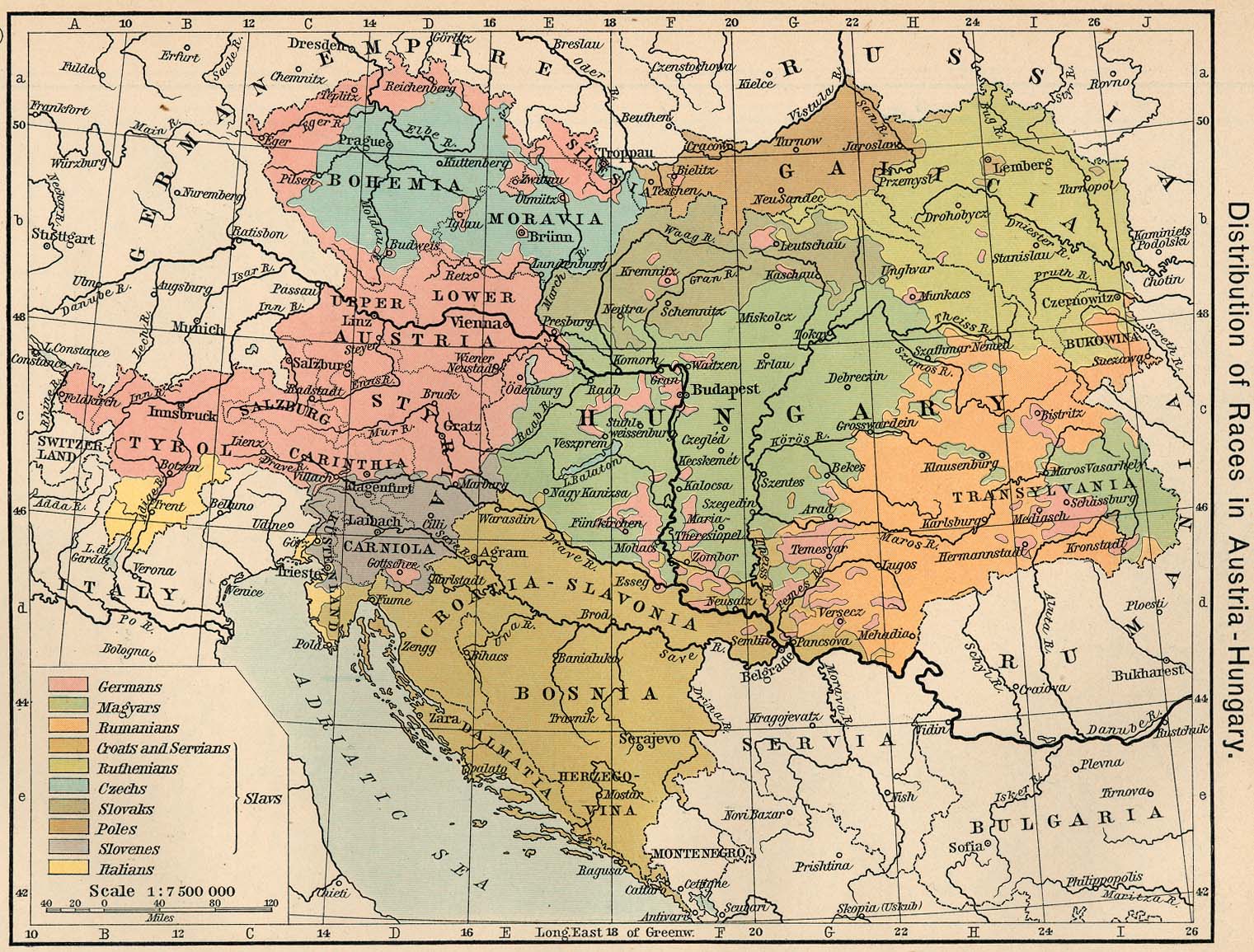
This meant poly-ethnic and poly-national entities like the Austro-Hungarian Empire and the Ottoman Empire were on a death clock. Yes they were reforming and yes, in some alternate realities, they may have even continued to exist but not as the empires we once knew them. The Austro-Hungarians had the issue of pan-slavism; that is, it had a significant amount of people from Slavic origin feeling like they were tired of being ruled by Austrians (mostly Germans) and Magyars (Hungarians). That would be Slovenia, Croatia, and Bulgaria-Herzegovina within their reach and Serbia just outside of their reach all calling for either autonomy or independence with a large amount calling for a pan-slavic union of all four nations for a greater Slavic empire, "Greater Serbia", to provide protection and unity for Slavic people.
Just look at this rough ethnic map and see just what kind of situation this was. The Brown and Grey in the south (Slovenes/Bosnians/Serbs/Croats)? The Poles, Ruthenians, and Rumanians in the North/East? The Czechs in the North? Slovakians just East of the Czechs? That is a giant powder keg of people who do not want to be inside of that empire; people who feel a strong ethnic/cultural/linguistic/historical bond to each other who are being ruled by a German or Magyar elite in a land far, far away.
Same thing goes for the Ottomans but in a different way. The Ottomans solved this issue a while back; they were a poly-ethnic empire who, roughly, did it correctly. They gave their ethnic groups a large level of autonomy as long as they paid taxes and provided soldiers when needed. Otherwise they were left to their own devices and even, at times, had a de facto monopoly on the legitimate use of force (easily the greatest signifier of sovereignty). However that autonomy would also spell their doom.
Unlike the Austro-Hungarians who tried to exert centralization which brought about violent end the Ottoman decentralization brought about economic woes that saw a much more 'natural' breakup in its future. Basically because they were not a centralized state, argues the narrative I know and love, they were not capable of keeping up with the industrialized/capitalistic boom of Europe and slowly faded away into the shade. With WWI, the Brits paying off the Arabs to revolt at last, and all that other fun stuff it was just the nail in the coffin for them to bankrupt themselves into all their semi-autonomous sub-states (and even the non-autonomous ones) to rise up and gain true independence. So they would have to deal with Greeks, Armenians, Kurds, Jews, and Arabs in modern day Syria, Iraq, Lebanon, Palestine and Israel rising up; all seeing a future of their own independence and self-determination based off the premise of common ethnic/linguistic/cultural/historical heritage.
These empires, crumbling at the seams (but, granted, by the war starting to make some good progress; it's not uncommon to theorize the Austro-Hungarians becoming a Federalist system [e.g.: the United States] without a war and enough peace to see it through) at the wars beginning were propped up by the 'balance of power' enforced at Vienna. It would be far more disastrous for these empires to fall apart, basically, was the mindset so the economically backwards Ottomans were kept afloat and the Austrians were kept afloat basically because of their industrious North and amazing capacity to keep minority groups suppressed. Once WWI showed the Ottomans in particular busting at the seams everyone said "screw it" and carved up Germany and Austria-Hungary (Hungary losing 2/3rds of its territory, for reference!)
Why did the German Empire get carved up? They were doing pretty well for themselves! Well again, another 'balance of power' scenario. They didn't want to break up Germany (in general...) but rather wanted to reduce them. They took away their colonies and their navy; Germany more or less created the conditions which started the war because of Empire and wanting to attain their own and everyone went to great lengths to make sure that didn't happen again.
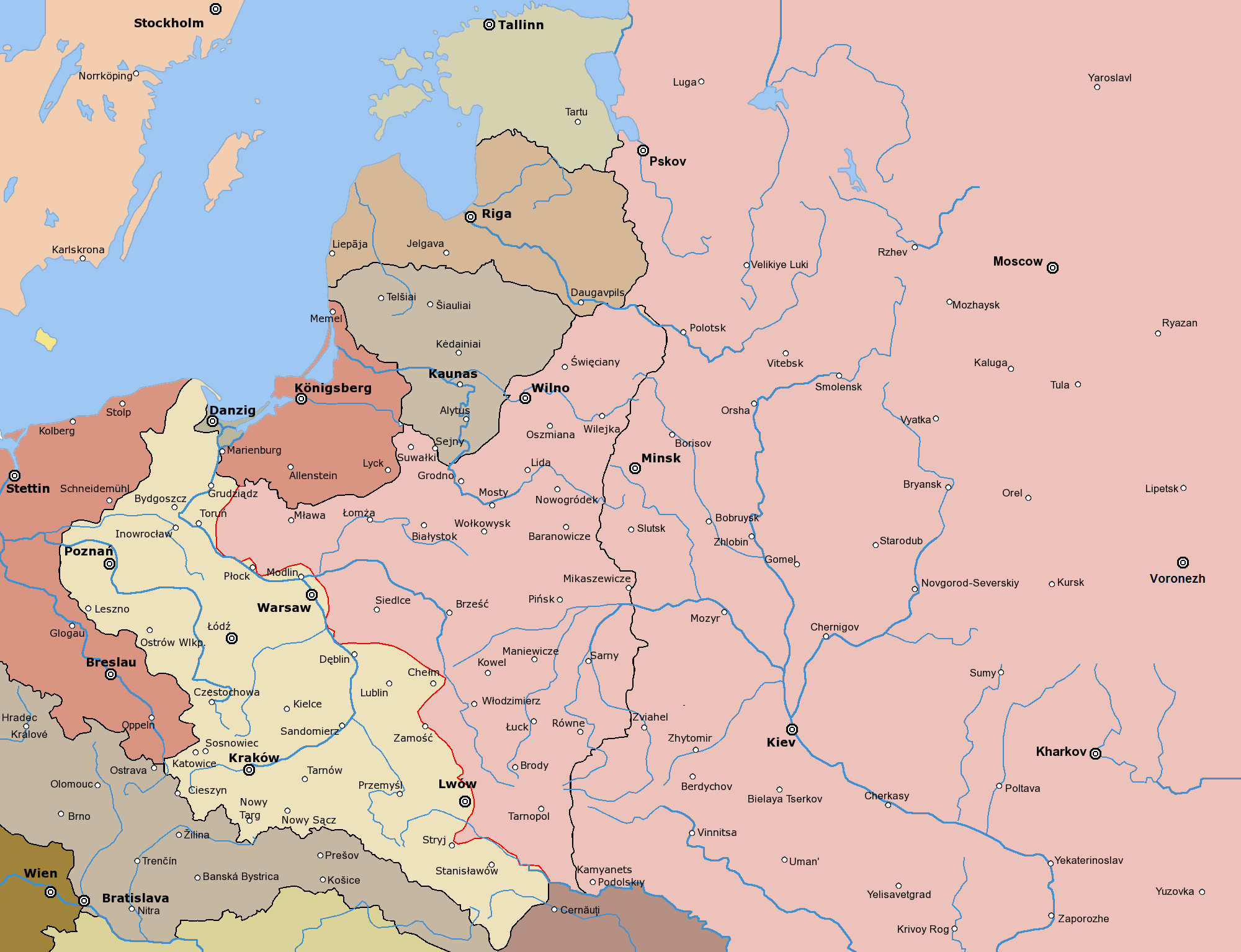
A common phrase is WWI was redrawing Europe around ethnicity and WWII was moving around ethnic groups to fit preplanned borders. That is precisely what happened. The green lands (bar the Saarland) were given a vote whether to join Germany or Poland as it was a tossup of demographics but in the general ethnic groups got their ethnic lands. Romanians got a huge chunk of Hungary (seriously...look at the before), Yugoslavia was created for that dreamed pan-Slavic state, the perpetually oppressed Poles who were split amongst three Empires (Russo, Prussian, Hungarian) for a hundred years were finally given their own autonomy, and the Austrians/Hungarians were (roughly) reduced to territory where they had ethnic majorities.
To be fair,as a side note, the USSR kind of tried to reconquer Poland/Ukraine (the latter being given independence via the 1918 Treaty of Brest-Litovsk b/w Germany/Russia), but the former would kick their butts back after being beaten back to Warsaw, crushing the Soviets so much they sued for peace almost immediately after losing at Warsaw. And yes, the Middle East was 'screwed over' by France/Britain into particular who arbitrarily carved them up and went back on claims of full self determination. However that's another story for another day; the nationalism of the Middle East still spelled the end of the Ottoman reign once war began and, in general, there was an effort made to give ethnic groups their ethnic lands back in Europe.