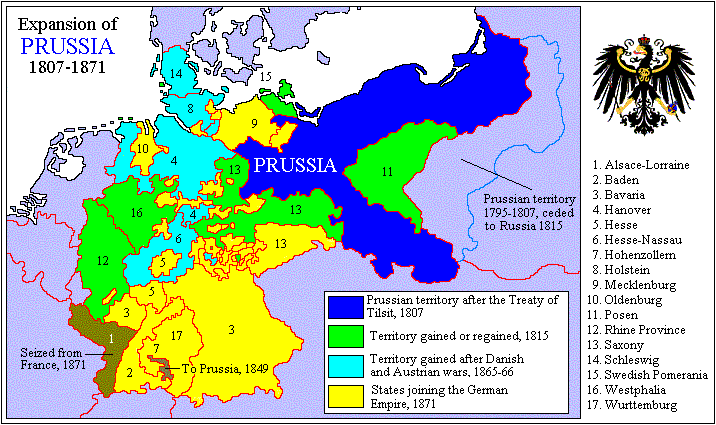
I have a few, hope you don't mind.
Is Prussia a current state of Germany, like Maryland or Pennsylvania in the US?
What was the transition from Prussia to Germany? When did this happen?
If Prussia is just a state of Germany, is it the most powerful, considering its location and cities? (Kind of like how New York would be considered more powerful than, say, Delaware.)
Sorry if the language confuses you. I don't really know how to ask these questions.
(1) No; the current states are, in no particular order:
Bremen
Schleswig-Holstein
Lower Saxony
North Rhine-Westphalia
Rhineland-Palatinate
Saarland
Hesse
Baden-Wurttemberg
Bavaria
Thuringia
Saxony-Anhalt
Hamburg
Mecklenburg-West Pomerania
Brandenburg
Berlin (?)
Saxony
Prussian identity was thoroughly stamped out at the end of World War II, specifically in 1947. It was seen as the driving force which sent Germany spiraling down into starting two of the deadliest wars in history in such a short span and, quite literally, unifying the Germanic peoples through warfare as well. Its entire history, from the beginning, was militaristic in nature and the Allies perceived Prussianism as the root of it all. From the Allied Control Council's Law No. 46:
The Prussian State which from early days has been a bearer of militarism and reaction in Germany has de facto ceased to exist.
Enacting the edict that every remnant of the Prussian state was abolished with its territories absorbed as Länder, or, the term for German 'states' as you could call Alabama a 'state'. Prussia, to this day, is seen by Germans as a symbol of militarism and autocracy; something they (in general) have grown quite apart from.
(2)
Prussia was a German state though, rather, a "Kingdom". The German Empire as it was was made up of four "Kingdoms" in its formation in 1871: Prussia, Bavaria, Wurttemberg, and Saxony. There were many more subdivisions of Duchy's, Grand Duchy's, and Counts but Prussia was the biggest of them all and only Kingdoms had the right of semi-autonomous control of their militaries and economies. However Prussia's king was also Emperor of Germany and thus had legal superiority to the other Kings; so a complicated system sure but there it is.
Right, so the reason it took Germany so long to 'form' comes from the fact that the Holy Roman Empire existed under Austrian rule until 1806. The Austrian system was more decentralized under the Holy Roman Empire with, by the end of it all, the Empire being more of a formality than anything else. The Prussian ideal came with a more centralized state to bring true protection and unity to the German people. Yet Prussia, coming into the end of the 1700's, was still a second rate power. Worst all, prior to the Empire's fall, expansion was strictly forbidden between member states in the Empire as all were protected by the Emperor and thus the smaller Germanic states could not organically grow. That was the purpose -- small states could survive without worrying about being gobbled up by their neighbors. Prussia kind of threw this out the window by taking Silesia from Austria but alas the structure remained in tact for over a thousand years.
So when the Holy Roman Empire fell apart in 1806 Germany would be dominated by France for almost a decade afterward. After 1815, and the Congress of Vienna, Prussia was given significant swathes of Western Germany and basically went into the post-Holy Roman Emipre world as the largest, baddest, single largest state in Germany. Without the Empire to keep it in check Prussia would gobble up enough land to make it own well over half of Germany by 1866 and then the smaller states were pressed with a choice: Try and stay independent and fight this megalith or join and stay protected and maintain a level of autonomy. They, obviously, chose the latter.
Specifically though you ask how/when this happened:
They did this through war. The sentiment was there, they knew from 1848 especially, but they needed to act on it. The German people, especially the smaller states, wanted unification as a strong central Reich would give them protections and rights and economic prosperity that would not be possible under their independent princes. Further what Prussia learned in the 50's is that when Austria was attacked there was popular outrage across all German lands that a 'German' state could be so relentlessly attacked and beaten without anyone intervening to help -- that is when France whooped Austria's ass in the Italian Wars. So what was the plan? Make a common outside enemy, in this case most conveniently France, declare war on a Germanic state (hopefully Prussia herself) and bring all of Germany to their aid. Hone that unity into purpose and make it beating down the French, something everyone could get behind in German lands.
After the French were subsequently defeated and South Germany in particular were brought into the fold through successful war and lots of chest beating the Kaiser acted on what he knew everyone wanted: a unified Reich to protect and bring prosperity to all Germans. He took Alsace-Lorraine (the latter being German speaking) and declared, in the halls of Versailles no less from his own lips, a German Empire under the Prussian King. It was not a unification of 'the people' it was a unification from Prussia and Prussia's might. We must not forget, at all, that this was an Empire created to further Prussian goals and this unification was one to bring all German peoples under their wing. The other German kingdoms would remain relatively autonomous like they wanted, allowed to keep their own military traditions, uniforms, etc. The independent princes would retain a level of autonomy and the aristocracy would thrive being given military generalships and political positions but 'the people' were placated as they were given the Reichstag -- essentially a 'parliament' for them to influence policy.
So it was less 'we beat France now we're Germany!' and more 'we need to bring all German people together under a common enemy and that was France. Now that everyone is together and united and we are in the high of victory we declare what everyone has been thinking for decades -- a unified, strong Reich.'
(3)
It used to be the most powerful as described above. See the map I linked; they by far contained the lions share of territory after the Napoleonic Wars. They gained a crap ton of land from the Congress of Vienna at the end of the Napoleonic Wars (1815) which made them the dominant German power in Europe. With some more warmongering they got the teal parts.