Recently I had learned about the Proto-Indo-European (PIE) Language. It is, in my understanding, a predecessor to a lot of different languages we see in the world today.
As such, many languages have similarities, even if extremely small or unnoticeable, with other languages if they are descended from the same language tree.
However, there are also other languages that aren't derived from the PIE language or any other language trees and are seemingly isolated in development from the other languages in the world, known as language isolates. An example or two would be Basque, and arguably Korean, although some may say Korean can be classified under the Altaic language branch.
How exactly does a non-derived language develop? How does the first semblance of grammar and the conveyance of ideas and instructions develop in an area with no prior cultural and linguistic influence? How does, say, a sentence like "I am eating an apple" form in different languages? Such as, how does the speakers of a language come to a consensus that an apple, in their language, is called a certain way? How does the difference in tense and other language particles come about?
A separate point of discussion would be: language scripts. The Greek alphabet is pretty well-known, and if I do remember correctly the Cyrillic alphabet is somewhat derived from the Greek alphabet. How do people come to a consensus that a certain alphabet represents a certain sound or vocalisation? How likely are language scripts and alphabets to develop alongside the development of the language itself?
For the last question, an example would be the development of the Korean language before the introduction of Hangul by Sejong the Great. Are there any cases of civilisations developing written script concurrently with verbal communication, or are all languages developed verbally first before a language script is implemented?
I'm really sorry if such a question is a fairly "weird" question to ask. However, this is a question I am incredibly curious about and I would greatly appreciate if some clarification could be given by any historians with the aforementioned knowledge here.
Derived is a bad word, evolution is better. No natural language is "derived" in the sense of a conscious choice to create it, rather they evolve slowly out of earlier languages. Language isolates, just like other languages, have continuously evolved since humans developed the ability to speak. They are just not related to other languages. Basque evolved from a proto-Basque language, which evolved from a proto-proto-Basque language and so on. In contrast, both Italian and French evolved from the vulgar Latin spoken in the late Roman Empire. Language families like the Indo-European languages all evolved from one ancestor language, language isolates might better be termed languages with no living relatives.
Scripts are usually adopted for a language by the educated class who then make an existing script fit their language. There have been only a handful of independent discoveries of writing, most of the time people take the script of a neighbor (e.g., Germanic peoples took the Latin alphabet) or see the power of a neighbor's writing, recognize how it works, and create a new one (e.g., Cyrillic, Hangul, and Cherokee). The three verifiably independent creations of a writing system are the cuneiform of Mesopotamia, the hieroglyphs of Mesoamerica, and the logograms of China.
While you are waiting for answers here, consider posting this in /r/asklinguistics, where specialists in languages hang out. They might be able to offer some good answers as well.
I am not a linguist, so much of your question falls outside my areas of expertise, but I can comment on your discussion of language scripts and the development of writing.
In this comment, I addressed the development of writing.
The gist of my comment is thus:
We know that language developed before writing, and that writing developed in order to represent that language in a visual rather than auditory manner. Prior to the beginnings of writing proper (the Sumerians in about 3900 BC) we have what is known as "proto-writing", which consists of symbols which represent ideas, but which do not yet represent spoken language (nouns, verbs, the ability to record all the words someone says).
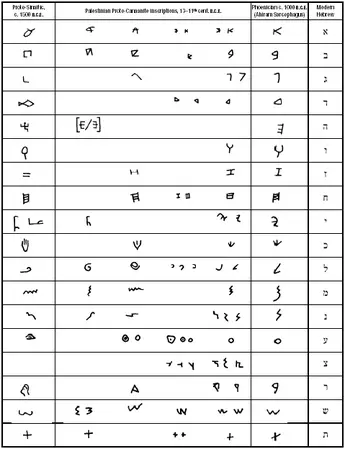
The earliest writing systems were not alphabetic, but rather logographic, which means they used symbols to represent whole words. Logograms also eventually beame simplified, as the Phoenicians began the first pre-alphabetic script, or a consonantal alphabet. These letters began as pictures representing words, the first sound of which was the letter in question. Therefore the first sign was the word for "ox", "aleph", and consisted of a stylized picture of an ox head. The second letter was the word for "house" which was represented by a stylized house shape, etc. We do the same sort of thing with the English alphabet when we teach it, "a is for apple, b is for bear, c is for cat, etc", except that we call our letters by their sound rather than by their original word-picture.
This is a chart showing how the pictures became letters
This article is the source for this information:
Hooker, J. T., C. B. F. Walker, W. V. Davies, John Chadwick, John F. Healey, B. F. Cook, and Larissa Bonfante, (1990). Reading the Past: Ancient Writing from Cuneiform to the Alphabet. Berkeley: University of California Press. pages 211–213
Once people realized that you could represent single sounds with a symbol, it became much easier to write. Eventually, the paleo-Hebrew alphabet became the first truly alphabetic script, taking certain consonants and repurposing them as stand-ins for vowel sounds (aleph for "a", yod for "i" and vav for "o" and "u"). The use of vowel signs became more and more prominent.
These letters changed over time, and though they can be traced back to the Phoenician alphabet, different cultures changed their letters as time went on, eventually giving way to the Greek and Latin alphabets and their derivatives.
I cannot speak to the development of Asian alphabets or writing systems, other than I believe that at least some of them followed the same pattern of logogram to sound marker.
EDIT: added charts