Less than some people think but more than is often given credit at exactly the same time.
Let's pretend you are me and you are wandering throughout your day, browsing through /r/history or /r/historyporn or wherever else and you see a post about WWI. "Oh! I love World War I! It was what got me into history and is my most passionate subject; let me give a looksie!" as my, I mean your, curiosity overwhelms you. You go inside and you see a discussion about the weapons of the war (as is often done) and you see the usual; stupid generals, human wave attacks, the usual pop history. However there is one little factoid that is always said and, unlike generals being stupid or human wave assaults, is never really directly contested; that is, that machine guns caused trench warfare.
Some conjecture I see all the time is some variation of people just started getting shot at by machine guns which could produce 80 rifles worth of fire per and just started digging in because they didn't know how to react to it. So allow me to make this abundantly clear: Machine guns did not cause trench warfare; machine guns in '14 and '15 just happened to be best suited to defensive actions due to their designs and other factors caused a slow down of attacks on the Western Front.
The reason trenches began is simple: Germany did not want to engage the Western Allies anymore decisively and had the capacity to enforce that will. After the catastrophe at the Marne the Germans were on the outskirts of Paris and had nearly encircled the French armies; they had wiggle room. They realized, quite correctly on that note, that the war would be won in the East and not the West and began to withdrawal. However due to their depth in enemy territory they had the luxury of giving up 10-20 miles of ground if it meant favorable positions; they were still, ultimately, occupying some of the richest territory of the enemy so who cares where they dig in. As in; it was a strategic level decision to entrench and one made very deliberately by the German OHL. The Western Allies, in tandem, responded by also entrenching as they recognized their superior position of encirclement (especially with Italy in the game), blockade on Germany, and superior manpower. Decisive action was costly and not necessary when attrition was their strongest weapon.
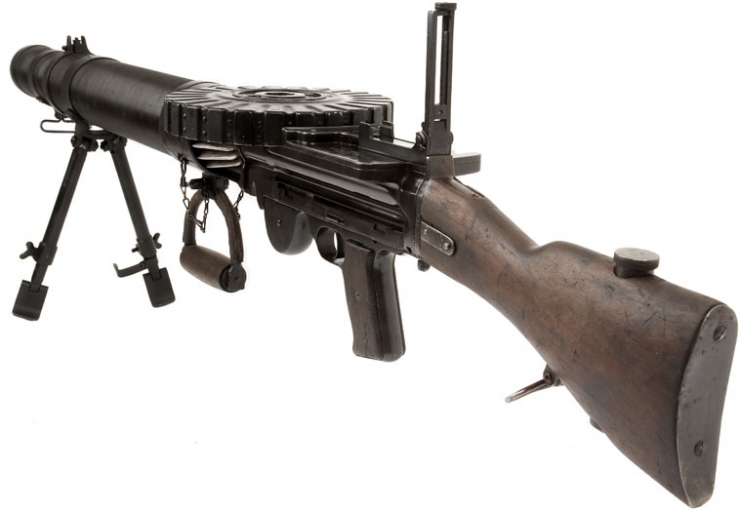
So then; machine guns didn't mystically "create" trench warfare out of thin air. So what did they do though? Nothing short of change everything; like I said 1914/15 Vickers produced something of 80 rifles worth of fire. Granted the British only had 24 per division (~10,000 riflemen) at this point which would, as the lighter and more modern looking Lewis Gun took over in 1916, be upped to around 204. By the end of the war every platoon would be reinforced with at least one Lewis Gun and it would be the centralized tool for offensives; as the February 1917 British General Staff's edition of "The Normal Formation for Attack" demonstrates:
" . . .the frontage of an Infantry Battalion in the trench-to-trench attack may range from 200 yards against a highly organized position, to 600 yards or more against one less highly consolidated."
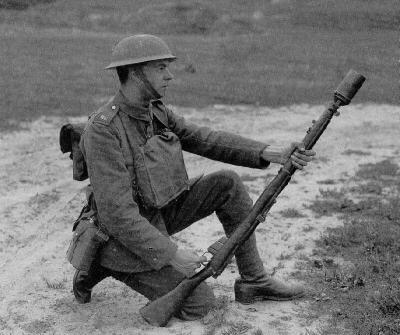
". . .the rifle and bayonet and bomb [grenade], being the most effective offensive weapons, should be placed as far forward as possible, closely supported by the rifle grenade, which may be regarded as the "howitzer" of the platoon, and the Lewis Gun [portable machine gun], which is the weapon of opportunity.
Each platoon will, therefore, normally be disposed in two lines, bombers and riflemen in the front line, rifle grenadiers, and the Lewis Gun in the second line. These two lines will constitute one Wave . ."
. . .
". . .[firstly] in the assault every man is a bayonet man, exceptiong No. 1 of the Lewis Gun, secondly, that every man in a bomber; and thirdly, that every man in rifle sections [14 privates + 1 lance-corporal] is also trained to be either a Lewis Gunner or a Rifler Grenadier, with a view to replacing casualties in men armed with those weapons."
As you can see by the fourth line especially Lewis Guns and Rifle Grenadiers were extremely prized positions and were, by training everyone to be capable of using them in every capacity, theoretically always in use by someone. The advent of a portable machine gun created the world that 1900's and early 1910's military thinkers dreamed of; machine guns reinforcing offensive capacity not being restricted to trench defense and an immobile destiny.
Machine guns would join each platoon and lay down its own pseudo-artillery barrages on enemy positions; large sprays of indirect fire which serves to suppress while rifles advance. This, in conjunction with mortar support and in the moment rifle grenade support, creates a style of warfare that is less concerned with precision and more concerned with suppression and movement and 'zoning' enemies out. As in you don't take a position by killing everyone in it, warfare is still fundamentally ruled by morale; it is taken by laying down so much overlapping fire and use that to maneuver in such a way that the defensive positions defeat is inevitable and their morale breaks thus allowing you to take the position.
Machine guns, the Lewis gun and its mobile contemporaries in particular, were just one cog in the machine of many tools (precision artillery, mortars, rifle grenades, mills bombs, etc.) meant to perform this task. Really in the face of grenades (mills bombs) and machine gun fire alone rifles seemed like the ancillary support tool rather than vice versa. It was machine guns and especially mills bombs which decided the battle ultimately; rifles were just there to, essentially, act as a screening force to let those tools perform in relative safety and then to act as an occupying force for said tools once they succeed.
So in short machine guns pushed the West further into what can be clumsily called late-modern warfare (WWII; 'modern' in the military history sense generally refers to 1815-1945) which is heavily centered on indirect fire rather than precision. Machine guns, grenades (holy hell people don't really realize how much grenades were used in both the wars...all the damn time), etc. It's more about laying an extreme amount of fire on the enemy position to suppress them and then out-maneuvering them to cause their withdrawal. Thanks to the mobile machine gun along with other major tools warfare in '17 and '18 would look much more WW2 than 19th century.
Richard Holmes, Tommy: The British Soldier on the Western Front
Holger Herwig, The Marne: The Opening of World War One and the Battle that Changed the World