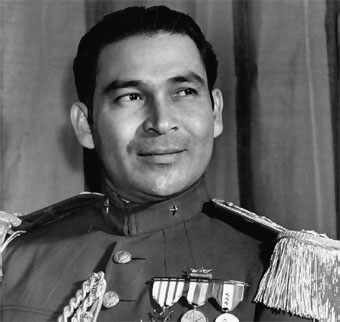
Was it anything particular about Batista? Was it something he was doing? Was there something about Cuban political society at the time?
To understand how Batista was able to gain and hold onto power for so long, you need to look at the preceding years in Cuban history. After a long period of direct American control, Gerardo Machado y Morales was elected President of Cuba in 1925 on a nationalist and suffrage ticket. Under Machado's reign, two things happened, he became increasingly dictatorial in his control, assassinating several of his political opponents, and the global sugar economy (as well as the world economy) tanked. By 1929, the price of sugar was less than 1 cent per pound and seeing as this was Cuba's main export, it was disastrous for the Cuban economy. The failing economy led to further reprisals by Machado and in 1928 he outlawed the main opposition party, insuring his reelection. From 1930 to 1933 he faced further dissidence from all sides and lost favor with both the Cuban Army and the United States. This loss of support in addition to a major strike countrywide, led to his fleeing the country in 1933.
Attempting to pick up the pieces was a temporary government headed by Carlos Manuel de Céspedes. However, the revolution was brewing and de Céspedes' government was overthrown by a combination of non commissioned officers led by Fulgencio Batista, Dr. Ramón Grau San Martín a prominent anti-Machadist, and a coalition of student groups.
However, by 1934, Grau was forced to leave the country and Batista was left in charge of this new government. He ran the country from 1934 to 1940 through puppet Presidents and from 1940 to 1944 when he was elected. He engaged in mild reforms and pushed the price of sugar back up during the war years, stimulating the Cuban economy. However in 1944 he was replaced by Grau as president who's very corrupt Auténtico party ruled the country till 1952. One historian described Grau and his successors up till Batista "Cuban country-club presidents who spent much of [their] time serving daiquiris" The period from '44 to '52 were notable for extreme corruption and gangsterism.
In 1952, after several months of near revolt, Batista overthrew (With full U.S. support) the Auténtico government and quickly set up his own dictatorship, Outlawing the Cuban Communist party, cracking down on dissidence, unions, and destroying labor strikes, his power was tenuous from the beginning, just as any Cuban leader, relying on strong-handed tactics and U.S. support. From 1952 to his fall in 1959, his reign was maintained by military strength and complete and total control of the Cuban mainstream media.
Sources: Breaking up with Cuba: The Dissolution of Friendly Relations Between Washington and Havana, 1956-1961, Daniel F. Solomon. Havana Nocturne, T.J. English (This I highly recommend for its insightful look into the later Batista government and the true extent of its corruption), A History of the Cuban Revolution, Aviva Chomsky