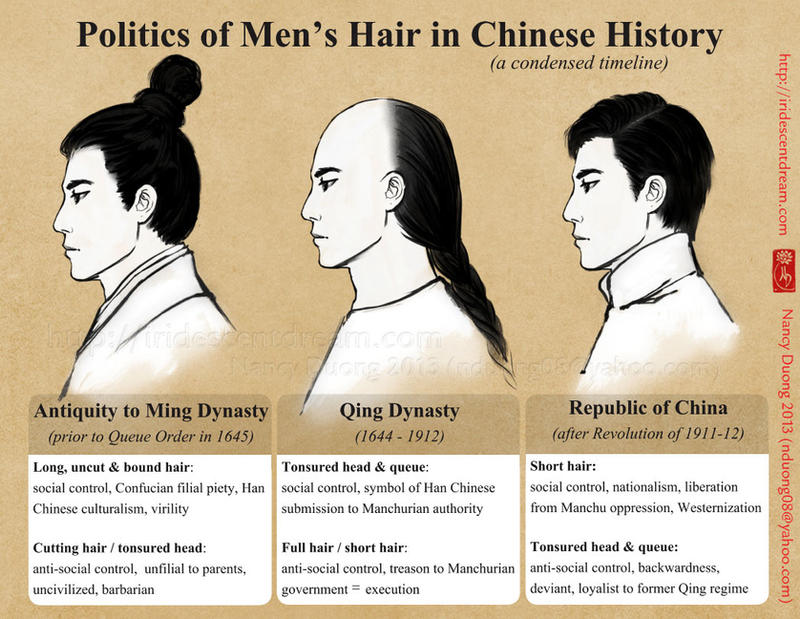
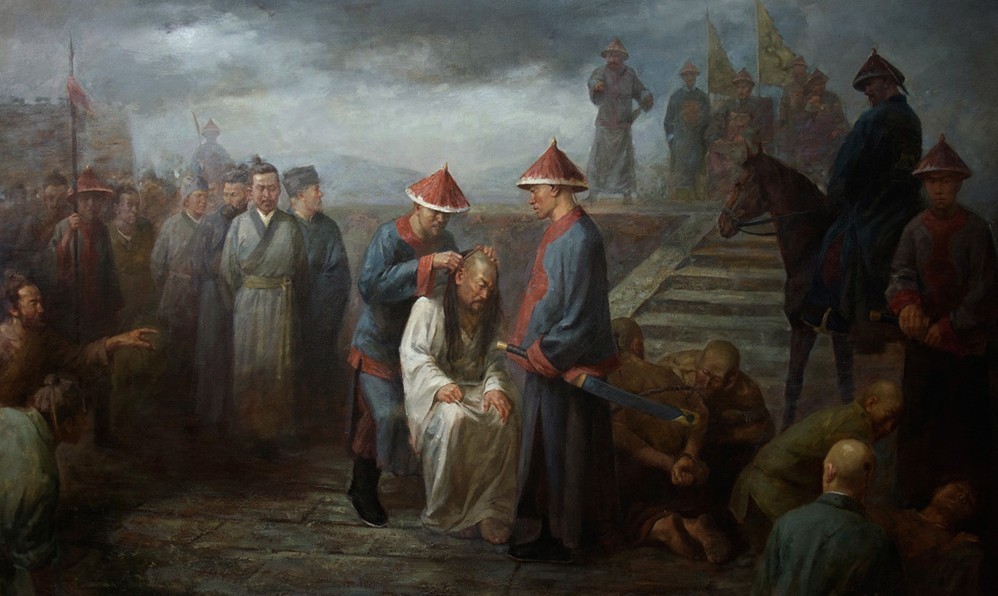
The very first thing you'd notice is that Chinese men wore their hair in a long braid, often referred to as the Manchu queue. An imperial mandate from the ruling Manchus of Qing China demanded that all men dress their hair into this long braid in the traditions of the Manchu.
Japanese hair for the common people was simple and practical, with very few social rules about hair. The vast majority of people did NOT have chonmage, as this was a hairstyle generally reserved for the upper class, namely samurai.
Japanese territories and provinces were very decentralized in their rule.
This meant that at the small village level, people only had an abstract idea of who and what the central government was and were only really aware of their local lord.
While this is arguably also true for Chinese settlements the farther away from the capital and imperial court, they were still administered by agents of the central bureaucracy and their local rulers were largely not identified as a separate independent agent. They would be officials that were raised and trained by the central government before being assigned their posts.
Edo Period lords and daimyo were hereditary owners of land and titles, which they or their house/clan had obtained through their participation in the battle of Sekigahara at the end of the Sengoku Period.
But of course, knowing the names of lords here or there wouldn't affect daily life all that much.
But what this decentralization in Japan did mean was additional taxes, especially on merchants and farmers who want to go to market not within their immediate areas.
During the Edo Period, Japanese lords would set up tolls and sometimes charge hefty sums for moving across borders of different territories of different lords. Movement in general was also heavily restricted. This was actually a change from the previously very low tax on commerce.
This was partly due to the fact that samurai were paid a stipend in rice and during the early 18th century, the Japanese economy was slowly moving away from rice. This meant that samurai were becoming less and less rich relative to their peers, especially merchants and farmers.
Taxes on rice were raised during this time period by Tokugawa Yoshimune which subsequently led to a diversification in the agricultural economy of Japan.
This is in direct contrast to China's Qing economy at the time where there were no exorbitant border crossing trade taxes between Chinese provinces, though there were often hefty taxes on foreign merchants, especially European merchants who came to ply lucrative trades in Chinese ports.
Another thing is that small villages in Japan would have a serious lack of money or coinage.
This is because farming communities often paid their taxes to their lords directly as rice during harvest time. Rice was a staple food in Japan but also a cash crop and was often used as an alternative currency to coins.
In contrast, Chinese villagers would need money because taxes were collected in currency only. Farmers would need to sell their crops and artisans would need to sell their goods for cold hard cash. For smaller villages, usually one or two of the local farmers would double as the local peddler, using their connections outside of the village to secure trades and bring back money, for a fee of course. Depending on the area, long distance traveling merchants may also provide the much needed influx of currency to small communities.
Japanese villagers were almost never allowed to bear military arms and villages would generally be lacking their presence.
Owning weapons was the privilege of the martial samurai class, as was the monopoly on force. Outside of being specifically allowed to bear arms, villagers would not have been allowed to carry or even own weapons. In case of danger, they would have had to rely on samurai and the local garrison of their lord's men to deal with it.
On the other hand, Chinese villagers would be allowed to own and use weapons in their self defense, to fight off river/ocean pirates, etc. Many veterans would still own their weapons after returning from campaigns. This being said, villagers would not have been allowed to openly carry them without a reason and even many guards generally did not carry them everywhere they went without a cause.
Both countries forbid commoners from owning firearms. Only the central government and their closest vassals were allowed access to them.
Finally, since you mentioned Hebei, a village in Hebei would have almost certainly used a large amount of their land for cotton. Hebei was well known for its cotton production during the Qing Period if I remember correctly.
Their foodstuffs would have mostly been sweet potatoes, beans, and probably a grain alternative to rice.
On the other hand, a Japanese village in Southern Honshu would have still been predominantly growing rice because the taxes on rice had only just been raised if we were talking about 1717. Within a few years, they will have diversified a great deal to include many more vegetables and more importantly, sweet potatoes and yams that have been cultivated from mountain species.
Cotton production in Japan would rise later but in 1717, it was actually importing cotton. Later on in the Edo Period, cotton production would rise meteorically and replace hemp in most clothing.
In 1717? Well the most noticeable physical difference would have been hairstyle. Traditional Confucian values considered head hair to be a sacred part of the human body, so any removal of it was considered abhorrent and deviant. This changed on the 21st of July 1645 when Dorgon issued an edict stating that all Han men must shave their foreheads and braid the rest of their hair into a queue identical to that of the Manchus in a show of subservience. The slogan adopted by the Qing was "Keep your hair and lose your head, or keep your head and cut your hair". Of course those who disobeyed were deemed rebels and opressed. By 1717 all Han men would have worn the Manchu queue. Here is an illustration of the traditional Chinese hairstyles: link link. A Japanese peasant would have immediately recognized a Chinese man due to this difference in hairstyle.
When you write "different", you mean purely physically, or you speak about the clothes, the behaviours, etc. ?