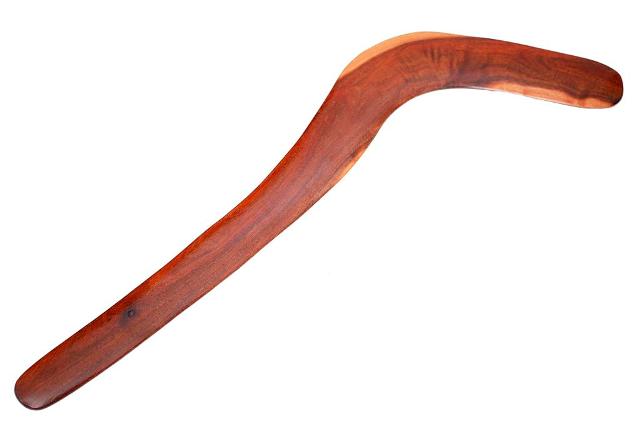
I've read this factoid in multiple books or magazines, but always only as a casual mention on the side, never with any sources, names or pictures.
The explanation on why this wasn't a completely absurd idea being, that originally boomerangs weren't made to return to the thrower, but that they were built to be thrown further and more accurately than a "normal" stick - or in this case a hand grenade.
I was almost about to think of it as a pure myth, but I actually found a mention on the website of the Australian Army Infantry Museum, stating that their collection includes "what is believed to be the only surviving example of a Russell boomerang hand grenade from 1915." Sadly still no picture though.
Does anyone have any more information on this?
As far as I was aware it was a trial that never went any further. Apart from being able to thrown further (and a possibly erratic flight path) I'm not sure what the difference was.
Here's one article:
http://paperspast.natlib.govt.nz/cgi-bin/paperspast?a=d&d=KCC19150818.2.38
And a report from a Melbourne newspaper at the time:
http://trove.nla.gov.au/ndp/del/article/1552805
Anyone in Singleton want to go have a look?
Boomerangs weren't always designed to fly back to the thrower. There's multiple types. There's the iconic one that will fly back and the hunting style that has a longer end that flies in an arc http://www.jagalingu.com.au/images/gallery/bb_jumullun_may_11_resize_0007.jpg. Good for hucking at running prey. I'd guess if there was a boomering with a grenade on it it would be more the latter allowing you to throw it and have it curve in the air.