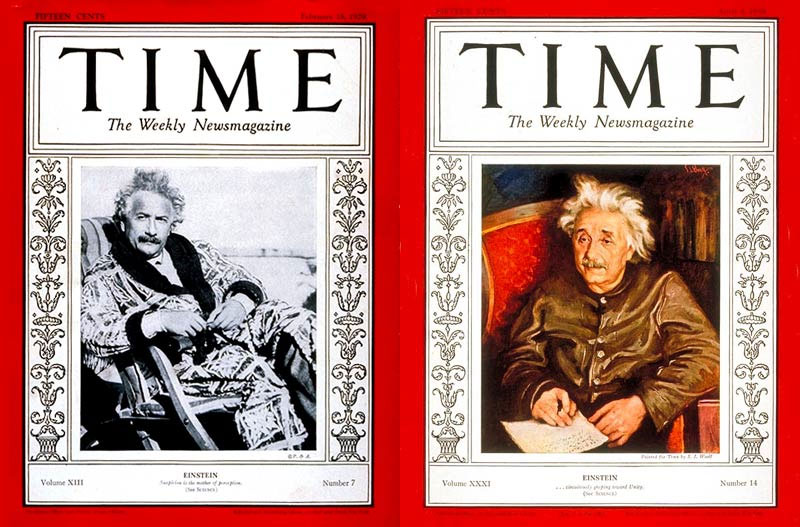
It seems to me that to become a world famous scientist outside if scientific community one has to do a lot of things other than science. Most modern popular scientific figures are there because they have published popular science books, media appearances or in case of Feynman, his lectures.
So what did Albert Einstein do that landed him in front of public spotlight? Were there some popular works he published or public appearances that he did that I'm not aware of? Or maybe his defection to U.S. was used as an anti-German propaganda?
The earliest public awareness of Einstein came from when he was one of the few German scientists to be outspoken in his opposition to World War I. This was a very jingoistic time, and many prominent German scientists had signed a big manifesto about how the British were terrible and the Germans were the best. Einstein made his own little manifesto that said, you're all idiots. This got him some press, because it was a rather daring thing to do.
But this little blip was quickly eclipsed (pardon the pun) by Eddington's observations in 1919. Eddington was a British Quaker who wanted to test Einstein's theory of relativity by taking photographs of the Sun during a full eclipse. If he could take pictures of stars just visible near the edge of the Sun while the Sun was blacked out, they could be compared to other measurements to see if the gravitational field of the Sun was bending the starlight according to Einstein's predictions. Eddington himself explicitly saw this as a way to "heal the wounds of the world," as he put it, because it would be a sign that science transcended politics (a British pacifist proving the the theory of a German pacifist). Eddington did the measurements and announced that Einstein's theory was correct, and this got a huge amount of press around the world, because it was one of those "all our physics is now obsolete" sorts of things. (The actual scientific merit of Eddington's experiment was much more problematic than most people know, but that is not really relevant to the public fame question.)
After that, Einstein was established as a big-brained thinker, and he played the role up well. He was politically very active for numerous causes (pacifism and civil rights, for example), he wrote a lot, he gave lots of interviews, he gave lots of lectures. He kept in the public profile, even if it was often as an eccentric. He won the Nobel Prize in 1921. He was outspokenly against the Nazis when they rose to power, and emigrated to the United States. (The Nazis were also outspoken against him, too, which helped with regards to fame.)
You can get a sense of his public perception in the USA by looking at the covers of TIME magazine he was on in 1929 and 1938. In both he is somewhat hamming up the "head in the clouds" reputation. In the first one he looks like he is in a bathrobe, in the second, pajamas. (He's actually wearing a really strange leather shirt with buttons in the second one — I have seen the photo it is based on — but anyway.)
But what really catapulted Einstein into the stratosphere, and made sure his public presence lived on well after his death (unlike, say, Robert Millikan, who was extremely well-known in the USA during his lifetime but faded from view very quickly after his death) was the atomic bomb. It became inevitably associated with E=mc^2 and his letter to Roosevelt became a key part of the standard narrative (rightly or wrongly). He became the symbol of how a head-in-the-clouds sage could actually hold the power of life and death in his hands.
The long and short of it is that any kind of public "creation" of this sort is a mixture of stuff the guy actually did, or were done in the guy's name (like Eddington, or even the Nazis denunciations of him), and what cultural "work" he did in a broader sense (he was someone the newspapers could evoke to talk about the character of scientists, for example). His public persona, especially what it became after his death, is not an exceptionally good representation of what he was like as an actual person, of course. After his death he became somewhat neutered, a "scientific sage" whose opinions were wise but uncontroversial. This is not what he was during his lifetime, where his advocacy for peace, racial equality, and socialism (with a small "s") earned him an extremely fat FBI file, among other things. The more controversial aspects of his life have been worn away by the public sainthood, for better or worse.
A few references: Matt Stanley's book on Eddington is great if you want to know more about Einstein's initial rise to fame; Einstein as Myth and Muse looks at the way his theories about space and time were taken up culturally, particularly by writers; Fred Jerome's The Einstein File talks about his political activism in depth.