I know what happens when a tree falls, because I can visualize it quite vividly. But the metaphorical "falling" of empires is not so easy for me to grasp.
As far as I can tell it has something to do with the following:
I'm sort of half guessing here. Reading the Decline and Fall of the Roman Empire would probably make clear to me what Gibbon means of "falling" as it applies to the Romans. But is there a short explanation that makes sense of the "falling" of the British Empire, the USSR, The Third Reich, and the Persians, etc., or is it so case by case dependent that the question doesn't really make sense?
What you seem to be talking about is a societal collapse, of which there are of course many examples in history and in this instance i will use the Bronze age collapse (although the Aegean was not an empire it serves as a very useful example of the type of thing you seem to be describing).
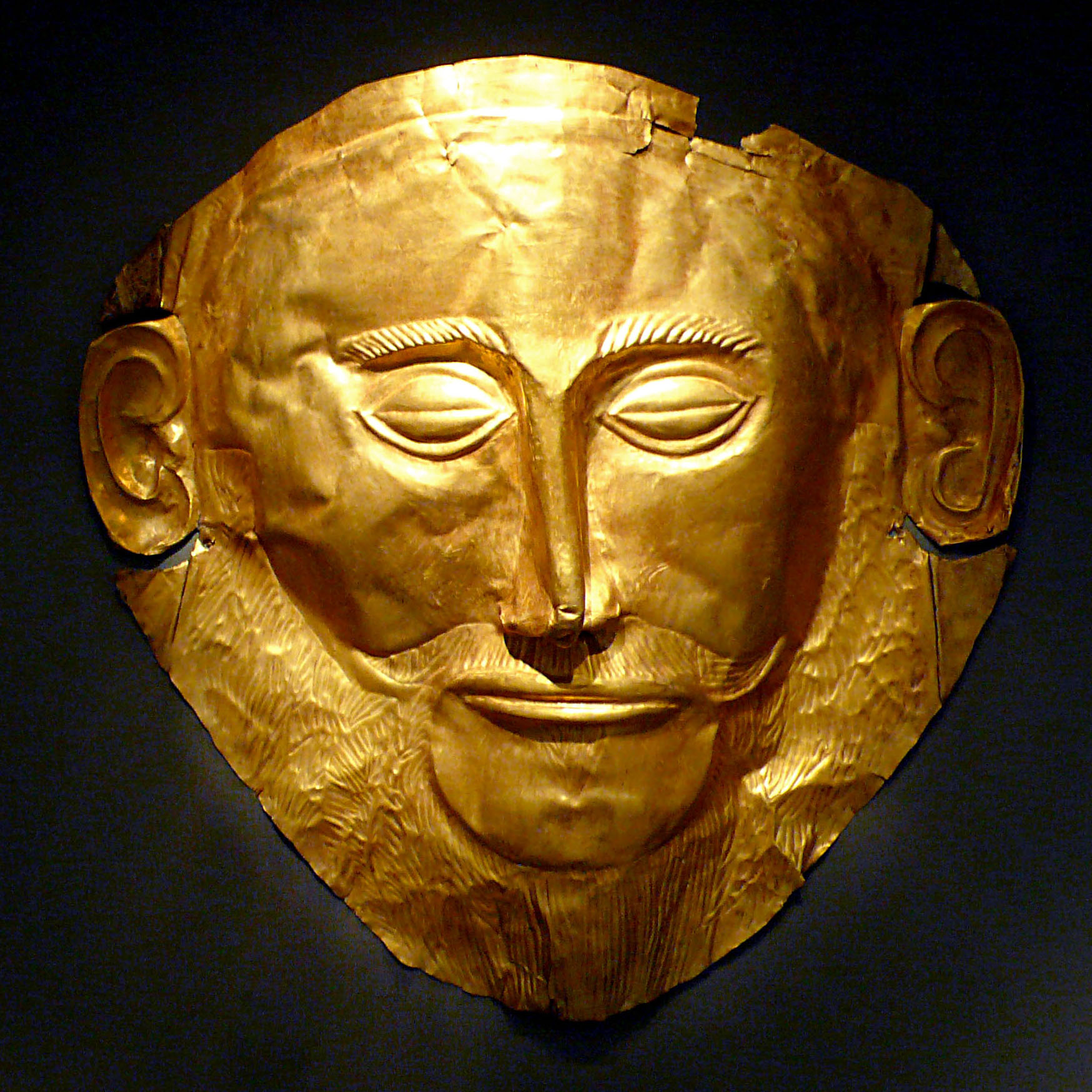
Long story short, in about 1100 B.C the Mycenaean Greek culture and the neighbouring Hittite empire suddenly collapsed. The palace system on which Mycenaean society rested fell apart and all the sites, such as Mycaenae itself, Pylos, Hattusa (the Hittite capital) and possibly Troy were suddenly violently overthrown. The how and why of this has been intensely debated and could be the subject of many historian's life's work, so I won't go into it now.
As you guessed there was a huge reduction in the complexity of the economy. The Mycenaeans were very skilled at [pottery making] (http://www.metmuseum.org/toah/images/h2/h2_53.11.6.jpg) and metal working. What we see after the collapse is a huge simplification both of the type of pottery to more geometric forms, weapons, although they were now made of iron, and so on. There is also an emergence of distinct local styles, indicating perhaps that there was less trade and cultural exchange. We can surmise that there was a sharp population decline, since the number of grave sites falls sharply after the collapse. However, we should not be too quick to jump to conclusions, it may simply be that elites became smaller, thus meaning fewer elite graves. Yet this points to an economy that is unable to support large amounts of elites and less diversified. As hinted before, trade shrank considerably.
As part of the overthrow of the Mycenaean palace culture the art of writing in linear B was lost. In short, linear B was only written by a small scribes guild in the palaces, and without the palaces there was no need for them and the art was lost, with linear B only being deciphered in the last century. Writing would only be reintroduced in the 8th century B.C and using the Phonecian system, which was adapted into the Hellenic alphabet.
It might be easier to see the "fall" of a culture or empire as simply a metaphor. It is attractive to personify an empire, like an old warrior slowly giving up and being beaten to death by a multitude of foes. while this is mostly true for the Western Roman empire it does not really hold for the British Empire which might be better viewed as a disengagement, a letting go, a slow steady decline or a realisation of changed great power status in relation to the USA. It could be argued that the British empire has not yet ended. The entire world works according to an Anglo-american world view, English is the international language of finance, science and academia, financial markets work on methods pioneered by the British and English, that is to say Western, culture dominates the world. However, I am mangling an argument from John Darwin's "After Tamerlane". If you want to read a proper explanation of how empires rise and fall, then that is the book I would urge you to read So there is no hard and fast rule, each empire or culture falls away in its own fashion.
I think it's problematic to group ancient empires in with modern great powers. while we know way less about social changes following the collapse of pre-modern (pre-1500) empires, it does seem that the affects were more drastic than they have been recently. Life in Germany following the defeat of the Nazi regime was clearly politically different, but were day-to-day civilian's routines greatly disrupted (discounting the obvious differences between wartime and peacetime)?
I highly recommend Paul Kennedy's "The Rise and Fall of the Great Powers," which examines the ascent and collapse of hegemonic nations post-1500 (according to his definition of a 'Great Power'). It largely focuses on economic developments.