Ooh, this is a fun one. Time to take a step back in time! I'm not sure if I'm going to be able to answer everything perfectly (I'm not precisely sure what "a standard alleyway" would be), but I can certainly help out on a few of these categories. I'm really pissed at myself for leaving my books at my apartment over this weekend (I can't carry 50 books with me wherever I go :( ), so you'll have to forgive me for not chattering more than I will :) I will, however, give some book recommendations for you at the end!
Let's start off with the "Alleyway!" There are a few reasons why I'm not so fond of this one, and there are some extra factors that I'll need to discuss to really get into it :) I'll start off by discussing something mildly tangential, but really important to understanding the way these men and women lived. I, unfortunately, can't find any pictures of the house in which Vorenus lived, and I'm unable to screenshot it at the moment. For those who haven't seen the show: They botched it. Essentially, Vorenus lived in what could be seen as a modern-day apartment, even if it was a bit shoddy looking around the edges. His wife cooked, there was a kitchen of a sort, there were seperate rooms, etc.
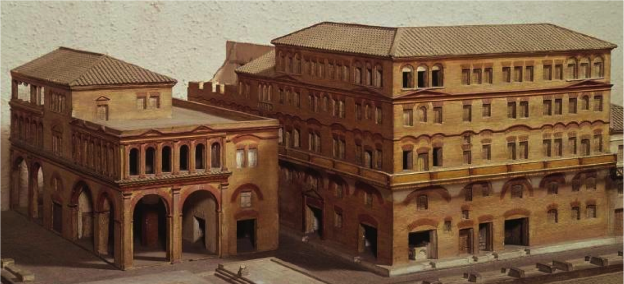
The common Roman would have considered this to be a luxury. Most of them lived in tenements like this one, which were called insulae (sing. insula). These insulae were often far larger than the one pictured, with some being built up to 10 stories high. If you want a quick idea on the layout, think college dorm made out of plywood. No insulation, no building standards (some of the emperors tried, but they were routinely ignored), extremely flammable, extremely small and cramped. The rooms got smaller and smaller as you went higher up - the bottom floor had relatively nice, roomy rooms which were regularly rented out as shops. Wealthier tenants also lived on the bottom floor, and it was common for young aristocrats to rent out a room in an insula as a nominal way of 'leaving the nest.'
Luckily, Rome had some lovely poets who included anecdotes and jokes about the dwellers in the insulae in their books! Here's Martial 7.20:
No one is more pitiable, no one more gluttonous, than Santra, when he is invited and hurries off to a regular supper, to which he has fished for an invitation many days and nights: he asks three times for boar's neck, four times for the loin, and for the two hips and both shoulders of a hare nor does he blush at lying for a thrush, or filching even the livid beards of oysters. Sweet cheese-cakes stain his dirty napkin; in which also potted grapes are wrapped, with a few pomegranates, the unsightly skin of an excavated sow's udder, moist figs, and shrivelled mushrooms. And when, the napkin is bursting with a thousand thefts, he hides in the reeking fold of his dress gnawed fish-bones, and a turtle-dove deprived of its head. He thinks it not disgraceful, too, to gather up with greedy hand whatever the waiter and the dogs have left. Nor does solid booty alone satisfy his gluttony; at his feet he fills a flagon with mingled wines. These things he carries home with him, up some two hundred steps; and locks himself carefully in his garret and bars it; and the next day the rapacious fellow sells them.
Needless to say, these people who would "climb 200 steps to get home" would be the poorest of the poor, especially considering the rate of collapse and fire in these things. Hell, Cicero himself was a bit of a scumbag of a landlord (sorry Cicero fans). Here are a couple of excerpts from his letters to Atticus (14.9,11)
[...] As to your question about the reason for my having sent for Chrysippus—two of my shops have fallen down and the rest are cracking. So not only the tenants but the very mice have migrated. Other people call this a misfortune, I don't call it even a nuisance. Oh Socrates and Socratic philosophers, I shall never be able to thank you enough! Good heavens, how paltry such things are in my eyes! But after all I am adopting a plan of building on the suggestion and advice of Vestorius, which will convert this loss into a gain.
[...] As to the Cluvian inheritance, since in all business of mine you even surpass me in interest—I may tell you that the total is approaching one hundred-sestertia. The fall of the houses did not depreciate the value of the property: I am not sure that it didn't increase it.
TL;DR: Not a single mention of those who passed away in the collapse, but he does express delight at how he'll be able to rent the rooms out at a higher price after the buildings in question are rebuilt. Finally, below, I'll quote some Juvenal at you - he discusses the plight of those living in these tenements in greater detail (Satires 3.190-211). I'll put in little notes to explain what he's talking about :) :
"Who at cool Praeneste, or at Volsinii amid its leafy hills, was ever afraid of his house tumbling down? Who in modest Gabii, or on the sloping heights of Tivoli? But here we inhabit a city supported for the most part by slender props: for that is how the bailiff holds up the tottering house, patches up gaping cracks in the old wall, bidding the inmates sleep at ease under a roof ready to tumble about their ears. [The insulae were creaky and extremely unstable - they were held up by makeshift wooden props.]
No, no, I must live where there are no fires, no nightly alarms. Ucalegon below is already shouting for water and shifting his chattels; smoke is pouring out of your third-floor attic, but you know nothing of it; for if the alarm begins in the ground-floor, the last man to burn will be he who has nothing to shelter him from the rain but the tiles, where the gentle doves lay their eggs. [Fire was a SERIOUS problem for obvious reasons.]
Codrus possessed a bed too small for the dwarf Procula, a sideboard adorned by six pipkins, with a small drinking cup, and a recumbent Chiron below, and an old chest containing Greek books whose divine lays were being gnawed by unlettered mice. Poor Codrus had nothing, it is true: but he lost that nothing, which was his all; and the last straw in his heap of misery is this, that though he is destitute and begging for a bite, no one will help him with a meal, no one offer him lodging or shelter. [Poor man who died in a fire - Juvenal lists his worldly possessions.]
So to bring this back to alleyways and the picture in question! Note that, in the picture, there are individual houses along the street, rather than tenement buildings. This would not have been the case - those insulae took up entire blocks by themselves. Individual buildings? Not so much a thing. Secondly, that building on the left would not have been in the middle of a bunch of insulae. It looks like a well-built mansion - which generally were in nicer neighbourhoods, where the wealthy lived. For an example off the top of my head, the last line of that second letter of Cicero's that I quoted to you earlier is...
I have here with me Balbus, Hirtius, and Pansa. Octavius has lately arrived at the next villa to mine, that of Philippus. He is quite devoted to me. Spinther is staying with me today: he goes early tomorrow.
Ohai, Cicero's also the neighbourhood gossip! He knows everyone who's moving in ;) But you get my point. That scene? Highly unlikely. Finally, the most egregious violation! It's way too wide. That's an image from Pompeii, where the original architecture is still preserved - and Pompeii was far less rambling than Rome when it came to how it was built. Note how tiny that alleyway is!
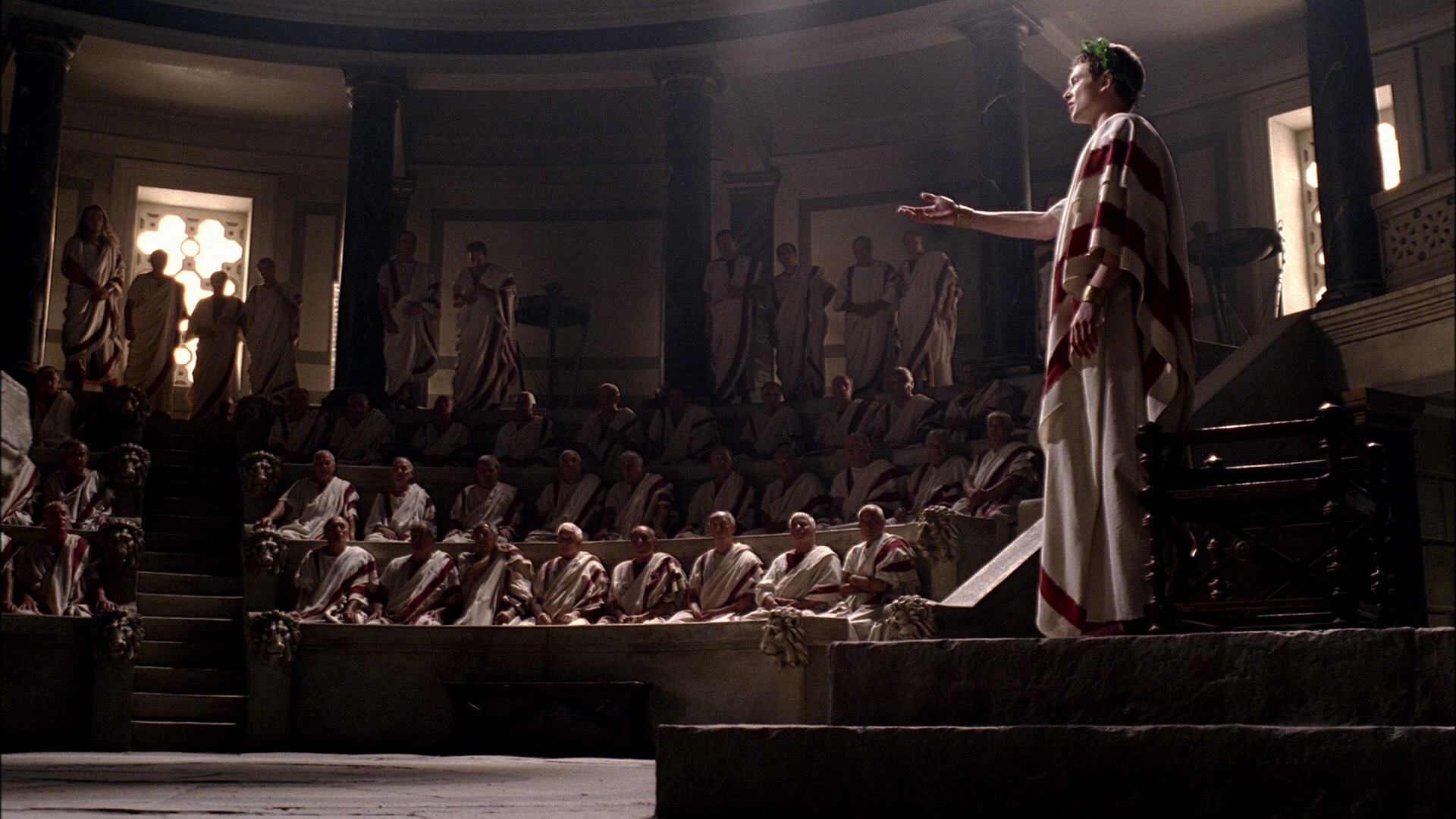
Next! The Senate. There's a very easy problem with this Senate building in 50 BCE. Namely, the fact that it exists. The Senate building was burned down in 53 BCE (three years earlier), and only began to be rebuilt in 44 BCE. The construction was promptly stalled for another 15 years due to stabby things happening to poor old Julius, and the new Senate House (curia) was eventually completed by Augustus in 29 BCE. During that span of time, the Senate essentially met wherever they were called to meet. It could be a manor, or it could be a large auditorium, such as the Theatre of Pompey. We know for sure that the Theatre of Pompey was used - it was where Caesar was assassinated.
If you'd like, though, you can take a gander at the Curia Julia today! It's the Senate which was reconstructed by Augustus, and it still stands. Here's the facade, and here are a couple of shots of the interior! This is an artist's conception of what it may have looked like. Senators would shift where they were sitting depending on whether or not they supported the man who was speaking at that moment :)
Lucky me! That section was much shorter than talking about alleyways :D
I cant tell you that the triumph scene is very inaccurate. Rome was a sacred city and as such no one was allowed to bear arms within it. The soldiers would have been in civilian garb, togae if they were citizens and tunics if they were auxiliaries. The returning general meanwhile would wear a solid purple toga, which he does not do here. As for the route, the end destination of the triumph was the temple of Jupiter in the forum, while the scene seems to show the forum the emphasis seems rather on the senators (who would not have been in attendance on stands) and the empty chair, not the sacrifices which would have closed out the triumph.
As for the alley, the buildings would have probably been much taller. Many Romans lived in blocks of flats called insulae which were often four storeys tall. The alley seems also rather too straight to me. Even to this day a streetmap or Rome looks rather like a bowl of spaghetti. The city grew randomly and haphazardly, twisting and turning. Further, because of the height of the buildings there would have been much less natural light. There are also no open sewers, a setpiece of many Roman streets.
While obviously I cannot speak for all Roman markets the one in the picture does not seem terribly accurate. The Romans did have shops, often built into the bottom floor of the apartment blocks and recessed into the building.
As for the wedding scene, it was certainly normal for people to wish the bride well on her journey to her new home. However, instead of flower petals they should be throwing nuts, which were a sign of fertility. I have not come across either drumming girls or palm fronds in wedding ceremonies but that does not mean that they did not exist. Lastly, it seems to me highly unlikely that a wedding procession would go through the forum since they normally took the most direct path to the groom's house to the brides, where he would then ceremonially carry her over the threshold.