It seems like when ever anything 1950s US is shown in the media its shown as men in suits and hats driving new cars to office jobs, women being good house wifes and teenagers hangout in their cars in milkbars and burger joints. So the question is was this a time of a rising middle class, obviously there was still poor and blue collar workers but was this really a time of cultural and financial independence\growth or is there a fair amount of cold war propaganda that has just stuck and now thought to be reality?
The pictures/images you paint are consistent with the dominant ideal of what "the good life" was supposed to be like in the 1950s. These images weren't just Cold War propaganda, they were also replicated and idealized in advertisements, in film and on TV, and in advice literature as well.
Many factors went into making this the dominant picture/stereotype of the "ideal" family; one is is that a whole generation of people who had grown up during the Great Depression and WWII were very happy to have the chance to have a family and live a more stable life after the war ended. Americans whole-heartedly embraced the "domestic" ideal of focusing of marriage, children, the home, and the consumption of commercial goods as the primary means of making themselves happy after the war. As part of that, large numbers of women either chose or were admonished (often a bit of both) to believe that their highest calling in life was to be a wife and a mother - they faced enormous social and cultural pressure to find a man, settle down, and become a housewife. At the same time, the federal government made a conscious policy choice to encourage massive consumer spending to help grow and feed the American economy after the war; things like the GI Bill (and the cheap mortgages which it allowed veterans to get), interstate highways (which spurred the growth of suburbs) and a whole range of other policies underwrote and encouraged Americans to buy and idealize the one-family, suburban home. And these policies worked: the post-war period was a time of tremendous economic growth and prosperity, which meant that large numbers of American families could afford these things.
But the ideal was just that: an ideal. It's definitely a mistake to look at "Leave it to Beaver" and think that this actually how most 1950s families lived. I don't watch a lot of TV these days so forgive the dated reference, but that's basically like watching Friends and assuming that everyone in the 1990s lived like Ross, Chandler, and Rachel (in massive, wonderfully furnished apartments that would have been way beyond the means of these characters in real life).
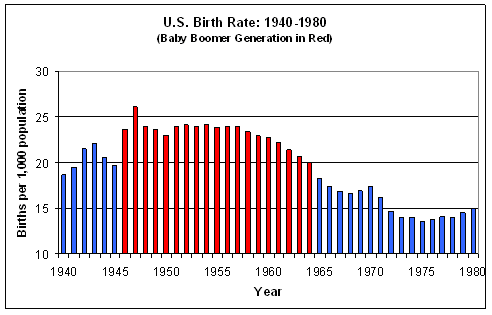
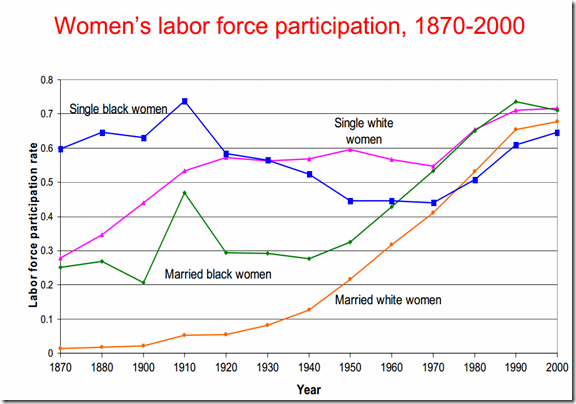
While stats like home ownership, the unemployment rate, and ye olde baby boom do suggest that there's more than a grain of truth to our stereotypes about the 1950s, there's also a lot of data that contradicts what we think we know about the 50s. In reality, employment rates for married women rose steadily throughout the 1950s, and was well over 30/40 percent by 1960. And note that it was rising for both white married women and black married women - the cost of living and spending rates were on the rise, and the idea that a man could earn enough to support his entire family wasn't really the reality for many families. You also need to acknowledge that for black families and other minorities, the ideal of the suburban home was almost completely unachievable: they were denied access to the jobs that would have enabled them to live that life, while racist housing policies + practices kept them out of the suburbs and confined to predominantly black neighborhoods.
Then there's the question of whether everyone was actually as happy doing these things in the 1950s as the ideal suggests - and while the answer here is (kind of) subjective, there's a lot of evidence to suggest that many of housewives who did stay home were miserable doing so, that many of the "domestic bliss" marriages of the 1950s ended in divorce in the 1960s, and that many of the kids who grew up in these homes had little to no interest in replicating their parents' lives when they themselves came of age.
Here are some books I'd recommend if you're looking for the full story on all of this:
Elaine Tyler May, Homeward Bound
Joanne Meyerowitz, ed., Not June Cleaver
Lizabeth Cohen, The Consumer's Republic
Stephanie Coontz, The Way We Never Were
Depends on the person or family's circumstances. President Johnson famously declared a "War on Poverty" in 1964. At the time, the US poverty rate was around 19% (according to the census, the rate in 2013 was 14.5%). Social Security, food stamps, and other programs were part of the effort to raise vulnerable Americans out of poverty and meet basic needs. There were also institutional barriers to education and employment -- the Civil Rights Act didn't pass until 1964. Protections for women and disabled Americans were largely non-existent. The 50s and early 60s were a pretty hard time to be member of a marginalized group--elderly, rural, minority, disabled, single mothers. The post-war era was a time of prosperity and income growth for a certain segment of Americans, but there were many, many people either forcefully excluded or left behind.