I know it's become one of the great touchstones of gaming in the intervening decades, but how was it received in its early days?
Hold your horses there, /u/WileECyrus. While the Nintendo Entertainment system was officially launched in the United States on Oct. 18, 1985, Super Mario Brothers wasn't among the 17 titles available at the start. Though it launched in Japan on Sept. 13, 1985, it didn't really make it to the United States until 1986. In fact, neither did the NES, really. You see, the NES' launch was limited to New York City, and even by the holiday season, it was almost impossible to get outside that city.
It wasn't until 1986, when Nintendo started selling the system (and Super Mario Brothers) in places like Los Angeles and Chicago that it started to spread. By the holiday season of 1986, it was popular. By the holiday season of 1987, it was everywhere. And by 1988, people were realizing that it wasn't a one-year flash in the pan.
You see, when the NES debuted in 1985, even magazines like Electronic Games thought the industry was in a slump after the videogame crash of 1983. "The videogame market in America has virtually disappeared" and "this could be a miscalculation on Nintendo's part" were two of the phrases that appeared in that magazine's March 1985 issue forecasting Nintendo's arrival. In hindsight, they look a lot like those infamous Slashdot comments about the iPod.
But even after sales of the NES started to take off, it took time for its popularity to sink in. For all anyone knew, the NES might be another Cabbage Patch Doll -- something popular for one holiday season and gone the next.
Whenever someone asks a question here about "critical response" or the "general public's reaction" to something, I usually go off an do a newspaper survey. Since so many newspapers are digitized (and I'm in the newspaper business and have access to a ton of databases) I can usually crack the bones and drain the marrow quickly. On this topic, I was surprised.
In the New York Times, Washington Post, Associated Press and every Alaska newspaper, I found no mention of the Mario Brothers or Super Mario Brothers before the holiday season of 1988. Now, there are display ads in the pages of these papers, but no editorial content mentioning the Super Mario Brothers. The Associated Press has the first mention of Super Mario Brothers (on April 4, 1988), and other newspapers follow suit. Here's an excerpt from the first mention in the New York Times on Dec. 4, 1988:
Some 10 million Nintendo ''home video entertainment systems'' have been sold in the United States in recent years and have sparked a firestorm of interest that toy industry experts - and millions of teachers and parents - say is America's latest toy craze and teen-age cultural phenomenon. ''It's a mania,'' said Rick Anguilla, editor of Toy and Business World, an industry trade journal. ''The kids of America are saying 'This is great, we've got to have one.' For boys in this country between the ages of 8 and 15, not having a Nintendo is like not having a baseball bat.'' For the uninitiated, the basic Nintendo system consists of a control deck that attaches to any television, transforming it into a screen that plays video games. This ''hardware'' comes with a hand-operated ''joystick,'' which the players use to control the on-screen video. This costs about $100. Then, there are ''software'' game cassettes to be inserted in the control deck, which cost from $25 to $45 per game. When played, the game cassettes can take up to 70 hours to complete.
A week later, there's a (hilarious in hindsight) column from a Long Island (New York) resident, who asks: "Video-Game Mania: Passing Phase or Permanent Addiction?"
Now, what you don't find are serious reviews of the game. After all, no one would review the latest Micro Machines toy or give a rating to the Skip-Bo. The first mention I can find of the content of Super Mario Brothers rather than the fact that it's an electronic game that all the kids seem to love isn't until April 26, 1990, when Times columnist Edward Rothstein states:
"When compared with NEC and Sega games, it is clear that Mario is from an earlier technological generation: the sound is mono and the graphics hardly sophisticated. But the games are gracious, even-tempered; the villains are bulbous creatures, some resembling ostrich-like turtles with red and blue shells. "There is no sexual or horrific edge to the Mario games. They are witty and intricate: there are hidden objects and unknown passageways and puzzles; players trade secrets. It is no accident that they appeal to girls as well as boys, adults as well as children, and it's as much fun to watch as to play. The Mario Brothers even have their own television show and will soon star in their own movie. "NEC and Sega have yet to match Nintendo's charming and compelling style. But Sega has announced games keyed to forthcoming movies like ''Dick Tracy,'' and built around celebrities like Michael Jackson, featuring some of his hit songs."
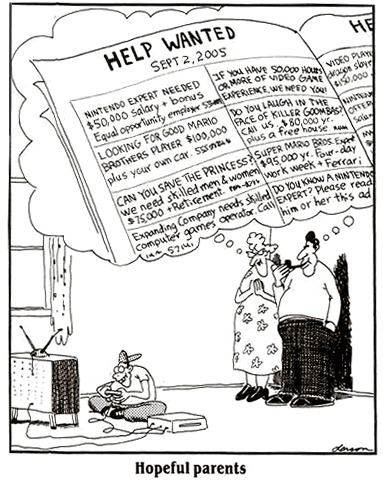
If you ignore the gaming press and focus on general-interest publications, the reaction is one of incredulity -- not just at the Super Mario Brothers, but at the popularity of video gaming in general. Perhaps nothing summed up the general thought better than a Far Side cartoon that hit newspapers on Oct. 15, 1990. Only the arrival of Wolfenstein 3D, Doom, and Mortal Kombat in the mid-1990s caused popular attitudes about videogames to shift.