RIP originally stood for R(equiescat) i(n) P(ace), which is latin for "may he/she rest in peace", coincidentally offering a similar emendation in English. As such, it was commonly found on christian tombstones of the Roman world in late antiquity. However, it was rarely abbreviated and rather written out - which is significant, since Christian inscriptions tend to get creative with abbreviations, even more so than Latin inscriptions in general. It was however markedly a late antique practice, only found after the fourth century, and never really prominent - a quick search yielded 35 results for 'requiescat' in various combinations. However, much more common is the form requiescit in pace, which simply means 'he/she rests in peace', with more than 2300 results for its various forms and combinations in antique Latin inscriptions, roughly half of which follow the exact formula requiescit in pace, usually prefaced with hic, 'here'.
Here is an example from Bergamo, it says "Here rests in peace the well-deserved Maxentia, who lived 40 years more or less, interred on the day before Kalends of July, 11th indiction (a 15-year circle for tax purposes, but often used in dating, which makes us unable to date it directly other than roughly 4th-5th century).
Here's another christian example, from Rome, where the formula is found at the end.
In the late medieval period the formula seems to change to requiescat, formulas such as hic requiescat or cuius anima requiescat in pace are a Medieval phenomenon and seem to begin to pick up after that, and I would venture a guess that modern popularity of the term (though not here in Germany, where it has virtually disappeared from tombstones and funerary contexts) builds on this tradition. I'm really out of my field by this time, though, so I hope someone else can add to that or correct me.
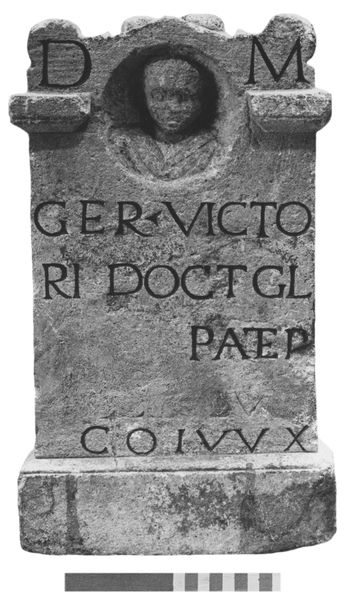
Regarding the second part of your question: Absolutely! In the world of Roman tombstones, the most common and prominent formula would be DM. This was usually set prominently in the beginning on top of the rest of the inscription (and thus is an easy way to tell what kind of inscription you are dealing with), and stands for D(is) M(anibus), sometimes with an added S(acrum). This has been translated differently, examples are "to the divine shades" "sacred to the departed spirits" "to the ghosts/gods of the dead". In any case, the general gist is that it was a dedication to the shades or spirits of the dead (or 'souls', if you will), the di manes (thus the Dative case). Sometimes, it just was a general introductory formula (when the name of the deceased followed in the Nominative case), a dedication specifically to the di manes of the deceased (+ Genitive) or to the spirits in general and the deceased (+ Dative).
We can also see a trend for this practice, since it only picks up in the julian-claudian period (after Augustus) and is unknown before that, and it becomes less prominent in Christian times - though it is sometimes found together with typically christian elements, probably the idea of di manes could be easily reconciled with christian belief in a soul.
Other typical phrases in a funerary context are HSE, h(ic) s(itus) e(st), 'here he/she lies', BM, b(ene) m(erenti), 'to the well-deserved', bene requiescat in deo patre is also known.
I can't speak to the modern history of the term RIP, but I'm sure others on here can!
Edit: Here's an example for a prominent DM (they're often found offset from the main inscription field to give it prominence), and here it's written out.
You might want to crosspost this to /r/etymology.
Sorry, we don't allow throughout history questions. These tend to produce threads which are collections of trivia, not the in-depth discussions about a particular topic we're looking for. If you have a specific question about a historical event or period or person, please feel free to re-compose your question and submit it again. Alternatively, questions of this type can be directed to more appropriate subreddits, such as /r/history or /r/askhistory.
Eliminating the second half of your question would be fine though. The latter part might make for a good Tuesday Trivia piece if that interests you though.