I've been reading up on the Vikings and noticed that they held a young death in battle to be the highest honour, but they also have been defeated in battle. I'm wondering whether they have ever surrendered, fled or deserted.
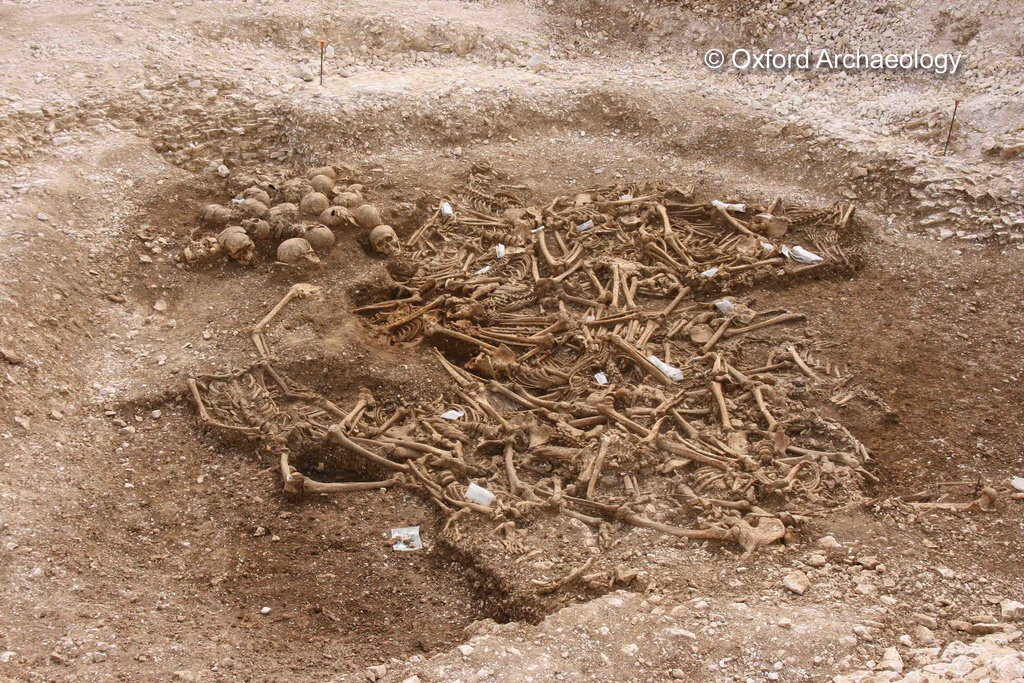
At Ridgeway near Weymouth on the English Channel, archaeologists recently uncovered the bodies of about 50 vikings. That is, they found a pile of 47 skulls next to 52 skeletons.
Some initial analysis has been done of trace elements in their bones, which show that they grew up in many different places, such as the Arctic and sub-Arctic areas of Scandinavia, northern Iceland, the Baltic States, Belarus and Russia. But by about three years before their deaths, they were all started eating a similar diet heavy in fish. In other words, this is a viking crew that was somehow captured and executed, probably late in the Viking Age around 1000.
Interestingly, there are few suggestions that these men fought or put up much resistance prior to their executions. There are no serious wounds that would suggest surrender in battle. These men were somehow captured without a fight.
The chop marks on the backs of the vertebrae and jaw bones show that these executions were messy. There's no suggestion that they were tied or otherwise bound, but some individuals did try to turn away from the blow, which only prolonged their suffering. Others took two or three poorly placed blows before the sword or axe finally severed their heads.
Whoever executed these vikings was proud of it, and they kept 3-5 heads as trophies. (There's some difficulty in getting an exact count of the jumbled bones.) This is reminiscent of the Norse practice of displaying skulls on city walls like at Dublin (human skulls found beneath the Viking Age ramparts) or on the outside farm walls as at Hofstađir, Iceland (these were cattle skulls).
The images of the Ridgeway burials are also eerily reminiscent of the bones stacked at Repton, which a viking army occupied in the winter of 873-874. Of course, there's little consensus as to weather the Repton burials were actually a reburial of bodies the vikings dug up when they occupied the monastery, whether they were dead members of the viking army, or whether they were people the vikings had executed. There's only been some isotope analysis, and the results were inconclusive and mixed.
So is this a viking crew that struggled without a fight and met a gruesome end? Almost certainly. But who executed them, when, and why? These questions are harder to answer ... but that's why I love studying archaeology!
"Cowardice" is a rather unclear term, but vikings surrendered on multiple occasions. The history of the British Isles provides several examples, for example in 980 Irish forces had crushed King Olaf's viking forces while besieging Dublin, and forced him to surrender and leave the country.
A History of the Vikings - T. D. Kendrick
There have been instances of Viking surrender recorded in The Anglo Saxon Chronicle from the 870s-880s during the reign of King Alfred. In 878, Danish forces led by King Guthrum fled the field of battle to a fortress where Alfred besieged them for a fortnight after which the Danes surrendered, gave high-ranking hostages and promised to leave Alfred's lands. Guthrum also sought Alfred's sponsorship in baptism. In 882, Alfred's forces engaged four Danish ships in a sea battle, two of which surrendered, while the other two were taken with all occupants slain.