I'm planning on joining the Middleseaxe reenactment group quite soon, and the weapon that I really like the look of is the hewing spear/partisan. These guys are pretty hard for the historical accuracy, so were they routinely used during that period?
What century(ies) do they reenact?
We know a lot about early Anglo-Saxon spears, from the fifth through seventh centuries. This is because they were frequently buried in graves, and the other objects they're buried allow us to pin down the dates in which different styles were used with some confidence. This becomes more difficult after the mid seventh century, however, because people stop burying spears in graves. Almost all the weapons that survive from between the late seventh century and the Norman conquest are stray field finds or, most commonly, finds from rivers. These are almost impossible to date because there's no context (nothing else with the spears whose dating we know), so it's difficult to say with any certainty what styles were most popular in particular centuries of these later periods. So if you want to know about spears of the early period, I can give you a very specific answer; after that, much less so.
In general, almost every early Saxon spearhead has a split socket. Like this example. Swanton hypothesizes that this split socket would make the spear perform badly as a hacking weapon because the socket would be pried open when it hit something; he's probably right, though some spears were reinforced with rivets or rings around the socket to prevent it from splitting open and falling off.
By the late Saxon period, welded sockets were more common. They wouldn't have the problem of splitting open and falling off the shaft, and might have worked better as hacking weapons. But precisely when this change happens (8th century? 10th century?) is very difficult to say.
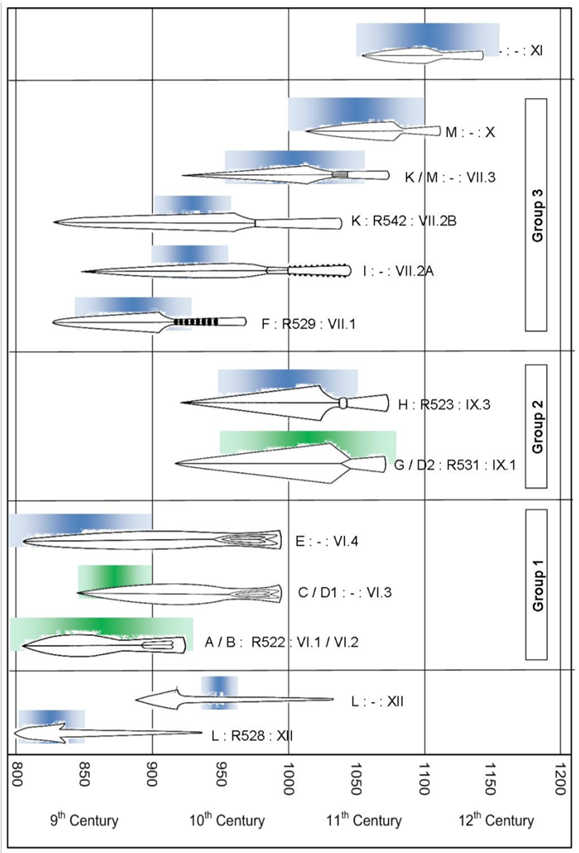
There are a lot of shapes in use in the early period. Here's a chart of the most common (I apologize for the poor image quality, google failed me here). Swanton discusses these at length in his 1973 study. Your university library should be able to ILL it for you, if you have access to a uni library (pm me if you don't). You really should look at swanton if you want to know about the early period spears.
For later spears, you're dealing with a lot less certainty. People were buried with spears in Scandinavia during the later periods, and their spears have been dated with some confidence. Similar shapes appear in England, though it's hard to say whether fashions in England followed Scandinavia closely (early Anglo-Saxon spears did not always follow contemporary continental styles).
Post a picture of the specific spearhead shape you like, and what centuries your group portrays, and I can tell you if it's defensible or not.