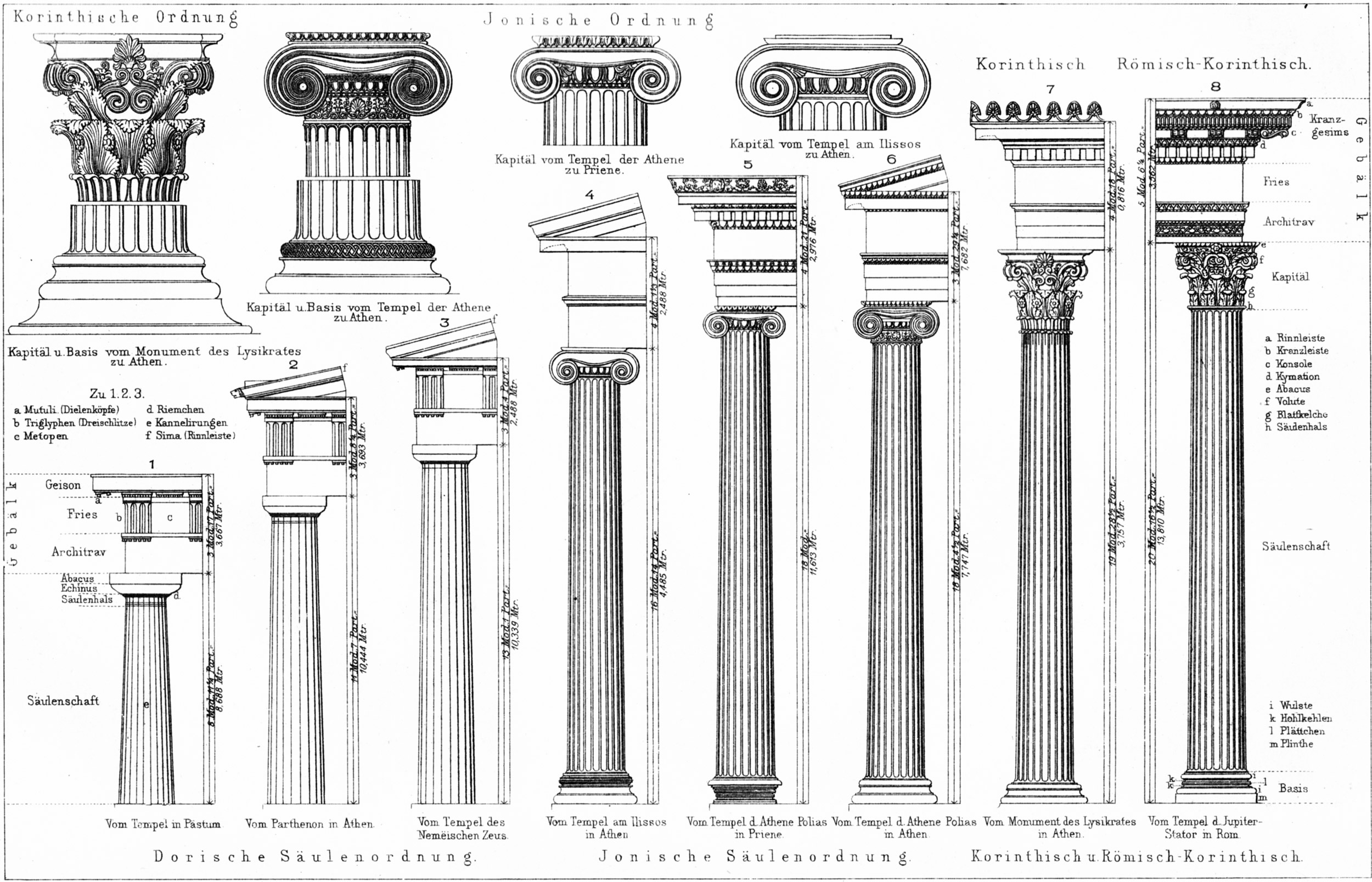
A very unscientific sample among my friends reveals that, without exception, every one of us learned about these three columns. No context to it, just that Doric columns have the square cap, Ionic have the scroll, and Corinthian are the really fancy ones. Why on earth did we all have to learn that?
CommodoreCoCo's response is excellent, but I would also add a few other points:
To expand on Comm. CoCo's mention of Washington, a great deal of American architecture, in particular civic architecture, is designed on neo-Classical architectural principles. You can see here just a few examples of the classical orders in the architecture of Washington, D.C.: Doric columns are found in the Capitol's Crypt and the Great Hall of the Supreme Court; the Old Senate Chamber of the Supreme Court contains Ionic columns; the Supreme Court building is built on the principles of the Corinthian order. Thus, knowing about the Classical orders can be a great help in understanding current American architecture, not to mention identifying important American civic buildings.
I'm not sure any American high school students are actually required to learn the differences between the orders, although I may be wrong. It's likely that you and your friends, by virtue of being friends, come from similar socio-economic, ethnic, cultural, etc. backgrounds, and so would have been exposed to broadly similar educational programs. Of course I could be wrong, and if anyone is an expert on the American high school curriculum, I would love to hear from them.
I doubt think anyone around here will disagree with me if I say that, all other things being equal, knowing the difference between the three Classical orders is preferable to not knowing them, just as knowing (nearly) anything is preferable to not knowing it. I would argue that just about anything you've come out of high school knowing is a net gain.
Also, as an aside: the curly-cue "scrolls" on the Ionic capital are known as "volutes," and they may be stylized representations of plants (perhaps clovers, like the Corinthian represents acanthus leaves), or even cushions to protect the "shoulders" of those poor columns forced to hold up a a heavy temple roof for all eternity. I favour the latter explanation purely for its delightfulness, not really for any evidence-based reason.
I actually never learned about that for some reason and I went to high school in America. I cant really answer your question but Im guessing the reason for learning it does not actually help students understand the different Greek groups in Achae, Thessaly, Macedonia, Ionia/Attic etc. and how they all differed other than the way they built their columns.
What state did you go to high school in?
Archaeologists and art historians often make architectural-linguistic analogies. Architectural style "languages" have different "vocabularies" or "lexicons" of motifs and designs which they assemble according to various "grammars." Innovative architects take these motifs and toy with them to create memorable buildings, much like a poet or novelist uses the same dictionary as every other to create their distinct art.
Doric, Ionic, and Corinthian are more than just columns; they are considered the three standard Classical orders. Vitruvius, whose work is our only surviving text from a classical architect, described these three orders, plus the Roman Tuscan order, in his De architectura libri decem. Orders governed much more than than the capitals (the things on top of the columns). As you can see in this handy diagram, they involved certain expectations of the entablature and cornice on top of the columns, the supporting base beneath the columns, and the height-width proportions of the entire building.
Within the language of Classical architecture, the orders represent different grammatical/rhetorical approaches to arranging the standard parts of speech (columns, capitals, dimensions, etc.). Tuscan is to Ernest Hemingway as Corinthian is to Charles Dickens: both authors work in the same language and medium, but each comes with certain expectations of style. Tuscan architecture sticks to the basics of Classical stylings with no embellishment, just as Hemingway was fond of short, simple words and lots of periods. Corinthian styles have flourishes on their flourishes, much like how Dickens was fond of lengthy conversational analogies and characters named Chuzzlewit, Magwick, and Ebenezer Scrooge.
It just so happens that Western architects have worked in the Classical "language" for many centuries. Just visit Washington, D.C. or any university campus and you'll see that designers are still working in these traditional orders. But of course, most of us aren't architects or art historians or archaeologists, so it's still a foreign language to us. You can't exactly differentiate Cicero and Vergil if you don't speak Latin. So, we do as one does with any brief intro to a foreign language: we teach a few basic "words" to maximize utility if that's all you come away with. If learning Spanish, you don't jump straight to conjugating verbs. You first learn basic phrases ("Hola! Como se llama?" "Me llamo Coco.") and a few operational words: questions like que, donde, and quien, verbs like es/son and esta/estan, and answers like si, no, and no se. You don't learn "Donde esta la biblioteca?" first because Spaniards are particularly fond of libraries or directions to them, but because knowing donde esta means "where is" can at least tell you the general idea of what someone is trying to get across. With knowing a few basic words, you can differentiate a descriptive sentence from an interrogative one or its reply.
Likewise, when we learn about the column capitals, it not because they themselves are the most important part of Greco-Roman architecture, but because they are the most recognizable elements of the three basic modes of Classical architecture. When you see Corinthian capitals, you can say "That's a fancy building!" When you see Doric capitals, you can say "That's a conservative, square, masculine one!" Just that little bit gets you farther than any other single detail could.
You must have gone to an incredibly upper-crust high school. I have never heard of a middle-class high school teaching those.