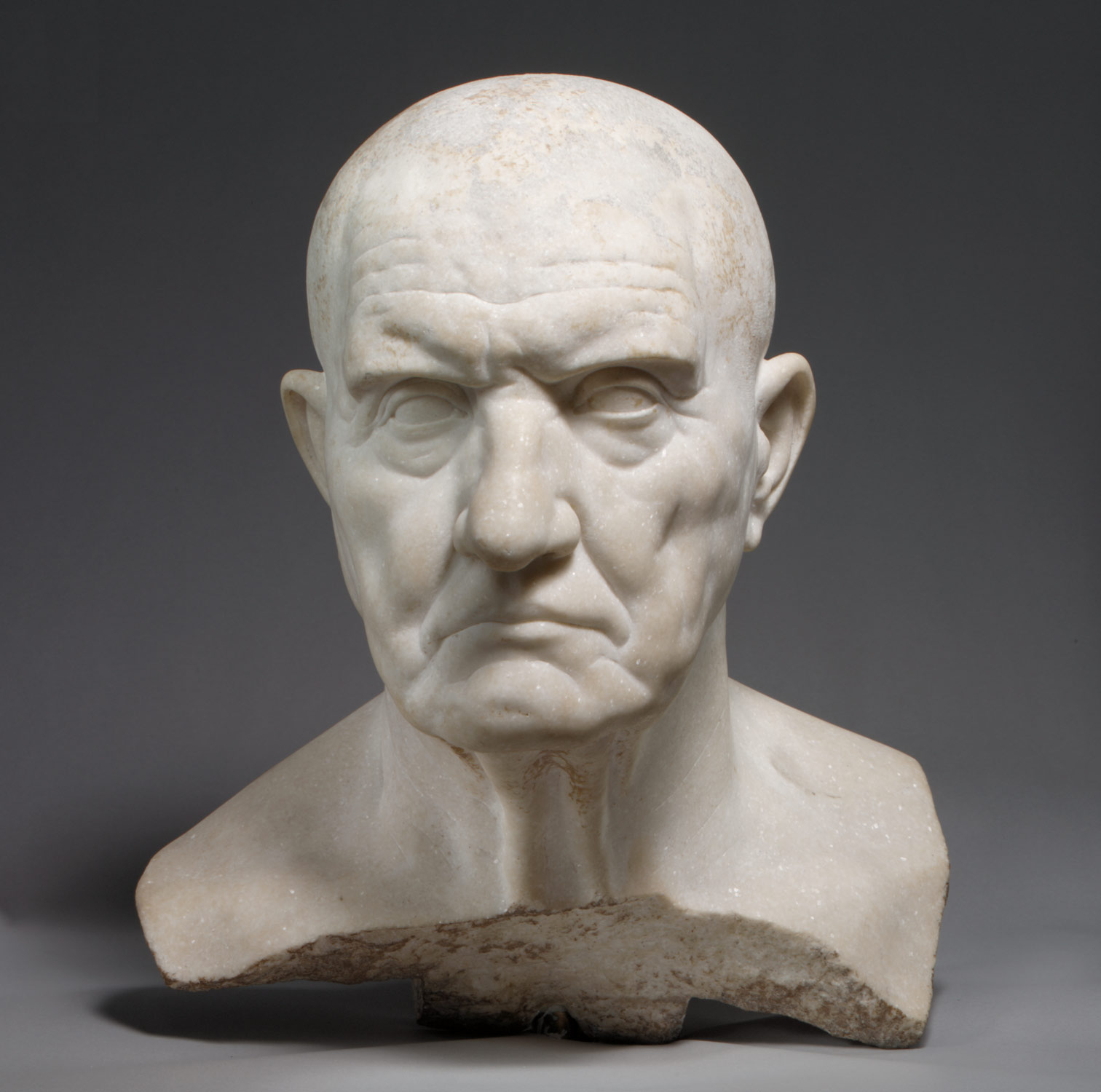
I asked this question here a while ago and got a lot of upvotes but no answers. I thought I'd ask again. I want to know how accurate they were or if they are just an artist's impression. Perhaps they were taken at the time like Wellington sitting for a portrait. Any help would be appreciated.
It depended a lot upon how much money, and/or what your rank was in the Roman hierarchy. Your family could be stuck with a wax Death Mask, which was later transferred to stone, or your family could have a bust made when when you were alive. You also have to take into account, there were a lot of really good artists at the time. So they could have easily altered the person's face to have less scars, look more angered, jovial, and the like. Though, of course, you still needed to have the money for it.
The realism in Roman portrait sculpture may well have developed from the tradition of keeping wax funeral masks of deceased family members in the ancestral home which were worn by mourners at family funerals. These were very often accurate depictions where even the defects and less flattering physical aspects of a particular face were recorded. Transferred to stone, we then have many examples of private portrait busts which move away from the idealised portraits of earlier sculpture and present the subject as old, wrinkled, scarred or flabby; in short, these portraits tell the truth. For official portraits of the ruling elite, in contrast to lower class subjects, the subject continued to be idealised, for example, the statue of Augustus as Pontifex Maximus has the emperor looking much more youthful and fresh-faced than he actually was at the time of sculpting (end of the 1st century BCE). However, by the time of Claudius in the mid 1st century CE, and even more so under Nero and the Flavian emperors, official portraiture on occasion strove for more realism. In the same period female portraits are also notable for their elaborate hairstyles and they no doubt were prime instigators in fashion trends.
For funeral busts, you'd be seeing either a plain old death mask, or something along the lines of a scenery portrait detailing some feat they had performed in life. These types of portraits were common in the second century CE, as they were more prone to bury their dead rather than cremate them.
I would like to direct your attention to two busts. One is of a middle aged man, whereas the other is of Emperor Trajan. From the description given of the middle aged man (see the third source below), it is said it is of a wax death mask showing the "traditional Roman concept of virtue called for old-fashioned morality, a serious, responsible public bearing, and courageous endurance in the field of battle." Whereas the Emperor's bust was made using the lost wax technique in which wax was used to make a clay mold. They were often embellished with silver or stone eyes, teeth and nails and copper eyelashes and nipples. The modern technique for bronze sculptures can be seen here.
Sources:
http://www.ancient.eu/Roman_Sculpture/
http://www.metmuseum.org/toah/hd/ropo/hd_ropo.htm