While you wait for more targeted answers, here are a number of relevant threads from the FAQ section on "What Did Germans Think? (About Hitler)":
What percentage of the German population actually supported hitler and agreed with his views at the time of World War 2? - 3 comments, over 7 months old.
The commenters here talk about the lack of opinion polls during the 3^rd Reich and the alternate methods needed to discern the general picture of public support throughout the regime's existence.
How many Germans actually supported Hitler in his endeavors? - 10 comments, over 1 year old.
The commenters here get into the various ways the Nazi propaganda and rule controlled the German people and further down there is a large list of sources for further reading for various related topics.
When did most Germans turn against Hitler? - 3 comments, over 1 year old.
A commenter gives an overview of the times at which German civilians, German military officers, and the Nazi Party individually became disillusioned with Hitler.
What was Hitler's approval rating throughout his reign? - 18 comments, over 1 year old.
One commenter delivers an answer with poor quality sources and other commenters identify these mistakes and talk about the difficulties in getting the information necessary to answer the question.
What kind of backlash did Hitler get for indiscriminately killing so many mentally ill and disabled people? - 3 comments, over 1 year old.
A commenter delivers a sourced answer talking about the particular organization and methods used in the Nazi euthanasia program that shielded it from the public eye and criticism.
During WW2, how did the German civilian population respond when reports from the concentration camps hit the common people? - 26 comments, over 1 year old.
The commenters here debate the awareness of various German demographics about the Holocaust and German opinions on the matter.
Were there any groups in German society who opposed the Nazis for moral reasons? - 2 comments, over 1 year old.
The commenters focus on two prominent examples and also give a list of sources for further reading.
How effective was Nazi film propaganda on the German public? - 3 comments, over 1 year old.
A few examples are brought up and another user discusses the specific reactions that the Nazi propaganda specialists wished to garner from the German citizenry.
Did Germans see really see Jesse Owens dominance at the Berlin Olympics as a blow to there theories of racial superiority? - 7 comments, over 1 year old.
This thread briefly discusses the incoherence of Nazi racial theory and how it changed as the Second World War raged on.
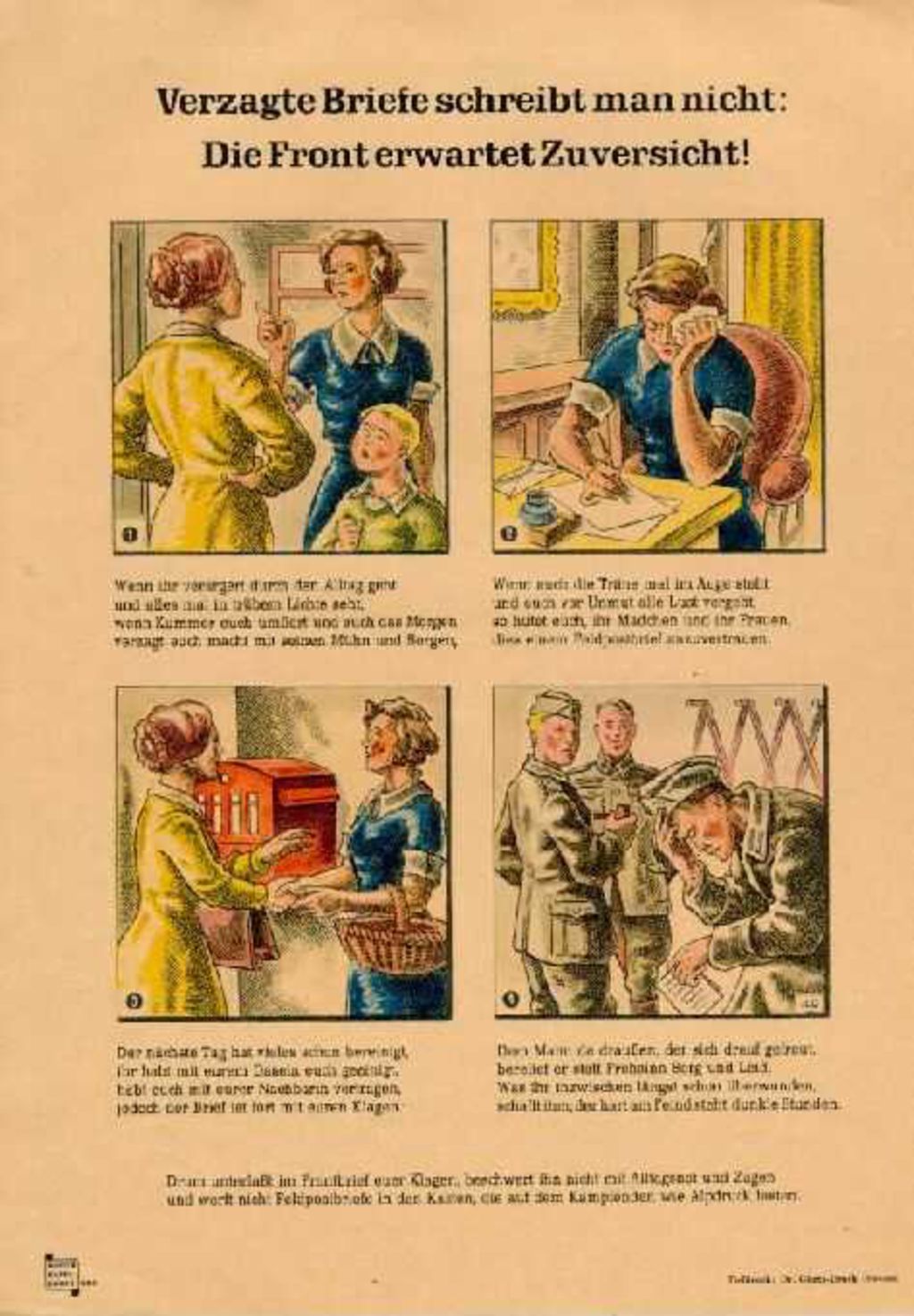
During the war, it was strictly forbidden for soldiers at the front to write in their letter about the actual situation and especialy about their feelings. There had been flyers that were given to the soldiers in order to inform them to only write positiv things, for exampel this one from around 1942: https://www.dhm.de/fileadmin/medien/lemo/images/d2a09021.jpg
The headline can be translated as something like this:
"Sad letters should not be written: Courage is needed from (and at) the front."
The writing under the pictures is to small for me to read but I remeber that its something like:
Don't forget your loved ones at home and what you would do to them with sad news. Write them that you are good, that you have enough food and that you love them and will be back soon after the victory. Don't let them fear about your life at the front, because rumors are fast at home and fear is an enemy for our people and our soldiers.
Hope that helps a little.
When things were going well, reporting on the war was more or less factual - for instance from the beginning of Barbarossa until Typhoon Goebbels could boast of an (almost) unbroken string of victories, until In October '41 the Reich Press chief held a conference (as directed by Fuhrer HQ) to announce that the war in the east was 'over'. The German people had initially been skeptical of a quick victory over the USSR, but after such huge apparent success were quite optimistic - from Goebbels' diary at the end of September:
The depression is now completely gone. At times the mood of the people goes far beyond the real possibilities. Once again one hopes that this winter the war will be over and we have very much to do in the next weeks to pull back the now extreme optimism to a normal level.
And a week later after a speech by Hitler that had all but announced the success of the Wehrmacht in the east:
Internally the Führer's speech has worked like a wonder. All criticism, all pessimism, even all the anxiety has disappeared completely.
And a SD (Sicherheitsdienst - 'security service') report of German public opinion on 9 October:
Much more widespread therefore is the notion that the last few victory proclamations are the beginning of a greater series of successes, which should bring the final decision in the east within reach.
There are examples of the ordering of fireworks and printing of posters to celebrate the coming victory in Moscow, and German bookshops began stocking the shelves with Russian grammar books (presumably to serve the officials and colonists soon to be occupying the conquered territory).
Interestingly this virtual hysteria made Goebbels uncomfortable, on 9 October he wrote:
The news is almost too positive and too optimistic. When, for example, the press are given the headline: “The War Is Decided!” that surely goes too far. I hope to God that the military operations develop so that we don't suffer a psychological reverse.
Soldiers experiencing the events first-hand were not always entirely convinced either (though some surely were), as one wrote in his diary:
On the radio we heard news of the victorious encirclement battle near Vyazma and Bryansk. The Eastern campaign has been practically decided. The remnants of the Red Army are one step away from annihilation; the Bolshevik leaders have fled from Moscow. Is the end in sight for the east? We hear this and even more over the loudspeakers; surely this will be the headline in the daily papers at home. I grab my head; how is this possible, has our leadership gone mad overnight? All of this is not true, it cannot be true; all of us here see too clearly what is going on. Do these gentlemen have blindfolds over their eyes!?!
Goebbels was frustrated that the public was not sufficiently discriminate between a 'decision' and 'end' to the war (so while he believed the Soviets were beaten, he acknowledged that combat operations would most probably stretch into the next year, while the public was expecting it all to end any minute) with a new strategy - comparison with well-known historical events which illustrated the point he was trying to make:
We will refer to the example of the Prussian–Austrian war of 1866 and the German–French war of 1870–1871. Here also the decisions were reached at Königgrätz or Sedan and the wars still went on.
The tone of press announcements became more circumspect, as noted by some perceptive civilians, like Mikhail Sebastian (a Romanian Jew):
A slight, almost imperceptible lowering of the tone in today's papers . “The Hour of Collapse Is Near,” said one headline in Universul. Yesterday the collapse was already an established fact. But the fact is that fighting is still taking place. This evening's German communiqué says that the destruction of Bryansk and Vyazma “is proceeding”.
And the Wehrmacht diarist quoted previously (Hans Roth) recorded:
Again, powerful snowstorm. All of a sudden there is a deep freeze, 7º C below zero! The roads are frozen solid. We would be able to advance if, yes if, there was any fuel! Gas and supply trucks are still far behind, somewhere stuck hopelessly sunk into the mud. About sixty per cent are somewhere stuck in the mud. That's right; this is what a victorious march forward looks like! And the muddy season has only just begun, and already after two days of rain we have these losses. All of this does not fit quite well with yesterday's victory fanfare!
American journalist Howard K. Smith who was living in Berlin commented:
From now on a wall of distrust separated the ministry of Dr Goebbels from his people. The shepherd boy had hollered “Wolf!” too often.
Indeed, during this period, sales of newspapers dropped and a threefold increase of Germans listened to outlawed foreign radio broadcasts was recorded - mainly from London and Moscow.
David Stahel describes a cartoon circulating in Berlin at the time (in his excellent book Operation Typhoon):
A more tangible manifestation of such scepticism came in the form of a darkly humorous cartoon, which was discreetly circulated around Berlin. It pictured a German soldier standing up out of his trench and holding a sign to the enemy which read: ‘Russians! You have ceased to exist! Dr Dietrich’[the Reich press chief]. In the next picture the soldier is hit by a Soviet shell and is in the process of being blown apart. At the same time, down in the trench, a German officer turns to his puzzled-looking general and states: ‘Stupid, these Russians, they apparently don't understand a word of German!’
Goebbels confessed:
our victory news is no longer accepted with the required attention and necessary importance because our most recent communiqués have already anticipated the final victory.
The BBC Foreign Service played the sound of a ticking clock, and asked the listeners in German:
Every seven seconds a German dies in Russia. Is it your husband? Is it your son? Is it your brother?
By the end of October and SD reports of public 'disappointment' Goebbels was beginning to acknowledge the probability of a stunning propaganda reversal/defeat:
At the moment the general situation offers little joy. Even though considerable progress is made here and there the planned grand offensive, which was supposed to lead to a complete annihilation of the last battle-worthy Bolshevik divisions, is currently stuck in the mud . . . Gradually it seems necessary to me that we and also our people need to abandon the idea that in this winter the ambitious objectives will be obtained and start anew in the coming spring. ... The damage caused from a somewhat too optimistic assessment of the situation has to be corrected as soon as possible.
After the war in his memoirs Walter Blumentritt (4th Army) claimed that:
We discovered to our surprise and dismay that the defeated Russians had not ceased to exist as a military force, and the intensity of the battles increased every day . . . All this came as a complete surprise to us. We could not believe that the situation had changed so radically after our decisive victories when, it seemed, the capital was almost in our hands. The troops recalled with indignation the bombastic announcement made in October by our Propaganda Ministry.
The propaganda prematurely trumpeting the success of Operation Typhoon (the attack on Moscow) marked the high point of Nazi prestige and public popularity (as well as their menace as perceived by the outside world), and when it failed it represented a blow to public and military morale in Germany from which it never recovered.
Nazi propaganda tried to spin the facts as positively as possible. As an example, here is a German newsreel that covers the D-Day operations.
Where that was not possible, they stressed the heroic sacrifices of the Germans which should serve as a call to arms and an obligation to fight and work as hard as possible. As an example, here a collage of newspaper headlines (mirrored from http://www.buecher-ernst.com/) after the fall of Stalingrad. The headlines read "They died so that Germany may live", "Everyone fights, as long as he can wield weapons" "Shoulder to shoulder until the last round is spent" "Imortal honor for the banners of the 6th army" etc.
Regarding support and morale, the best sources might be reports of the Gestapo (secret police). IIRC, they tried to sound out the public opinion of ordinary Germans on a regular basis. Arguably, they were in the best position to do so, but I found no wartime reports online. OTOH, the Social Democratic party of Germany exiled to London also collected reports from within Germany. Here an example.
For major setbacks like Stalingrad and D-Day, German civilians absolutely knew about the setbacks themselves. Granted, there was always propaganda around them (like others have mentioned; i.e. the 6th Army fighting to the death at Stalingrad rather than surrendering). Almost immediately following the surrender of the 6th Army, normal radio was interrupted with a broadcast announcing the German defeat.
As for support throughout the war... At the start in 1939, there were mixed emotions, even among the General Staff. Walther von Brauchitsch thought Hitler was leading Germany to its doom. Some doubt, some optimism.
1940-1941, there were mostly feelings of elation. Germany had spectacularly conquered France, and Germany's prestige loss in the aftermath of WWI had been restored.
1942, still optimistic, but also some concern.
By 1943, it began to become apparent to most people that Germany was going to lose the war.
(There are obviously a lot more thorough answers than mine; I just wanted to give a concise answer to the question.)