As far as I can tell, the guys in the front rank were exponentially more likely to get shot than the guys in the rear. Would the commanding officers place their most experienced veterans in front? Was it seen as an honor to be in the first rank? If i were a soldier in this time period, I'd at least try to stand in a spot that had two or three rows of comrades in front of me to absorb enemy fire, as shitty as that sounds.
According to the drill manual used by the Continental Army during the American Revolution, placement in the line-of-battle was determined by height. Shorter soldiers generally stood in the front rank, so that their comrades in the rear rank would have an easier time firing over them. In each rank/row, taller soldiers stood on the flanks, with shorter men at the center. At a distance, this would create an optical illusion that every member of the line was roughly the same height.
A soldier's rank determined where he would stand in line. This diagram based on the Continental Army regulations devised by Baron von Steuben shows the position of each officer and NCO in an ideal regiment. The numbering of the companies was usually based on the seniority of their captains - the 1st Captain's company would be the company led by the captain holding the earliest commission.
Note the level of detail in that diagram. Officers were often to keep a precise number of paces apart from the main line. Moving these intricate formations at speed without losing cohesion took a lot of training, and it was this training that von Steuben brought to the army at Valley Forge, not, as the History Channel stupidly portrayed, physical training on an obstacle course or some such nonsense. Warning: literally everything about that video clip is terrible.
Alright I'm going to build off of what /u/TRB1783 said and progress us about 100 years in US history to the American Civil War. For reference I will primarily use Hardee's Manual, the predominant training manual of the time, as well as much clearer visual references from Gilham's Manual and Casey's Tactics.
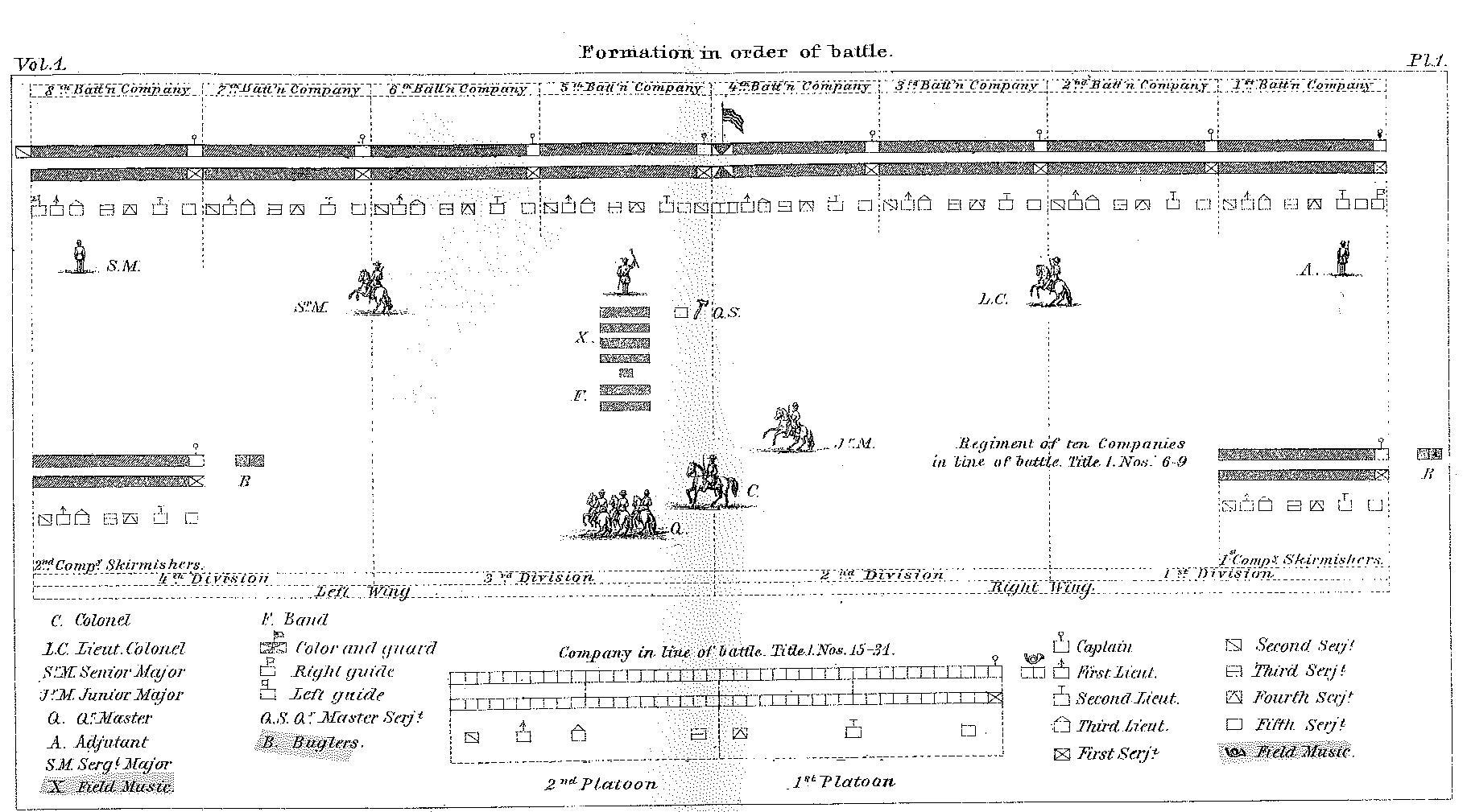
Let's start with the reference image of a line of a regiment in line of battle taken from Casey's Tactics. Casey's Tactics was written during the war and seems to be heavily based on post-Napoleonic French Tactics. There are a few issues to point out. There was no such regular position of Junior Major since there was only one Major in the Regiment. The company numbers do not correspond to their lettered designation but were instead just an easy way of labelling them in battle. In actuality they are a bit jumbled up. From right to left they were A, F, D, I, C, H, E, K, G, B (per Hardee's). Also the skirmishers would have been about 500 yards in front of the main body of the regiment.
This table adapted from Gilham's Manual is a bit easier to visualize and shows the whole company. Hardee's Manual describes a similar line of battle from the regiment.
Position in the line of battle beyond rank is based on height. The tallest man and tallest corporal formed the first file on the far right. On the far left was the shortest man and shortest corporal. In between the men were ordered by height with the taller of the pair at the back.