No, it was not.
Celluloid Mushroom Clouds: Hollywood and the Atomic Bomb by Joyce Evans discusses this briefly (and I imagine /u/RestrictedData might have other suggestions), but both the 1957 book and the 1959 movie were more nihilistic than most predictions. Eisenhower's cabinet, in fact, was alarmed enough by the popularity of the movie that members were concerned it would encourage a "ban the bomb" movement. Moreover, even then, experts knew enough about fallout and the weapons then available to say that even if every 1959 atomic weapon was used successfully, human beings would survive.
About the time of On The Beach, perhaps the best-known nonfiction work about atomic warfare was Herman Kahn's On Thermonuclear War, which was published in 1960 after a series of lectures the previous year on the topic. That book is technical, and it doesn't give you the answer you're looking for, since it's built with the knowledge that war is impossible to predict. There are too many factors involved to say how many weapons will be used, and on what targets.
Still, Kahn talks at length about radiation and genetic damage, coming to the conclusion that even under high-yield scenarios, there will only be small increases in the number of children born with defects.
As an aside, if you're looking for other nuclear war fiction written at that time, you might consider Pat Frank's Alas Babylon, which is more a "cosy catastrophe" type of fiction.
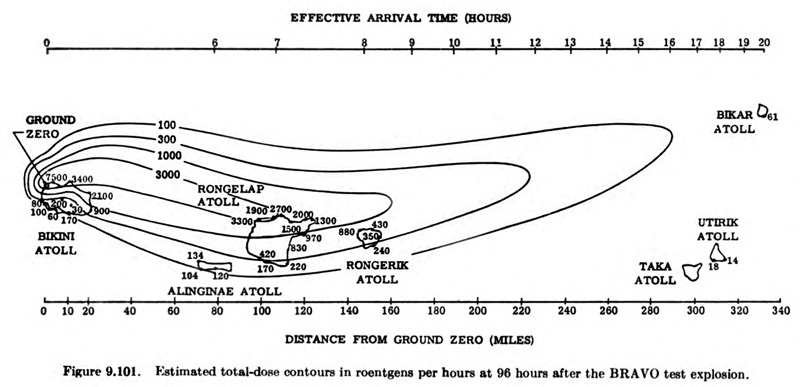
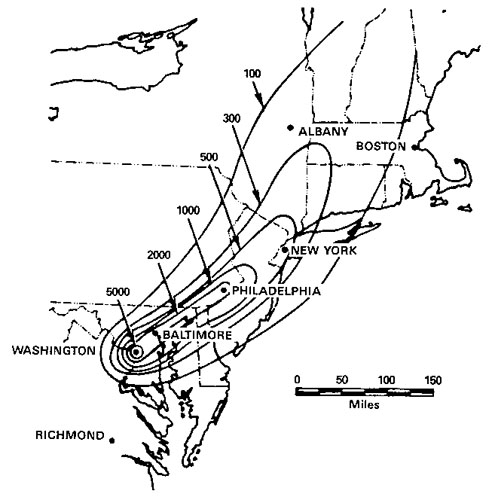
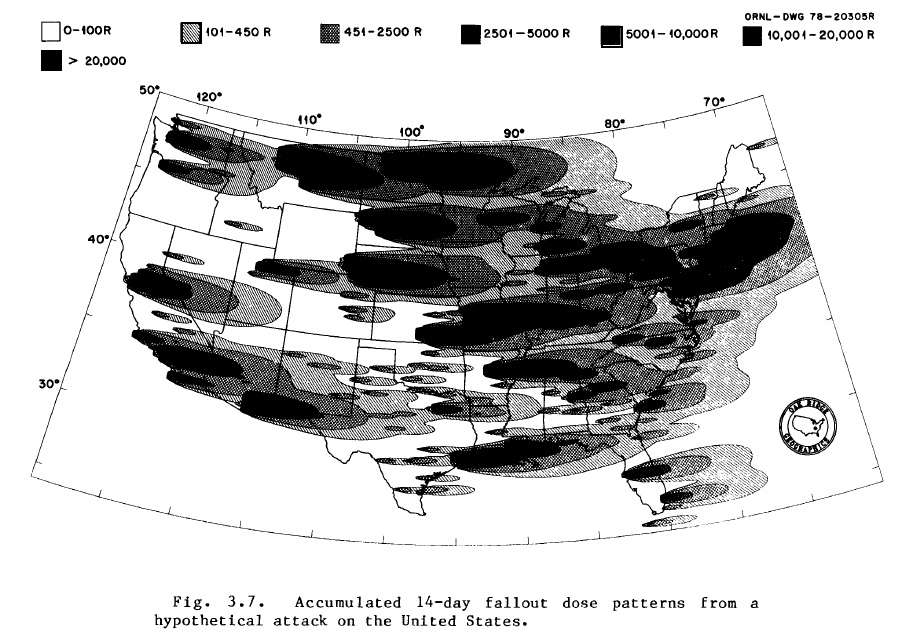
On the Beach implies that a large-scale nuclear exchange will create massive roving clouds of deadly radioactivity on a global scale. This has no scientific backing. While deadly radioactivity (fallout) does result from nuclear blasts, and the areas affected can be quite large from a human scale for multi-megaton blasts (e.g. here is the Castle Bravo fallout pattern, and superimposed on the Atlantic seaboard — any number 500 or over is pretty acutely deadly, any number under that becomes just contaminating/adds to background cancers), from a global perspective these are quite limited. A major nuclear exchange would spread a lot of radioactivity on the countries under attack and those immediately near to them. But those clouds do no remain that radioactive long enough to be acutely deadly across the entire planet. There is such a thing as global fallout — and you can trace the passage of the radioactivity across vast distances — but it is much much lower in activity than the "local" fallout. It can increase background cancer and birth defect rates but would not acutely kill people.
In the 1950s there were some calculations that suggested that on the order of 10 gigatons of nuclear detonations would increase the global background radioactivity to dangerous levels, but these were later revised upwards. This is about the closest one comes to a real On the Beach scenario.
Now this is not to say that global nuclear war in the 1960s would not lead to massive, global problems. They would, but they would probably be of a climatic variety, not a radiological one. Nuclear winter, not deadly clouds of radioactivity traveling the globe. But that understanding did not come until a bit later.
The TLDR; of this is, it's not especially accurate, it misunderstands the nature of the radioactive threat, but there are in fact global effects of a major nuclear exchange, just not the ones highlighted in that film.
Just one small note: In On the Beach, there were no destroyed cities, no dead bodies.