Recently I've been reading about the trojan war and stumbled onto a character named Memnon, and it stated in the wiki that he was from a land called Aethiopia. After looking into this place I found out that the mythical princess Andromeda(mythical damsel in distress from the story of perseus) was also from the region.
From here on I may be wrong but this is also what I found:
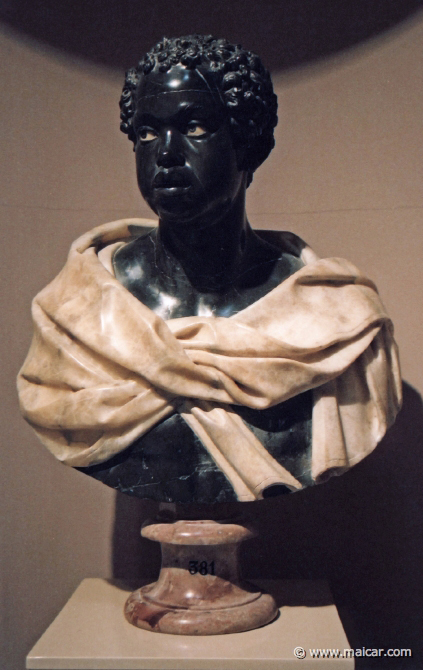
It seems that the romans equated it to be in subsaharan africa along the red sea, since the etymology roughly translates to "burnt face". Even to this day Memnon is depicted to be african.
However it seems that the greeks may have placed it in the Hittite kingdom near troy since they claimed it was in the east and all their Aethipian depiction show them to be caucasian. Memnon's father is said to have been born a trojan and nothing tells us that perseus traveled to africa to save the princess of Aethiopia.
The "Aithiopes" in early Greek thought are in two (or strictly speaking three) different places. As a result ancient Greek writers got a bit confused over this too -- so don't feel too hard done by.
It seems that the term "Aithiopes" was originally used for a mythical people living at the rising and setting-places of the sun. That's what we're explicitly told near the start of Odyssey book 1, for example, where we're told that Poseidon is away being hosted at a feast by the Aithiopes, and it's implied again later on when Poseidon returns from his feast via Anatolia (i.e. coming from the east). This is the origin of the name, which in Greek means "burning-faced people". And this would usually be the homeland of Memnon, who was the son of the dawn goddess Eos.
However, the name was extended to refer to the people of southern Egypt and living south of Egypt, too, presumably because of their striking skin-colour, and this shift in meaning occurred at a very early date: explicitly for the first time in a 6th century BCE writer called Hekataios, but there seems to be a trace of this in the Odyssey as well: at one point we're told about Menelaos visiting Egypt and then the Aithiopes, implying that they're neighbours. So we get both variants of the Aithiopes in a single poem. If you'll excuse a moment of speculation, I'd suggest this extension of the name's meaning could be linked to Kushite dominance in Egypt in the 25th dynasty (mid-8th to mid-7th centuries BCE) bringing Nubians into a limited degree of contact with Greek culture, in a way that hadn't been the case previously.
There's just as much confusion in later writers, such as geographers, who weren't sure how to reconcile the two variants of the Aithiopes. I don't have access just now to a reference work for pictorial depictions of figures like Memnon and Andromeda -- ostensibly members of the purely mythical Aithiopes --, but I wouldn't be at all surprised if some ancient representations depicted them using tropes associated with the historical Nubians. Myth just isn't tidy.