https://www.youtube.com/watch?v=RO0SARWYiJc
To me it comes off as biased in favor of the revolution.
There are tiny hints. Occasionally you'll see a single woman in that total black covering that stands out a little from the crowd, and carries a gun or something who are fairly obviously supposed to be in some kind of security role, maybe monitoring the crowds, or driving the crowds.
I'm certainly not saying that the shah was everyone's friend. And the intro does admit that "it descended into score settling, death squads, and chaos"... but, for instance, I think one of the crucial problems, is that they seem to frame the revolution itself, and it's demands as coming from "the people"...
I'm sure there was some popular support for the overthrow of the shah. And certainly, with supporters of the revolution, the US was not popular, but how accurate is it? What do they get right? What do they get wrong?
edit It looks like the closest the concorde got to iran was bahrain. I suppose they could relay it passing it from plane to plane, but that seems even more ridiculous.
The revolution in Iran was genuinely popular. It covered a cross section of the population with liberals, secularists, women, orthodox muslims and others all uniting in opposition of the shah. In this sense we should not be mislead by the ideological narrowness of the theocracy that resulted from the revolution; while it was and is decidedly exclusive, the movement behind the revolution itself was remarkably inclusive.
This clip is a generally accurate if simple record of Iranian history. For example, many histories (including this one) paint the shah as universally reviled, but some of his policies were well-liked. For example, the lower class (peasants) liked his land reforms when they were unveiled. Dislike of the shah built and built over time rather than existing at a constant high. This clip also leaves out important antecedents to the revolution, like the Tobacco Protest, the Shah refusing to hold elections, inflation, and corruption, among other things.
Regarding the US and the West, Nikki R. Keddie says "western values did not trickle down to the popular classes any more than did significant benefits from the modernization program. Ultimately the vast majority of Iranians became more anti-Western, more anti-Shah, and more open to oppositionists who stood against the shah, the West, and Western ideas" (135).
Nikki R. Keddie, 2006, Modern Iran: Roots and Results of Revolution. New Haven: Yale University Press.
Oh boy, overall the intro is sort of accurate in the grander scheme of things, however it has many, many points wrong, some of which I'll list below:
Shah Mohammed Reza Pahlevi wasn't put into power in 1953, he was king since 1941 after the Anglo-Soviet Invasion of Iran. Iran was a Constitutional Monarchy at the time, the Shah ruled while the Prime Minister had control over Parliament and such. The 1953 coupe resulted in the over through of Mossadegh, the Prime Minister at the time, which allowed the Shah to gain more power over time until 1979. Big difference.
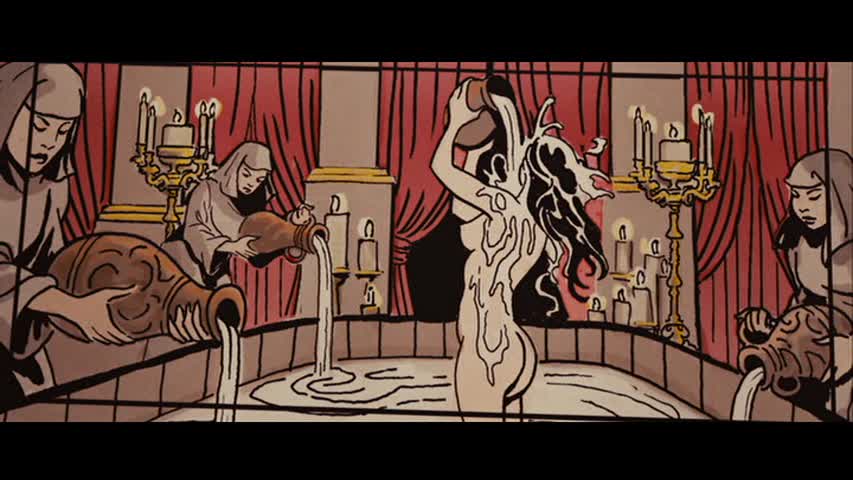
The Shahbanu, aka the Queen of Iran (wife of the Shah), is rumoured to bathe in milk. This may sound like opulence to non-Iranians but in reality bathing in milk was thought to help with aging and skin care. Women in villages in particular did this practice. What it tries to show via the picture in the intro is the contrast between the veiled servants compared to the naked princess bathing in milk, which is more out of the movie 300 than reality.
There is no record of the Shah ever owning a Concorde plane (which was put into commission in 1976, three years before the Revolution), much less using one to fly his lunches into Iran every day. While Iran Air, the national airline of Iran, ordered a set of Concorde jets in 1972 they were scrapped after the Revolution. On a side note the Shah was known to have many dietary restrictions, including an allergy to caviar.
Also it was unlikely the "people starved" in Iran, far from it. At the time Iran was one of the fastest growing economies in the world and due to the White Revolution beforehand land reform allowed property and land to be distributed to the lower class. On another note the White Revolution reformed the education system in Iran, especially in regards to universities.
The movie implies that the Shah was given asylum to the US and stayed there, however he was allowed to enter for medial treatment in New York (he had lymphoma). However Carter kicked him out of the US less than two months after his arrival, due to US hostage crisis.
The movie also implies that the Revolution was based around Khomeini and his ideals with no other opposition or organisations. Prior to Khomeini's return in 1979 protests were organised by many groups of people. Some groups wanted less reform and to slow things down, others wanted more reform and to make it more liberal and secular. There wasn't just one central theme behind it, however when Khomeini returned to Iran he was able to successfully organize and crush almost the entire opposition to the idea of the "Islamic Republic".
I'll post more in the morning but in short Argo is a typical Hollywood movie, with inaccuracies and all.