If dropping the bombs hadn't worked to force a Japanese surrender, or the bombs hadn't been ready yet, was there a plan in place to invade?
What would the plan have looked like?
Who would have led the invasion?
When would it have taken place?
Our invasion at Normandy was into an allied country with friendly civilians, how would we have treated the Japanese civilians who would have been hostile to the invasion?
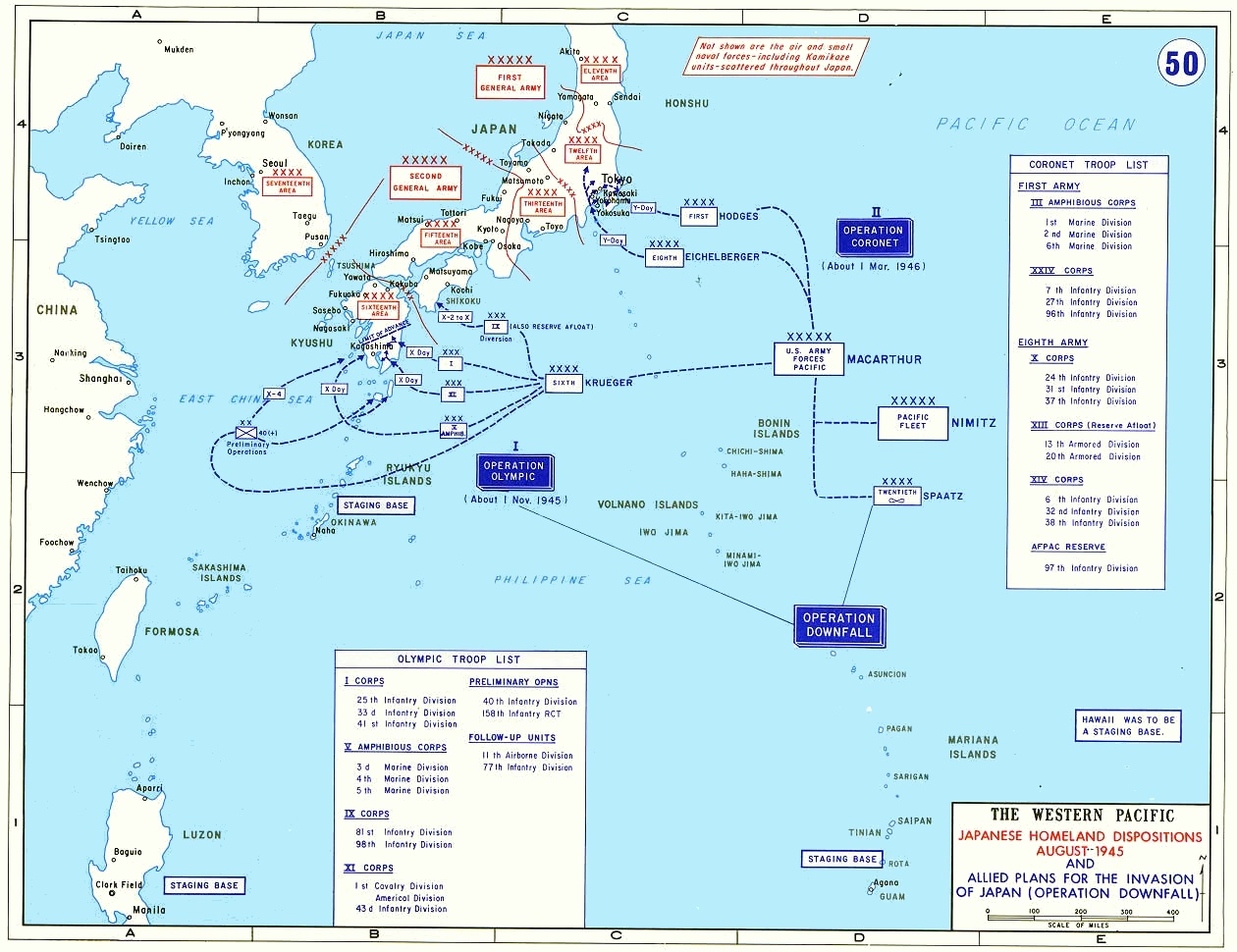
So, as /u/cazador5, stated, the plan was called Operation Downfall, which was the collective term for Olympic and Coronet, the two separate landings on the islands of Honshu and Kyushu.
Olympic would have been the first of the invasions. Ketsugo, the Japanese plan for self defense, would have included literally thousands of Kamikaze strikes, they were also planning on utilizing civilian defense forces often armed with next to nothing. Both plans recognized that the difficult terrain and logistics for both sides would have quickly reduced the fighting to a relatively small pocket for the Allies before winter set in. Fighting was anticipated to be terribly fierce and brutal. It did not help matters that after the war, it was discovered that Japanese planning had anticipated the Allied plans down to almost the exact landing beaches.
It's an often cited fact that so many casualties were anticipated that several hundred thousand Purple Hearts, the American wound medal were made in anticipation, but never used. In fact these medals which were planned for this invasion, are still used today to be given out for recently wounded soldiers.
One fact, often overlooked in the study of this Operation as well as debates about the use of the nuclear bombs were two factors.
1.) Japanese infrastructure. 2.) Japanese agriculture.
The collective Japanese rail structure throughout the main islands were connected together by, get this, no more than 20 key bridges (17 if I remember correctly). Due to the mountainous terrain of Japan, these few bridges held together the entire rail system which had to cross valleys, canyons, rivers, and other obstacles. The allied plan included destroying these bridges to prevent troop and supply movements. Should these bridges have been destroyed, the logistics of the Japanese military's home defense would have been fatally crippled.
Fortunately these bridges did survive, which leads us to our other variable, agriculture. Japan before the war, and of course throughout the war imported a major portion of it's food supply, especially it's staple food: rice. By 1945, only 300,000 tons of rice were able to be imported from outside the country due to the complete devastation of it's shipping fleet. Domestic rice production fell short in 1942 and again in 1944, wiping out reserves. Rations by the end of July 1945 for Japan hovered at the 1000 calories a day mark and were even then being reduced! Even with the atomic bombs being dropped, and the Allies occupying Japan, during 1946, half the time, the Japanese citizens of Tokyo did not receive their full ration allotments, which by then were floating around 800 calories. That's with a semi-functional and recovering distribution system supported by the Allied occupation forces.
If Downfall had occurred, those bridges and rail lines would have been destroyed, any further shipping would have been cut off especially as the Allies freed areas of Indo-China, Korea, and China proper from Japanese control. With the already existing shortages of food, along with the destruction of any distribution systems, it's entirely likely that Japan would have suffered widespread famine and it's associated diseases.
In fact there was! I'm not an expert on this particular moment in history, but I know that there was a plan for Operation Downfall - the ultimate invasion of the Japanese home islands. The plan, if attempted, would have been the largest amphibious operation in military history, because of the necessity of breaching the Japanese islands in force. Here is a map of what the operation would have theoretically looked like from a strategic view. While planning was stunted because of the eventual use of the atomic bomb, it still would have been a massive undertaking with millions of allied troops involved. Projected civilian and military casualties were in the millions.
I can't answer many more of the questions with any accuracy, but American experiences on Okinawa, where the civilian population was actively hostile and refused in many cases to surrender (sometimes choosing suicide instead) indicate that the resistance would have been fierce from both military and civilian populations. It would have been a whole other ballgame from the Normandy invasions.
One interesting thing I have heard from some professors was the idea that the US was actively placating the USSR in terms of European territory in order to gain support in terms of manpower when it came to an allied invasion of Japan. The USSR had massive troop formations that may have been necessary in light of what could be an absolute meat grinder of an invasion.
Hell To Pay by D. M. Giangreco is a good read and a pretty comprehensive analysis of the situation, if you're looking for further reading.