Not only before Europeans arrived, but after as well. The various Mississippian societies extended over a broad swath of eastern North America, and of course there were "reasonably complex" non-Misssissippian societies in other parts of the continent as well, which we could get into later if you're interested.
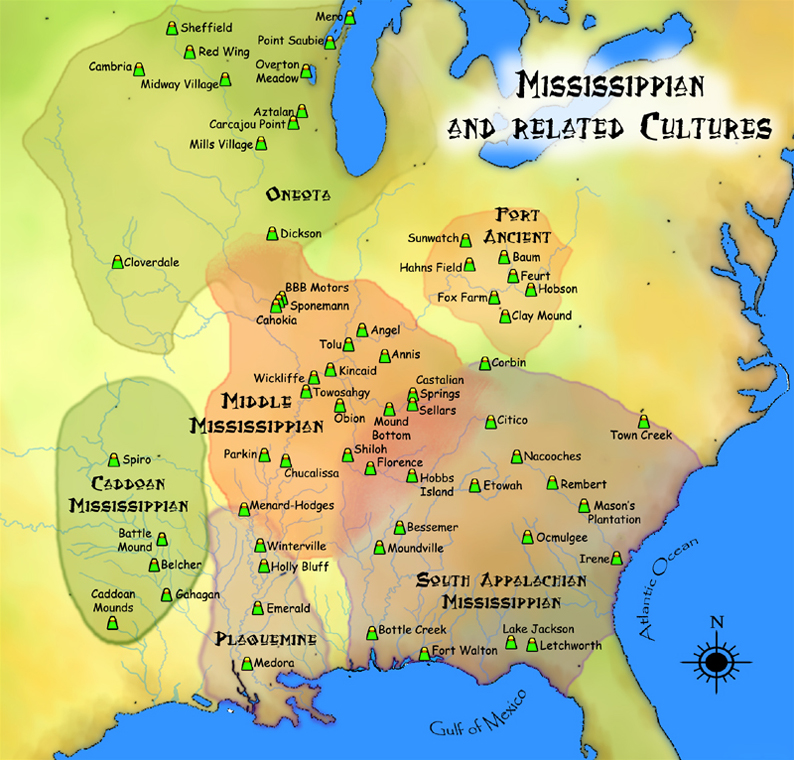
The basic, large-scale cultures within the broader Mississippian sphere, as recognized by archaeology, are shown on this map. The blobs here don't represent individual nations, but collections of related ones. Also, for a bit of clarity, on that map Oneota and Fort Ancient are the "related cultures;" Plaquemine isn't explicitly labeled as Mississippians but descendants of the Plaquemine tradition contributed greatly to modern understandings of Mississippian societies. To qualify as a "Mississippian" culture, you basically have have a maize-based economy, employ the iconography of the South Eastern Ceremonial Complex, build earthen pyramids for temples, tombs, elite residences, etc., and have a political hierarchy with a paramount leader at the top.
Cahokia, east of present day St. Louis, is generally regarded as the largest Mississippian city. Around 600 CE, it was just one of many large towns in the middle Mississippi that had recently adopted maize-based agriculture. Maize had been introduced to eastern North America several centuries earlier but it seems to have been a novelty until the Middle Mississippians developed a variety that could be employed as a staple crop. At which point, it was added to and became a central part of the pre-existing agricultural system of eastern North America (often, people will say that it replaced the old system outright, which isn't exactly true - old crops like squash and sunflowers continued to be important, and while other plants like goosefoot and marshelder became less important than they had been, they were still planted).
Around 1050 CE, old Cahokia is radically restructured and its population skyrockets. The people of Cahokia begin a phase of rapid monument-building, first constructing a new Grand Plaza, then building several earthen pyramids around it. The most famous of these is Monks Mound, the largest pyramid north of Mexico with an area at its base larger than even Egypt's Great Pyramid (it's not as tall as the Great Pyramid, however). Surrounding this central precinct of the city was a palisade, which was rebuilt three times over the life of Cahokia, each time with different bastion styles. While the wall definitely evokes defensive themes in its design, we don't find any evidence of warfare in Cahokia itself, so it doesn't seem like attacks on the city were the reasons for the occasional re-designs. This overhead reconstruction of Cahokia should give you an idea of what it looked like.
At its peak around 1200 CE, its population might have been as high as 50,000. It's influence definitely extended over other large sites in the vicinity, including Mound City in modern St. Louis which was about half the size (in terms of its number of pyramids at least; whether this reflects the population is uncertain, since Mound City was destroyed as modern St. Louis expanded over it before any detailed archaeology could be done). Cahokia's influence extended eastward into central Illinois, where small farming communities helped keep the city fed. In southern Illinois, the various communities surrounding the Mill Creek chert quarries were likely subjects of Cahokia too, due to cultural similarities between small "administrative" sites like Hale and the importance of Mill Creek chert in the Cahokian economy. Nearby Kincaid, though larger than the Mill Creek sites, might have also been subject to Cahokia, or at the very least, closely affiliated with it by other means. Continuing south, we know Cahokia had trading partners in the Ozarks. Looking north and west, we know less about the Cahokian sphere of influence. There are a few sites to the north, such as Aztalan and Red Wing on the first map, that are strongly affiliated with Cahokia-era Middle Mississippians despite being deep in Oneota territory. These seem to be trading outposts to funnel northern resources like copper south to, among other places, the many copper artisans of Cahokia.
During the late-1200s, Cahokia goes into decline, with the population dispersing into increasingly more distant outlying communities with fewer Mississippian traits, until they stopped being "Mississippian" in the archaeological sense. As Cahokia becomes weaker, the Angel site in southern Indiana becomes more prominent among the Middle Mississippians, extending its influence along the Ohio River from the Falls of the Ohio (modern Louisville) at least as far Kincaid if not all the way to the Mississippi. Angel would remain one of the dominant powers in the area until around 1450 CE, at which point the people of Angel seem to have adopted a more confederacy-style of social organization like the neighboring Fort Ancients and shifted a cluster of sites around the mouth of the Wabash River, without most of their Mississippian trappings. The transformation of Angel into the Caborn-Welborn culture at this time is essentially the end of the Middle Mississippian polities.
The South Appalachian Mississippian and the Plaquemine lasted longer (unfortunately, I can't say much about the continuity between the Caddo Mississippians and the Caddo confederacies; it's not really an area I know much about).
In this post, I discuss a run-in between the Spanish and the most powerful of the Plaquemine leaders in 1543, Quigualtam. The most famous Plaquemine societies are the Natchez of southwestern Mississippi. They maintained the general Mississippian lifestyle until 1730, for reasons I discuss in this post.
The South Appalachian Mississippians included early polities like Moundville in Alabama, Etowah in Georgia, and Jackson Lake in Florida, all of which where established as major population / political centers around 1000 CE. Cahokia's shadow is long and it influence a considerable amount of Mississippian development, but it didn't have a monopoly on Mississippianness at the time. We know, for example, that there were three "schools of art" influencing wide portions of Mississippian culture - the Braden Style of Cahokia, the Craig Style of Spiro (a Caddo Mississippian site), and the Hightower Style of Etowah.
In this post, I discuss Coosa, the political heir of Etowah, which was the largest Mississippian polity at the time of European contact, in terms of area, stretching along the southern Appalachians from the western tip of Virginia to central Alabama. There are a few encounters with Mississippian Coosa and Europeans in the 1500s, but by the 1700s Coosa was one of the four Mother Towns of the Creek Confederacy, rather than the single dominant power in the region.
In the follow-up to that post on Coosa, I also discuss the Apalachee. The aforementioned Jackson Lake site had been the Apalachee capital until shortly before the Spanish arrived. In the early 1500s, however, the Apalachee split political power between two capitals: Anhaica at modern Tallahassee, Florida, and Ivitachuco to the east. In the early 1600s, a Spanish priest visited Ivitachuco to help negotiate a truce between the Spanish-allied Timucua and the Apalachee. He estimated that around 36,000 Apalachee were in Ivitachuco, which would put Ivitachuco within the error bars of Cahokia's population estimates.
I think this post has gotten long enough already, so I'll stop here for the moment. If you have any follow-up questions, just let me know. One last thing though, while I focused on Mississippian cultures here, it's important to remember that these societies didn't just emerge out of the ether 1000 years ago. They grew out of and built upon older societies, like the Hopewell cultures, who were roughly contemporaries of the Roman Empire.