It seems like a very simple invention, yet from what I can tell, they only were developed circa 500 AD. Why did it take so long, given how beneficial they are to cavalry and how long the the horse had been domesticated?
Well, stirrups really aren't a simple invention, and they're connected to a whole string of other not simple inventions.
In order to have stirrups that actually work, you need to have adequate saddle technology, and to have saddles, you have to have an understanding of both equine and human anatomy. You also have to have a pretty solid idea of how horse riding works.
Now, we don't know exactly when people first started riding horses. We do know that horses were likely used for meat first, and then as pack animals, and then as draught (pulling) animals for chariots.
The earliest known horse riding manual was written by Xenophon, sometime around 430 B.C. (B.C.E., if you want to be all hipstery). Saddles did not exist at all at this time. At most, you might have what Xenophon calls a "saddle cloth," which today, we would call a bareback pad.
One could effectively attach stirrups to a bareback pad or a saddle cloth. To understand why, one must understand a number of aspects of saddle construction.
The saddle is more than just a seat for the rider. The saddle is a device that distributes the weight of the rider evenly across the horse's back. A good saddle will not inhibit the motion of the horse, nor will it cause painful pressure points. It also will fit well enough to prevent it from sliding forward and backward and side to side.
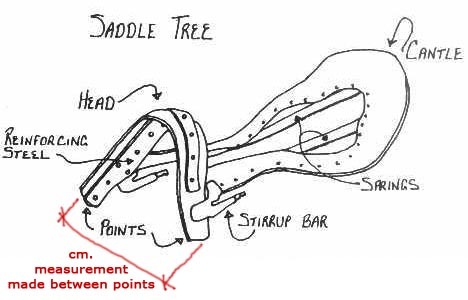
The weight distribution happens through a part of the saddle called a tree.
The tree distributes the weight of the rider evenly to the panels, which then distributes the weight to the horse's back.
As you can see in the first image, the stirrup bars are attached to the tree. The stirrup leathers (straps that hold the stirrup irons) are attached to the stirrup bars. When the rider puts his or her weight in the stirrups, that weight is transferred to the tree, which allows for a more even distribution of weight, as well as a secured position.
If you just have the stirrups attached to a pad without some manner of weight distribution, a few things happen:
The weight of the rider is focused almost entirely behind the withers of the horse an a very small strip of leather. This causes pain to the horse, which causes all sorts of lameness and muscle problems, not to mention problems like bucking and refusal to move because of pain.
Without effective weight distribution, the saddle would slip if the rider attempted to lean from side to side.
Given the lack of security, placing one's feet inside of a stirrup is much more of a liability.
Now, there isn't really any definite evidence pointing to when the framed saddle was first invented. The very first framed saddles probably were constructed in Central Asia and are now long since lost. The earliest we have record of were made in China, probably around 200BC. Then came a few centuries of development of the frame. And then somebody in the post-Han dynasty decided that it would be a good idea to add a mounting device- a kind of proto-stirrup that one could use to help with getting on quickly. And then another person added two of them, and the rest is history.
But now we can get to your question a little more precisely. One answer is that there really wasn't a need. Horses were short enough to mount without stirrups, and the riders were competent enough to do what they needed to do without stirrups. Next was that for travel, it made much more sense to travel by carriage if you had the money to afford a horse. Cavalry also wasn't really that prevalent in militaries, so there wasn't much of a need to develop anything to make better horsemen.
For example, Greek and Roman military thinking was focused more on infantry than on cavalry. Infantry are cheaper, they can fight on more types of terrain, and you don't need to feed the horse.
There's also the fact that it took a while to develop the saddle first.
Additionally, it's likely that horses were first used as pack and draught horses first. If you're curious, you can search the sub for "domestication of the horse" and you'll find some of my answers on that topic.
Another answer is that it just took longer to invent things back then. Major discoveries were a lot more spread out- there were fewer people with the spare time and education to create new and novel contraptions.
And finally, many inventions are only obvious in hindsight. Why did it take so long to develop the pulley? It's definitely simple, especially for anybody with a high school level knowledge of physics. But simplicity and obviousness are two very different things. I could ask, "Why haven't you invented the next simple improvement to cars yet?" But you haven't, because it's not obvious, and it takes somebody with a really unconventional mind to think of the obvious solution to a problem people might not realize they've been having.
Anyway. So, this answer kind of went all over the place, but, it's a difficultly worded question to answer properly. I hope this helped.
"The Roman Cavalry Saddle," Peter Connolly and Carol van Driel-Murray, http://www.jstor.org/stable/526629
"Riding Astride and The Saddle in Ancient China," Chauncey S. Goodrich, http://www.jstor.org/stable/2719034
"On Horsemanship," Xenophon
"Seats and Saddles," Francis Dwyer
"Some Remarks on the Origins and Construction of the Roman Military Saddle," R. S. Gawronski.