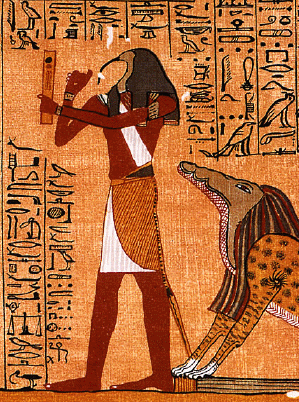
About half of the Egyptian pantheon are depicted as human with the head of an animal. Sometimes this makes sense, such as Sekhmet having the head of a Lioness or Sobek having the head of a Crocodile, but most of the time there seems to be no discernible link between the animal and the purpose of the diety.
Where did the concept of a deity being hominiform from the neck down and animal from the neck upcome from? And how were the animals chosen?
Note that the same deity can be depicted as entirely human, entirely animal or as a combination of both. Many deities can also be depicted as different animals. For example, both of these are Thoth, the god of the moon and writing: ibis-head, baboon.
The origin seems to be in so called sacred animals. Many animals show qualities that can also be associated with a deity. For example, a cow may represent motherhood and become associated with a goddess of motherhood. Since animals have a variety of qualities, they can be associated with different deities for different qualities. Often, an animal would be brought in the temple as a vessel for a deity, just like statues can be vessels for them.
Now, when it comes to depictions of deities, symbols are very important. What are they holding in their hand, what is on their head, how are they dressed. The animal head is just another of these symbols. The ancient Egyptians didn't think that their gods looked like this. Instead these are highly stylized depictions of humans. The animal head just represents some of their characteristics.
There is probably always a link between the animal and the deity it represents. However, the link is not always obvious. Especially because our interaction with and perception of animals is different from those of ancient Egyptians.