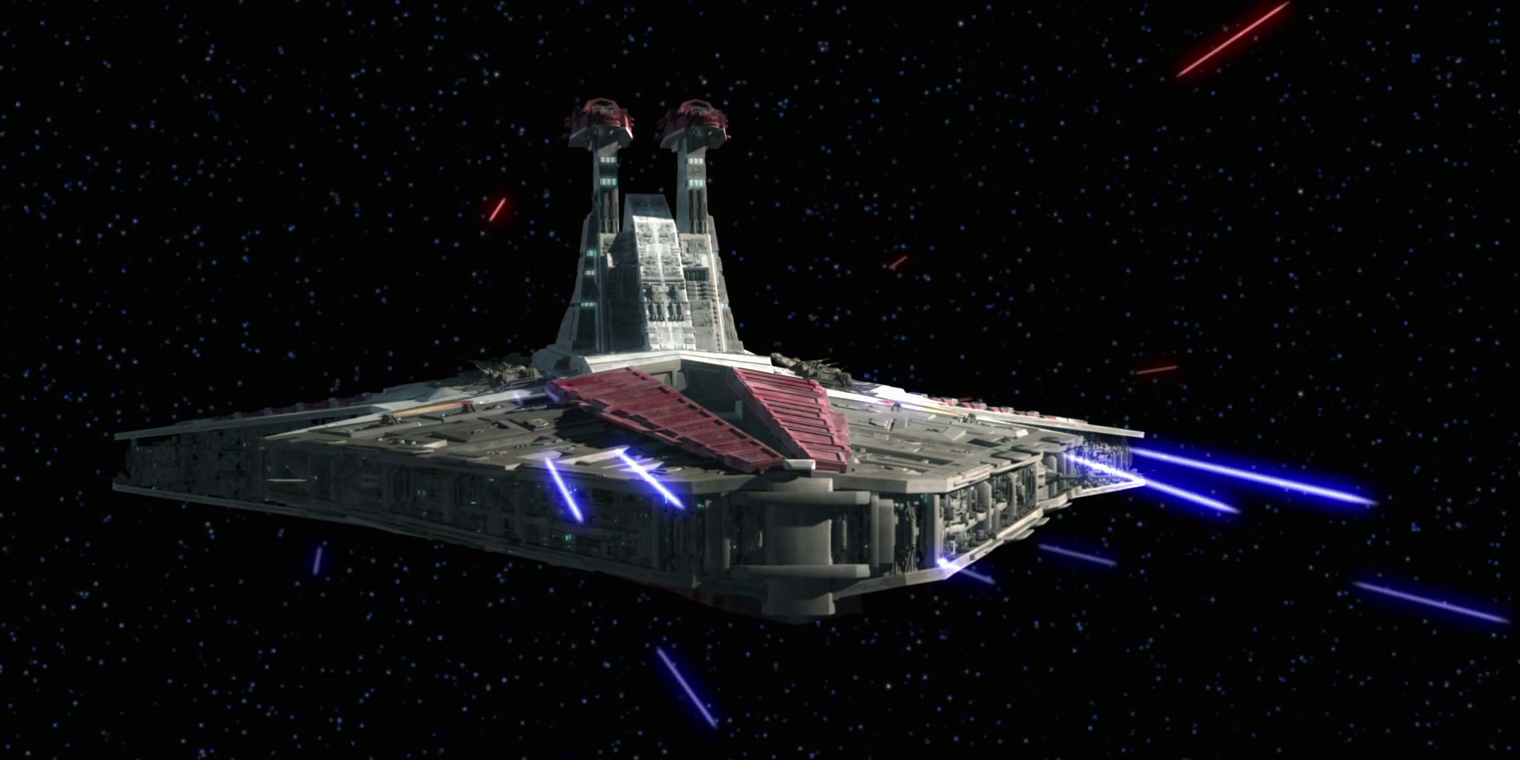
It just seems so baffling to me. In the Mandalorian Wars, which which began in 3976 BBY, the mainstay of the Republic fleet was the Centurion-class battlecruiser. According to Revan's commentaries (book 4, The Jedi Civil War and Grand Strategy) the Centurion-class's fat, triangular design was later deemed to be vulnerable to attack from above and below, and sleeker ships were adopted by both sides: the Interdictor-class for the Sith, and the Hammerhead-class for the Republic.
And yet almost 4,000 years later, during the Clone Wars, the Star Destroyer-class of vessels adapted this archaic and vulnerable design, something which had been phased out thousands of years before. Can anybody explain this? To me, it seems almost like there's just not any technological advancement at all!
I'd like to start by noting that, recognizing all the contributions Revan has made to Old Republic history (even despite his debated legacy), he is not well regarded as a naval authority. Therefore, I'm reluctant to take his comments at absolute face value.
Nevertheless, there has been an argued legacy of wedge-shaped starship structures that has roots perhaps in the prehistory of the Republic, it's a bit of a volatile point among the naval scholars, so I'm equally reluctant to give it major credit. But we should also know that the wedge-shaped vessels of the Mandalorian War Era and the Clone Wars Era were technologically distinct in armament and protection. The radical design of the Hammerheads actually represented a pretty imaginative period of necessity and experimentation in Old Republic naval buildup. It's cheap and fast design process, a reflection also of the apparent primacy of Rendili Hyperworks, and multirole use encouraged it's adoption as a mainstay in Republic fleets. Successfully introduced at the Battle of Koros Major, it found it's role at the core of Republic battlefleets thrusted upon itself in the aftermath of the Mandalorian Wars and the loss of a major portion of the Republic Navy to warfare or Revanchist defection. I'd argue, then, that the Hammerhead prevalence in the Old Republic Navy was one more of necessity than architectural revelation.
The wedge-shape design of the Republic Star Destroyers in the Clone Wars was (to my off-hand knowledge!) driven by the aggressively expanding Kuat Drive Yards influence in the Republic military industry. I'd feel it unfair to consider the Republic Star Destroyers archaic and vulnerable in design, on closer consideration, we find that their designs are actually quite sleek.
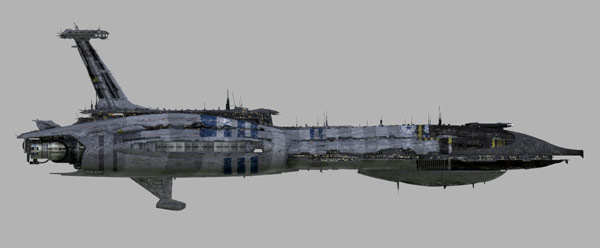
From a view of the bow and sides, the profile of Republic Star Destroyers is quite flat and presents a harder target for gunners to aim for. This becomes even more apparent in contrast with CIS vessels. which are noticeably bulkier in design. The celebrated duel between the Republic ship Guarlara and Confederate flagship Invisible Hand over Coruscant reinforces, in my view, the advantages of the formers slimmer profile in scoring more critical hits upon the latter, even as it engaged in a side-to-side gunnery duel that placed the Republic ship in a less advantageous position (as I will explain in the following paragraph).
The wide range from the bow presents the Republic Star Destroyers a large front forward to fire on the enemy vessel. Typically, tactical doctrine called for Republic Star Destroyers to begin a battle with an assault from the front, so as to bring all firepower to bear. An artistic representation will show what I mean. In that regard, the wedge-shape designed was not totally 'archaic', but found enough usefulness that it became a mainstay of the Clone War Republic Navy, and later a symbol of the Galactic Empire's power projection.
You have to realize that the Victory-class and Venator-class Star Destroyers were much more heavily armed than the Centurion. As stated in your link, the Centurion is 1200 meters long and is armed with:
By contrast, the Victory-class is 900 meters long and is armed with:
The Victory-class has more than twice as many missile tubes as the Centurion has total weapons. With the advancements in technology, ships were no longer limited to 20-30 guns. The Victory-class was 300 meters shorter, yet a single one of them could fight off half a dozen Centurions.
What's interesting is following this trend into the Imperial era. The main line battleship of the Imperial Navy was the Imperial Star Destroyer, a mile-long starship armed with the following:
That's nearly 150 guns. This armament made them feared across the galaxy. The quote that I like to use to put that kind of firepower in perspective is something Carnor Jax said to Mirith Sinn:
"Have you ever seen what a Star Destroyer can do to the surface of an unshielded planet? Stones run like water and sand turns to glass."
A single Imperial-class Star Destroyer could lay waste to a planet with nothing but the guns on its hull. And on top of that impressive array, the Imperial-class carried four dozen TIE starfighters, a dozen TIE bombers, and a wide assortment of landing craft for the nearly 10,000 infantrymen and assorted vehicles onboard. A single Imperial-class could overpower small fleets and begin invasions. When grouped in fleets of half a dozen, they were nearly unstoppable. And this was just the first iteration of the Imperial-class. The second iteration, put into service after the Battle of Yavin, was more heavily armored and came with significantly upgraded weapons and shielding.
The triangular shape was weak and vulnerable in Revan's era because the technology of the time was a handicap. That was not the case in the Clone Wars and the Imperial era. The Victory-class and Imperial-class were groundbreaking warships, and changed the reputation of that shape from weak and vulnerable to a force to be feared.
The wedge design is part of the Empire's over-arching military doctrine of victory through numerical superiority and overwhelming firepower. As you've noted, the core design has been in use for thousands of years, but I think that anyone would agree that it was truly perfected in the waning days of the Republic and the early days of the New Order.
The downsides of the wedge design have been thoroughly noted (for an exhaustive tactical analysis, I recommend Pellaeon's Logistics and Methodology of Imperial Fleet Tactics), but the crux of the issue is that its greatest strength is also its greatest weakness - firepower concentrated forward. More than any defensive benefits gained from a slighter silhouette or low-angled ablative armor (though those advantages are not themselves insignificant), the wedge design allows for the ship to concentrate the vast majority of its considerable firepower directly in front of it. For an individual vessel this can be a glaring weakness, as it allows for more maneuverable vessels to get around to the sides of the ship and attack it from its more vulnerable sides.
This weakness, however, is mitigated by Imperial fleet tactics. By massing several Star Destroyers in staggered fleet formations the overlapping field of fires allow the fleet to keep enemy ships in the front firing arc of at least one, ideally several Star Destroyers, while using smaller support ships like the Raider and the ample reserves of expendable TIE Fighter squadrons to hold enemy ships at figurative arm's reach long enough for the overwhelming firepower of the capital ships to crush all before them.
Heh, a lot of you self-proclaimed historians seem to think you have the solution to everything. I'm a simple pilot, so I can only give you the working Sullustan's perspective.
Purely an aesthetic thing. The Galactic Senate feared that using a more modern design would send the wrong message to the more conservative politicians and constituencies of the Republic, so they reverted to a classic look as a way to placate the people who would be opposed to the army. Who knows how many systems they prevented from seceding with that political move?
And as a starship connoisseur, I can tell you that the classic look of the triangular capital ship is both one of the most attractive and one of the most intimidating. If you've ever been run down by one of those suckers, you know what it's like to look into the face of fear itself. Sure, intimidation wouldn't have much effect on the droid forces of the CIS, but the war was as much ideological as it was practical. The organics were the ones who chose to secede. A wall of those battleships staring down your planet would make anyone reconsider supporting the CIS.