I quite surprised Germany had accepted the loss of large after the war had partially been about recovering land lost in the First World War?
Modified from an earlier answer
"The Oder-Neisse, Eastern provinces - they're gone! They don't exist anymore"- Konrad Adenauer in conversation with Willy Brandt, 1953.
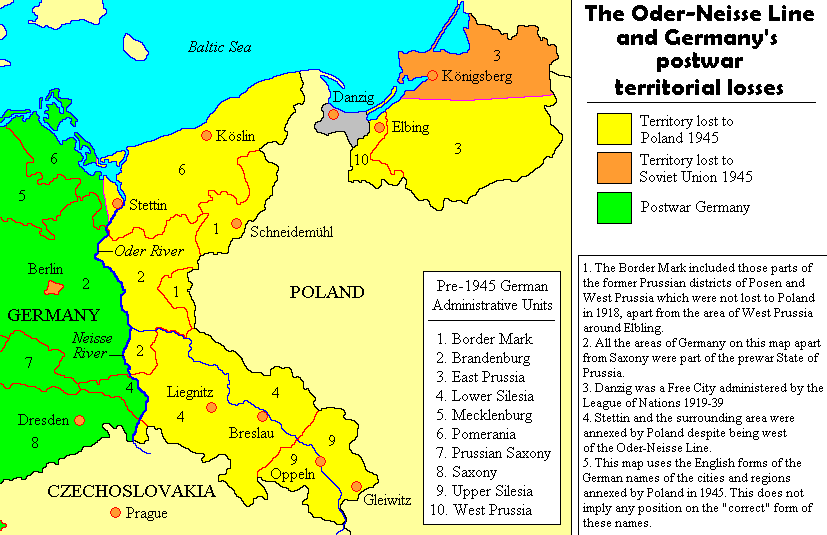
The bulk of the German territory lost at the end of the Second World War were the Prussian and Silesian territories that became the Western portions of Poland and the Kaliningrad Oblast. The GDR obviously had little choice in accepting these territorial changes, but the territorial change, called the Oder-Neiße line, were somewhat contentious in West German politics. Although on the surface, the importance of the Oder-Neiße within West German political discourse looks like a revanchist sentiment, in reality its importance within FRG politics is relatively prosaic. Although there were some revanchists within the FRG, the FRG's political mainstream adapted the position that Oder-Neiße area was under temporary control due to reasons of domestic and international politics.
At the core of the Adenauer generations opposition to the Oder-Neiße line was the issue of sovereignty. Even as it became increasingly clear that Germany was to be partitioned, the main goal of FRG politicians was a return to normalcy and assert that Germany was a fully-functioning sovereign nation. Adenauer's basic position, which was reflective of both SPD and FDP's opinion, was that Germany's final borders needed to be decided by an all-German government in negotiation with the deciding parties. The charter generation of the FRG asserted that it was that all-German government. The FRG's Basic Law asserted that it applied to the whole of Germany including the Eastern zones and territory now controlled by the USSR and Poland. Far from being quixotic, the FRG politicians knew that the Oder-Neiße revision was unachievable as exemplified by the above Adenauer quote, the Oder-Neiße issue possessed something of a Realpolitik character. Keeping the issue alive was one way for the FRG to assert that it was the true political inheritor of Germany by counter-intuitively asserting that Germany was incomplete. Heinrich von Bretano, the FRG's Foreign Minister would say in 1956:
I have stated very plainly. . . [that] there is no German Federal Government, either today or tomorrow, which can recognize the Oder-Neisse Line as the frontier. Firstly, it will not do so because it is not entitled to do so. It is not entitled to dispose of German territory. Secondly, it will not do so because it is not entitled to do so towards the people, the German people, who have lived there for centuries.
The latter half of the von Bretano quote exemplifies another aspect of the Oder-Neiße issue: its importance to electoral politics. A sizable portion of the expellees ended up in the FRG and they became an important voting bloc in the FRG. In the early decades of the FRG, most of the mainstream political parties sought to court this voting bloc and keeping the issue alive was one of tactics used to gain their constituency. The expellees also created various special interest groups and organizations that kept the issue alive during the 1960s and 1970s as it became more apparent that the borders were fixed. Although some of these expellees were revanchist, most of them recognized that this territory was gone. Tours of the lost East organized by these groups in the 1960s and 70s often underscored the permanence of this loss. Demshuk's recent study of these groups persuasively argues that as new immigrants to the FRG, the amount of attention paid to the Heimat of the East was a mechanism to cope with their internal migrant status by creating a "Heimat of memory" to assert their German identity and heritage in the FRG. These expellees were internal migrants into an country which prided itself on extreme localism and regional identity was often indelibly mixed with the conceptualizations of national identity (the "nation was a local metaphor" to paraphrase Alon Confino). Emphasizing the essential Germanness of these areas made the expellees more German and less foreign in this context. While there the expellees' publications had prominent anticommunist editorials about the how former German land was now under a brutal occupation, the rest of the articles focused less bellicose matters like forging new associational connections within the FRG.
Thus the revision of the Oder-Neiße line became something that the mainstream FRG dropped both politically and culturally with reunification. The Western Allies were relatively patient with this issue as well. After all, the rationale used by Adenauer gave the West a moral high-ground during the Cold War; the central position of the FRG was only a freely-elected government could decide this issue and the Poles could not decide their border as well. Their chief concern was that the more intransigent the FRG was on this issue, the more propaganda value the USSR would derive from it. Thus the Allies took the middle position that the Oder-Neiße line had been decided and any calls otherwise were dead-letters, but needed to be finalized by a formal negotiation with all parties involved. There was some variation in this stance; JFK floated the idea of using the Oder-Neiße issue as a bargaining chip over Berlin and the British Foreign Office under Macmillan saw a more conciliatory approach as a strategy to decouple Poland from the Warsaw Pact. However, all the mainstream political actors recognized revision of the line was a dead issue and acted accordingly: to instrumentalize it for their own ends.
Sources
Demshuk, Andrew. The Lost German East: Forced Migration and the Politics of Memory, 1945-1970. New York: Cambridge University Press, 2012.
Hughes, R. Gerald. "Unfinished Business from Potsdam: Britain, West Germany, and the Oder-Neisse Line, 1945–1962." The International History Review 27, no. 2 (2005): 259-294.
Liulevicius, Vejas G. The German Myth of the East: 1800 to the Present. Oxford: Oxford University Press, 2009.