I understand France for the most part wasn't the aggressor in Napoleon's wars but in the end, Napoleon decided to annex and create puppet states/forced alliances in almost all of Europe (excluding Sweden, GB, and Russia, and maybe some more) instead of impose harsh economic treaties. My knowledge on the subject is limited. I know one of his motivations was to seclude GB from the continent but I would think economic based treaties could handle that, or am I wrong? It seems obvious to me now that France was way overextended and would eventually collapse so I really don't know what Napoleon was thinking but maybe you guys could enlighten me?
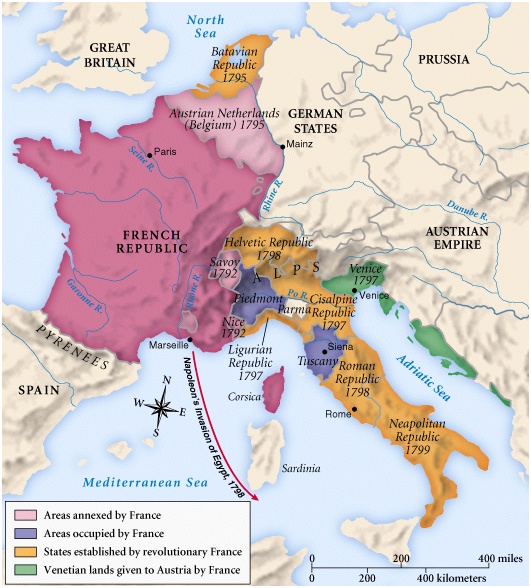
Napoleon's satellite were really not that great of a departure from the practices of prior French Revolutionary governments. As the Republic's military fortunes turned for the better after 1793, it took it upon itself to spread republican values into the European continent. These so-called sister republics were based upon new boundaries and its leadership tended to be local notables drawn from the upper middle strata of society. These new republics were to enact French-inspired laws that would put these societies in line with Enlightenment values. The sister republics would abolish feudalism, rationalize local administration, and generally ally themselves with French interests. Gradually, the last precept emerged as the most salient one as the French Directory government saw the republics both as a buffer zone and a source of fiscal revenue. The republics had to pay for the upkeep of French troops allegedly defending them and contribute troops to fight in France's wars. Although the French paid much lip service to notions of republican freedom and solidarity, it was a highly unequal relationship.
So Napoleon's erection of client kingdoms instead of republics was cut from much of the same cloth as his predecessors. Napoleon certainly added a more personalist tone to this process as he put members of his own family on the various thrones of Europe. Yet even this was more of an evolutionary outgrowth than a departure from prior practices. The sister republics were frequently inconstant allies of French and they often did not put up much of a fight when France's enemies occupied them. Imposing direct French rule but mediated through local organs would rectify this situation, at least in Napoleon's formulations. The satellite kingdoms continued Revolutionary practices of streamlining administration and setting it up on a more rational basis. Although the Napoleonic regime jettisoned much of the rhetoric surrounding republican freedom, the content of French policy remained much the same. The view from Paris of these states was consistently the same: French interests were inseparable from European ones and these states owed France for their modernization.
Napoleon did depart from French Revolutionary policies in two very important ways. Firstly, Napoleon's new emphasis upon monarchic government made it much easier for him to forge alliances with the minor European powers in Central Europe like Bavaria or Saxony. The Revolutionary governments had tried this, but it was ideologically difficult to maintain. These French client states were enlarged at the expense of Napoleon's enemies and the minor polities. The French demanded fiscal and military contributions from these monarchs, but this dovetailed with their desires for an enlarged centralized state. Secondly, the scale of Napoleon's system was unprecedented by prior French practices. Napoleon was able to affect a continent-wide system of client and satellite states which greatly upset the European balance of power. In many ways, Napoleon's martial prowess worked against France's larger interests. Napoleon's military skill meant that he need not take heed of warnings that his system had upset the international order. If Austria, Prussia, Russia, or Spain sought to undo this system, Napoleon could, and did, reverse whatever military gains they made against French interests on the continent. This ensured that Napoleon was not inclined to create a more equitable and manageable international system. Napoleon's increasing reliance upon military victories to resolve diplomatic crises increased the destabilizing nature of the French hegemony over Europe. As France's enemies became more competent, Napoleon demanded more contributions from the rest of the empire to counteract this trend. After each of his victories, Napoleon enlarged his satellite states at the expense of the defeated to preclude any revanchist sentiment, but it only increased it among the defeated powers.
Sources
Connelly, Owen. Napoleon's Satellite Kingdoms. New York: Free Press, 1966.
Dwyer, Philip G. Napoleon and Europe. Harlow, England: Longman, 2001.
Grab, Alexander I. Napoleon and the Transformation of Europe. New York: Palgrave Macmillan, 2003.
Lyons, Martyn. Napoleon Bonaparte and the Legacy of the French Revolution. New York: St. Martin's Press, 1994.