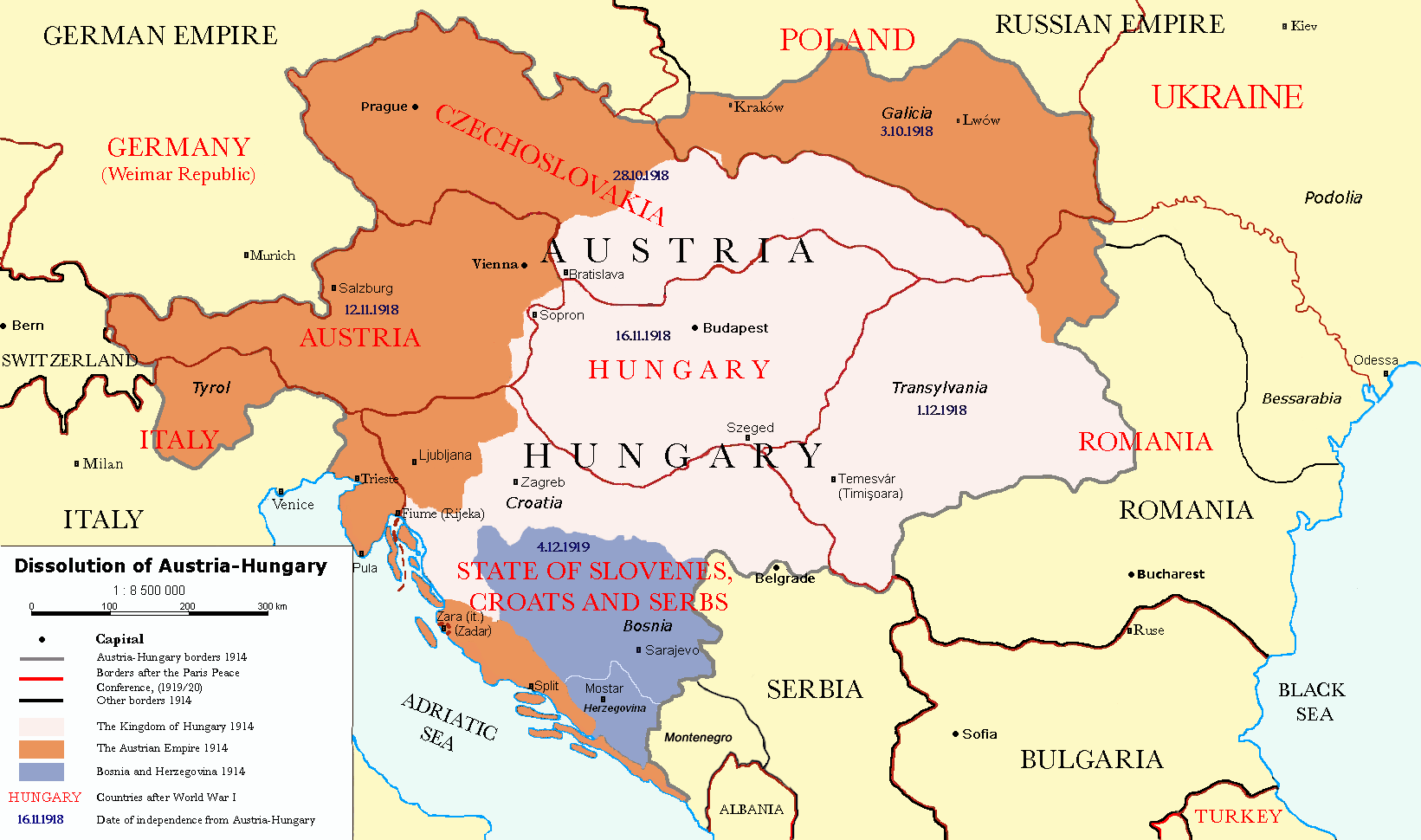
Austria-Hungary got split up in different countries after world war one, why didn't the allies cut up Germany into different countries like how it was pre-Bismarck. I get that there is less ethnic divesrity between, lets say, Bavarians and Saxons than there is between Austrians and Bosnians, but still, most of the german cultures had long histories of independence. Why didn't Germany got cut up like Austria-Hungary?
Ultimately the Austro-Hungarian Empire was split up because their included states wanted to be broken up. The Slovenes, Croatians, Serbians, and Bosnians in particular had a very strong sense of unity where 3 out of the 4 were under Austrian yolk. Right away with their breakaway the Austro-Hungarian Empire loses its entire Southern portion. It's far more clear on this map with the other one open as well but you can see how Hungary was also torn apart from ethnic lines which fundamentally did not want to be under Magyar rule. Ultimately the only people who really wanted to be part of the Austro-Hungarian Empire, in general, were the Austrians and Magyars themselves.
The game was entirely separate for the Germans; for the most part everyone within the Empire was ethnically German and, further, was totally supportive of the state. The only land, just like the Austro-Hungarians, that was "given away" (or given the choice for such) were generally parts of the Empire which were not ethnically German majority; exception in the West obviously with France taking back half-French half-German Alsace-Lorraine along with the Saarland occupation (one of the industrial hubs of Germany meant to basically keep her down).
You can see though there was a voting process for these territories that were borderline. Northern Schleswig voted to be Danish and Southern Schleswig voted to become German! Yes, Versailles allowed a "Danish" territory to become German! Upper Silesia mostly voted toward becoming German again as did Allenstein. The only land strictly taken away from her without vote is, as you see, West Prussia and Posen which had a firm ethnic Polish majority.
There's a reason the process of German unification was, mostly, completely consented for by the German stats who would be absorbed under Prussia's yolk. The economic and military implications of being kicked out of her sphere was just too great and, by this point, those minor quibbles mostly faded away after 2-3 generations. Ultimately, as you said, even though there was independence for hundreds of years, ultimately even well before unification, there was a strong German national identity which was perceived to exist in all German people in all German states. To truly appreciate this idea let's look at the 1833 edition of Politisches Wochenblatt in which the following comment would be made:
. . ."Do not let us chase after castles in the air, let us allow the French their levelling-down concept of equality, their departments, their centralization and their vanity and let us preserve the true knowledge that on the contrary Germany's unity consists precisely [in the fact] that in each part of the German fatherland, even in the smallest part, special life impulses are beating which give nourishment to the heart."
The only exception, of course, being Catholic majority and general Francophile Bavaria who resisted to the last breath to join the Empire and had to be given almost de facto independence within the Empire just to get them to stop kicking and screaming. However, again, this died down significantly but they would be the notable case of a state which seceded from the German state in the aftermath of the war, The Free State of Bavaria or more commonly The Munich Soviet Republic but would be quickly put down in about a month by the Freikorps.
TL;DR:
German Empire was made up of people who more or less had very good reason to be there, more or less chose to be there, and had a strong national bond which extended back centuries. Austro-Hungarian Empire was divided between Slavs, Galicians, Poles, etc. who all had very strong, very distinct, very independence-oriented national identities separate from their rulers.