Putting aside movies like 'JFK' and 'Seven Days in May', were there any real concerns that the US military or intelligence community would try and take over the government, or had started to blackmail politicians behind the scenes?
Truman faced a couple of challenges from within the US military, the most significant of which was the increasingly overt insubordination by Douglas MacArthur over the conduct of the Korean "Police Action".
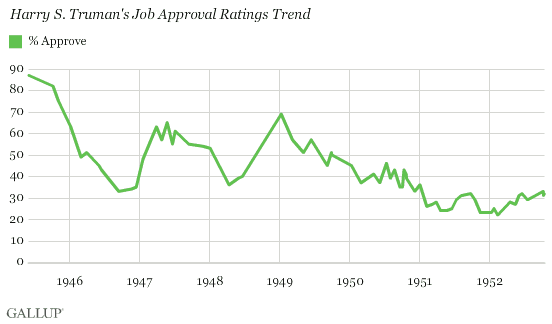
The significant context here is that MacArthur held immense prestige within the US, while Truman struggled with high disapproval ratings.
In Sept 1950, MacArthur stunned everyone (including the Joint Chiefs of Staff) with his amphibious invasion 150 miles behind enemy lines at Inchon, which routed the North Koreans and allowed the retaking of Seoul. Calling on the Communists to "surrender or die", MacArthur wanted to defeat them on the battlefield, and proposed widening the conflict by bombing enemy staging areas in China.
Truman wanted a negotiated peace, and insisted that everything be done to limit Communist China's role. This set the stage for MacArthur's challenge to the presidency.
In November 1950, Communist forces launched a major assault which pushed UN forces back. Stung by this defeat, MacArthur blamed Truman. He went to the press complaining about "extraordinary inhibitions without precedent" that had hamstrung his campaign and led to his defeat.
Truman responded to this challenge the next day, with a directive that nobody in the Pentagon should issue statements on foreign or military policy without clearing it through the State Department.
By March 1951, MacArthur had regained the ground he'd lost, and he felt emboldened enough to ignore Truman's directive. On March 7, he held a press conference where he warned there would be a 'senseless slaughter' of Americans if Truman did not let him pursue the conflict his way.
Truman intended to make a speech on the Korean conflict in late March. When MacArthur learned of this, he decided to get his own message out first. On March 25, Macarthur released a statement to the NY Times. He concluded this statement with the stunning claim that he could, in his role as commander-in-chief, arrive at a negotiated settlement with the enemy.
Truman cancelled his speech.
The final challenge came in the form of a letter from MacArthur to Republican minority leader Joe Martin, Jr, which Martin read in Congress. This letter was again critical of Truman's limited-war policy, though it's unclear if MacArthur intended for this letter to be made public (Martin had offered confidentiality, but MacArthur hadn't asked for any).
Three weeks later fired MacArthur for insubordination. Truman was politically wounded by this act, and set new record lows for Presidential approval ratings - records which stand to this day.
As far as the CIA goes, it never really hit its stride until Allen Dulles took the helm under Eisenhower. There's some evidence that the CIA subverted Eisenhower's agenda in Iran, though the President was happy with the outcome.
Initially, Ike had great sympathy for the Mossadegh government in its conflict with the UK, and wanted to 'send him ten million bucks'. The CIA spent 10% of its global budget on Iran in the year prior to Operation Ajax, and actively manipulated Eisenhower's perception of the situation there. (When Ike dispatched trusted advisor Harriman to Tehran, he was greeted by a CIA-sponsored protest mob chanting 'Death to Harriman'. Tehran's Chief of Police - a major CIA asset - opened fire on the protesters against government orders, killing about a dozen of them. Harriman duly reported back to Eisenhower that Iran was spiraling into chaos).
Under Dulles, the CIA never directly challenged the President, but then again, they didn't really have to. Since they provided much of the foreign intelligence the White House relied upon, they were able to influence by crafting perceptions. This worked well until the Bay of Pigs operation, which is probably the first point where the White House felt it had been deliberately manipulated by the CIA.