Afternoon all. Got an unusual one for you;
A friend is convincing me to get into historical reenactment. His period is WWII. Now I'd love to play a soldier like him, but I believe the uniforms tend to all be made of wool. I unfortunately have an unpleasant wool allergy - I can bear wearing a wool uniform (tested during WWI theatre productions) for a couple of hours, but after that it just gets too uncomfortable and I have to get changed.
As such, I'm trying to find out if any armies/units etc. wore or permitted the wearing of cotton uniforms, so I can both take part next to my friend and stay historically accurate.
Cheers!

The United State's army's Khaki uniform of the period was the standard warm weather garrison, service and combat dress. This uniform, according to Shelby Stanton, was made of 8.2 ounce cotton khaki. The soldier in the picture wears the olive drab tie, but the uniform Some more images: Staff officers of an air corps squadron in Morrocco, 442nd Regimental Combat team parading in Washington after the war. In addition, the herringbone twill fatigue uniform saw widespread service as combat dress in the pacific theater.
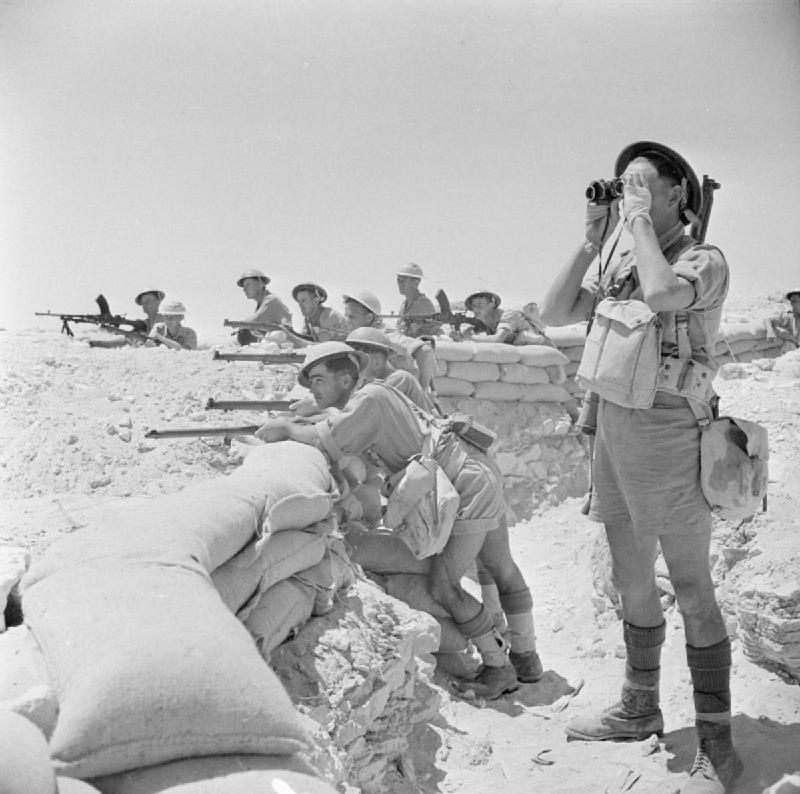
In the British army, Khaki Drill service dress was worn in the North African campaign, as both service and combat dress, and in the early stages of the war in the east. The material used for both the trousers, shorts, and tunic was of Khaki Drill material in use since the 1890's. The shirt was of a lighter airtex fabric.^1 Bush jackets or bush shirts could be of airtex, khaki drill, or herringbone twill. The Jungle Green combat dress was later adopted for use in the eastern theater. According to the Imperial War Museum, this special uniform was manufactured in India and made of aertex.^2
The uniform you choose should, of course, depend on your geographic location. Cotton uniforms, whether of chino or khaki drill, were designed to be worn in warm locations, and, as such, they should be worn appropriately. Furthermore, for health and comfort reasons, lightweight clothing is not the sort of thing you want to be wearing when its 20 degrees outside when everyone else is gussied up in greatcoats and knit caps.
I'm afraid I know less about the uniforms worn by the other armies in the Second World War- Soviet, German, Japanese, or what have you.
For more reading on the subject, there's a seemingly inexhaustible supply of books on World War 2 uniforms. Here are some I found to be particularly helpful:
Shelby Stanton, U.S. Army Uniforms of World War II (Stackpole Books, 1994)- Numerous illustrations, describing each garment, and its various patterns, worn by the US army in the war.
Andrew Mollo, The Armed Forces of World War II (Little, Brown, and Company, 2002, reprint)- Introduction to the major forces involved in each theater in the war. Good information on rank and divisional insignia. Numerous photographs, as well as color illustrations by Malcolm Macgregor and Pierre Turner.
In addition, the Imperial War Museum has an extensive collection of uniform items, photographs of which can be viewed on their website. Here's the link. Also a useful resource for period photographs.
^1 Brayley, Martin. The British Army 1939-45 (2): Middle East & Mediterranean (Oxford: Osprey, 2002), 36-37.
^2 IWM, Bush Jacket, Jungle Green (Aertex) Indian Pattern: British Army/30106661
On top of the answer provided regarding the US military.
Let me give you some info about the Japanese Army.
During WWII on Japanese Army infantry mostly wore the following type of uniforms. Since you are only interested in cotton uniforms I will skip the winter uniforms which are mostly wool.
The type 98 uniform is the standard uniform of the Japanese army from 1938 to the end of the war. There is also a later version of the uniform called the Type 3 Uniform, which is made in 1943 in the face of the down turning war front, it's mainly a simplification of the previous uniform and uses less material.
There are two versions of this uniform. One is made from wool for use in colder weather areas like Japan, Aleutian islands, and Northern China. And another made from cotton, to be used in warmer weather area like the Pacific and Southern China.
I'll leave the other details as you only wanted to know the materials.
The other one, perhaps a little bit more famous are the myriad of "Anti-Heat clothes" used in the Southern fronts and the Pacific.
These are 2/3rds shirt made from thin cotton, with it's shape mostly the same between variations but a huge difference on colors depending on unit and front. From light green, white, white with green collar, deep green, and even camo painted deep green.
The anti-heat cloth also comes with a thin inner pants. However, in the hot weather in the Pacific many soldiers opted to wear the type 98/3 pants while wearing the anti-heat uniform on top.
On top of the main uniforms, many items worn by the Japanese army are made of mix between cotton and wool. And late war production wool will feel like rough cotton due to downgrade in production capabilities.
For example, the caps worn by the Japanese military famously are made out of wool. However, most other gear are made of cotton instead. Such as the backpack, and the various packs they lug around.
There are other details, but I left them out as it does not pertain to your question about the materials. Especially skin contacting materials like you are concerned.
I also do re-enacting as my hobby in California. Feel free to shoot me a message about the details if you'd like to talk about it!
I also do Red Army, so I will try to give you a detail when I can get to it, but suffice to say their uniform that are contacting you skin is surprisingly, cotton. The Red Army's way of dealing with the cold is a layered approach. You'd have your cotton underwear, then you'd have your cotton summer uniform like the M35 and the M43. If you are cold you wear your telogreika, which is a padded cotton/wool uniform set. If you are still cold after wearing that you'd put on a wool great coat. The wool great coat will probably cause you pain, but since you are not wearing it on your skin (like US Army) you should be fine.