Background
Early in 2011 my father was given a copy of 'East of the Jordan' by Selah Merrill published in 1881. Chapter 27 is entitled 'An Underground City', and in this describes Merrill's visit (which references J. G. Wetzstein's visit) to a remarkable underground labyrinthine city (village?) close to Dra'a. Shortly after reading these accounts, the troubles in Syria started precluding local investigation of these accounts further.
More recently my father has found a book entitled 'The Giant Cities of Bashan and Syria's Holy Places' by J. L. Porter, which describes towns constructed of rock in th in the area.
Is there any more recent academic corroboration of the evidence given in these accounts, and if so can we be pointed to these sources, even if it is just confirm the existence of the underground city.
Each of the books suggests that the cities in the area were governed by King Og, who was defeated by the Israelites, though each text was likely heavily influenced by each other. It is also worth noting that each of the authors was attempting to place biblical events in geographical context as the purpose of their travels.
I realize this may not be the most appropriate sub, for what may be considered an archeological question, or that it may be too esoteric to get an answer, but my father has been researching this for some time, and appears to have hit a dead end. It is possible that current events may make further research of this topic impossible.
Thanks for listening,
TFL
Thanks for the ping, /u/Tiako. I'm not super familiar with Syrian archaeology, mostly because it's been really hard to dig much around there for quite a long time. But I was interested in this question and so I did a little research of my own.
For /u/Tiako and anyone else interested in reading the original work cited by the OP, here is a link to the Archive page, which allows for a PDF download of the book. The relevant chapter, 27, is quite legible in this version.
It appears that the geoagraphic area in question is near the modern city of Dara'a, based on everything I could figure out from the place-names mentioned in the original text. Here is a Google Maps overview of the area based on common place-names in the text (it being to the east of the road between Nawa and Ramtha, and not particularly far from Busra, all of which are near the Daraa governate in Syria, which is in the very southern tip of Syria).
This much is known already to the OP I am sure, I just want to make sure the info is visible to anyone interested.
I am not aware of any archaeological excavations taking place in this area, however, so I don't know if this particular underground network/city has been excavated or examined in any sort of rigorous academic way. I understand from several archaeological sites that the underground network of tunnels is known to the Syrian tourism board, and therefore must have been looked at recently, but I am unable to find any record for any dates for the creation/occupation of the tunnels.
Reading the description of the underground city/tunnel network sounds quite similar to some similar underground networks I have encountered in Israel (not too far away from the study area), specifically the site of Beit Guvrin, which is a similar city with a very large and extensive underground component. They had a number of different cave types in the area, including bell caves, possibly for keeping doves or pigeons for guano, burial caves, extensive passages between water sources, etc. Similarly, around the 130s AD the Jewish rebels under Simon Bar-Kochba took refuge in a number of caves and tunnels, mostly natural karstic caves but which in some cases were modified to make them more suitable, in a number of areas around the modern country of Israel, from the chalky hills of the Shephelah (foothills, between the hilly country of Jerusalem and the flat alluvial plains of the coast) to the cliffs around the Dead Sea. Yigael Yadin excavated some of these occupied caves and the remains of some of Bar-Kochba's rebels, and published it in his book Bar-Kokhba; the rediscovery of the legendary hero of the second Jewish revolt against Rome. I have actually been inside some of these caves, and while they are sometimes pretty small and bare, the chalky marl is very easy to cut, and caves are easy to hollow out, they made a very good temporary refuge in times of real trouble.
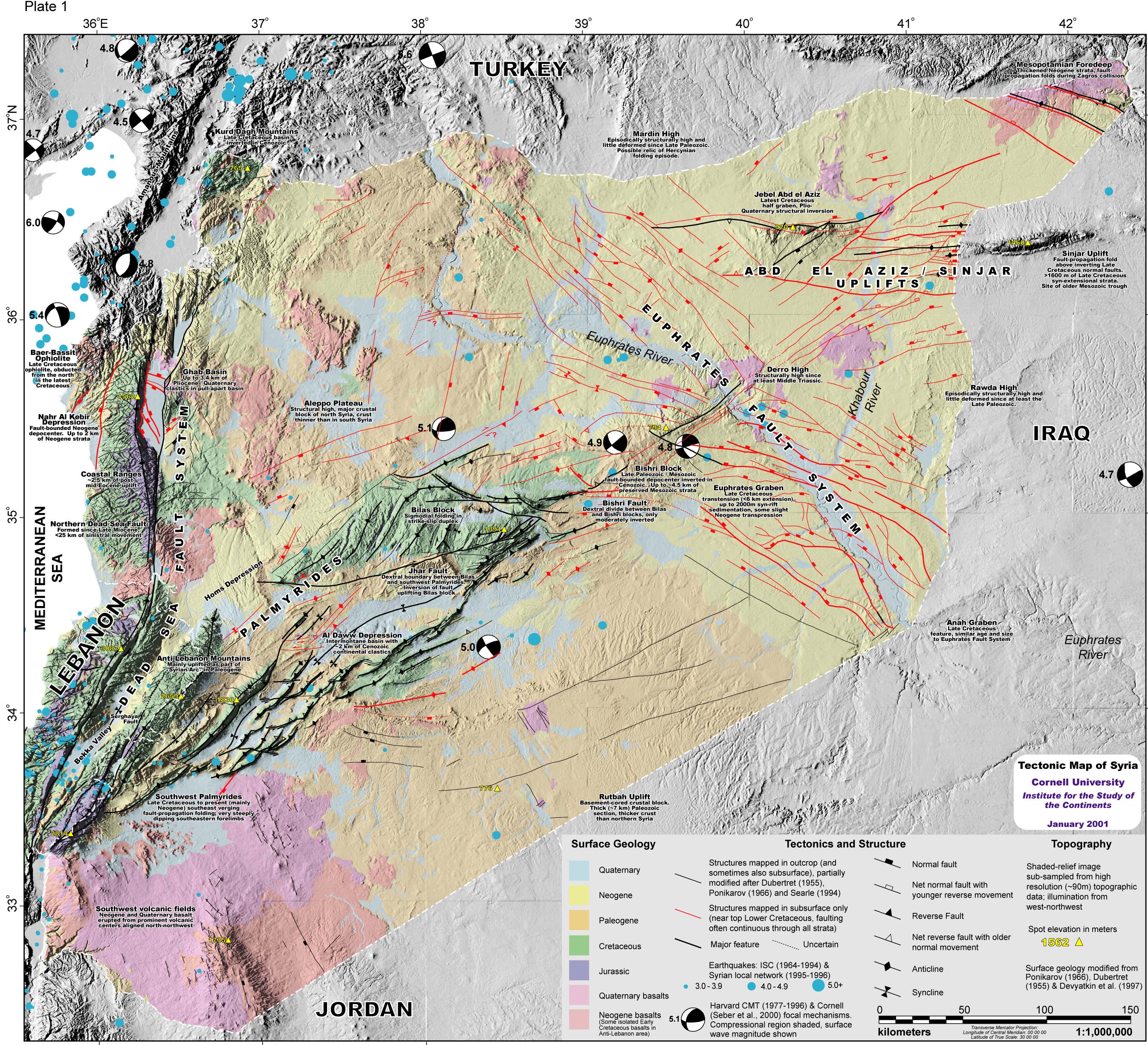
Therefore, the account in Miller's book about natives taking refuge there from the Crusaders and cutting their water bucket ropes is entirely plausible and consistent with what we know of the use of such subterranean networks. Indeed, based on the scant geological maps I have been able to dig up on Syria (like this one, which looks like a homework project, and this one, from some guy's dissertation on tectonic faulting in Syria) indicate that despite the region being mostly basaltic, there is a region of chalky marl, exactly like what you would expect to find caves in (which would be mainly natural, but fairly easy to modify and cut) right in the area of Daraa.
So, are the caves there and did ancient people live in them? Yes, almost certainly. All the evidence I can find points that direction.
Now, the real question is how early did these caves become so heavily used? Most of the analogues I have cited are used much later than the time of Og, king of Bashan. Beth Guvrin and the Bar-Kochba rebellion come rather late, between the Persian period (~400 BC) to the end of the Roman period (~135AD). It is clear that such places were in use later, as they were apparently used during the Crusades, but the earliest point is more difficult to find. Miller states that he picked up pieces of Greek pottery, which falls within the use dates I have described (~300-100 BC, perhaps a hundred years earlier for some styles of pottery such as Attic ware). Greek pottery is pretty identifiable, and is quite unique and different from the local stuff in terms of its appearance. By this time pottery typology was beginning to be well-established (thanks Sir William Flinders Petrie), so if he says it's Greek pottery, it's probably pretty close to it. But without actual excavation reports of the area or published pottery finds from the area (which may exist in some Syrian government office or university, but inaccessible to me), I can't really pinpoint the use of the underground city more specifically than that. Is it possible that they were in use in the Late Bronze Age during the time of Og king of Bashan? It's possible. The natural caves would probably have been present. Were they used then? I have no evidence for this, so I can't say one way or the other. My gut feeling is that the underground things were a later development (in the Persian to Greek periods), based on what I know of parallel underground complexes in the greater region. But I could be wrong. I just don't have access to any excavation records from the area.
I hope this was useful, and I will try to answer any follow-up questions you may have.
I was able to find a text of the book online, but unfortunately it is fairly corrupted and honestly I'm having some trouble parsing the geography. That being said, my gut is that Merrill is talking about Petra and misinterpreting it as a Biblical site. Does that seem possible, or can you give a closer description of where exactly this underground city is?