Proper nutrition and adequate energy intake seem crucial for troops marching and carrying heavy gear in the field, but weren't the MCIs too cumbersome to be carried in higher amounts? 3 MCIs weight 3,5 kilograms and consist of twelve different sized cans.
Were 2 MCIs per day a sufficient amount of food during like a week-long patrol?
Broadly speaking, the diet of US ground troops is unclear but it would be safe to say that the field troops did not match or adhere to the US Army's expectations. Part of this problem is because there is a disparity between what the US Army taught the troops to do vs. the reality on the field. Additionally, the Vietnam war is a long conflict and the standard US Army's field rations went through a number of changes in that period. Lastly, different troops received different types of rations. However, I will try to answer your question as best as I can.
For the bulk of the war, most US ground troops were issued some variation of the C-ration/MCI. While there are small changes between the different generations of c-ration, they were all similar in the respect that they contained canned, wet food. As a result c-rations were heavy, loud and bulky. You can imagine this made them unpopular among ground troops.
"The main trouble with the C ration in combat, when you often had to eat it for days on end, was its weight and bulkiness. Besides being uncomfortable to carry, it was almost impossible to stuff a two-day supply of cans into an already crowded backpack."^1
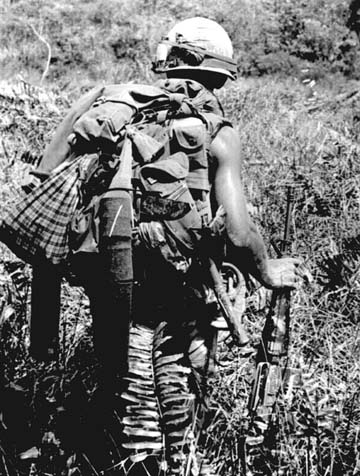
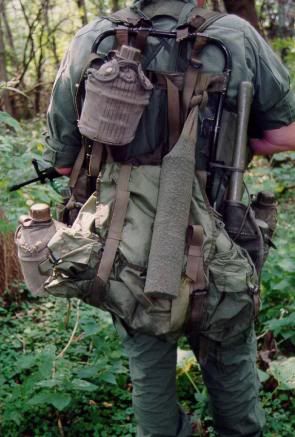
A full c-ration was supposed to replenish 1200 calories but ground troops often took the rations apart so that they could carry only what they needed most. It was customary for troops to put the cans into socks and to sling them on their backs like so: example 1, example 2. This limited the amount of sound the cans made, lightened the load, and freed up space in their patrol kits for other items. Occasionally ground troops would also take food from local towns that they came across to supplement their meager rations.
"If available, we "borrowed" onions from some of the local gardens to enhance our meals."^2
As you can see, much of the evidence is anecdotal. What and how well the soldier ate depended largely on their own individual decisions. This makes it almost impossible to give you a clear answer. The only clear thing is that C-rations were not ideal for jungle warfare and that ground troops made the best of it. Just to give you an idea of the difference, North Vietnamese troops tended to subsist off of dried rice which was much lighter and could be cooked later with hot water.
Towards the end of the war the US Army recognized this problem and began to produce lightweight LRP (long range patrol) rations using dehydrated or freeze dried food which could be prepared with hot water. This would ultimately go on to become the successor of modern MREs. However such rations were expensive and not quickly adopted by all branches. It would seem that LRPs were mostly used by specialized troops on high priority missions while regular infantry continued to use C-rations through to the end of the conflict.
"Airborne troops and other elite outfits at times got good lightweight combat rations for important operations."^3
Sources:
1.) The Doctor's Lounge, Goodbye to the C Ration, Bulletin of the Muscogee County (Georgia) Medical Society, March 1979, Vol. XXVI No.3, p.14 (Available online here)
2.) Bramen, Lisa, Fishing With Grenades and Cooking With C4: A Veteran's Vietnam Food Memories, Smithsonian Magazine (2010). (Available online here)
3.) Kearny, Cresson H. (Maj), Jungle Snafus...And Remedies, Oregon Institute (1996)(Partially available online here)
-Edit- Fixed grammatical and format mistakes.
In a way, the "MCI diet" was not sufficient. As you point out, the MCIs were heavy and this added onto an already heavy pack that had to be carried, which considering the amount of walking that had to be done led to many going through weight loss. When it comes to how many MCIs were consumed, it's hard to generalize and it was very much up to the soldiers themselves to choose how they would approach their meals and how they'd sustain themselves throughout the day. Most ate breakfast but after that, it varied. Thus, it's hard for me to give you a proper answer since there isn't a right or wrong answer. If you ask any US front soldier from the conflict, you'd get different answers that would apply to their platoon or squad but not outside of it.
I would however like to mention something related to this. Some US soldiers liked to spread the weight of the MCIs by putting the cans into spare socks, tie them together and hang them from their packs, belts or necks. It goes to show that while they might have been cumbersome, they still manage to find a way to carry them all around.