Did sailors just board each other's ships and fight normally? Did ships ram each other?
How were ships destroyed? Were they lit on fire or their hulls broken by weapons?
During Alexander the Great naval siege of Tyre in 332 BC, the defenders used catapults against the Greek navies... the aim was not to sink the ships, though, but to incapacitate enough of the rowers aboard that they could no longer be effectively maneuvered.
During the Punic Wars of 3rd and 2nd centuries BC, the most common battle tactic on the sea was ramming. As such, ships were constructed with reinforced prows that were in effect battering rams. Ideally, a hit would outright sink the enemy ship, or at least severely incapacitate it.
The Romans, being a primarily land-based power, were out of their league fighting the Carthaginians at sea...and figured it out very quickly when the majority of their first major fleet was trapped in a cove and captured pretty much right off the bat in 260 at the embarrassing (for the Romans) Battle of Lipari Islands.
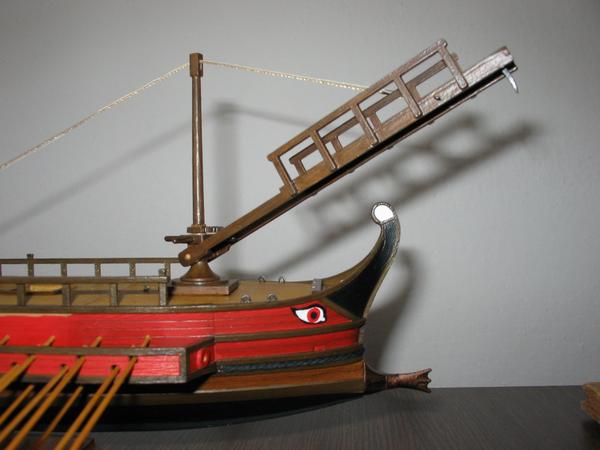
The Romans did what the Romans always did when faced with defeat: they doubled down and constructed a new fleet, but added a critical new invention: the corvus - which was in essence a ship-mounted draw-bridge with spikes on the bottom, that allowed the superior Roman infantry to drop it down on a nearby Carthaginian ship, latch on, and then board and engage in hand-to-hand combat... at which they excelled. This really turned the tide of the First Punic War and resulted in a major Roman victory.
Nevertheless, the corvus was a stopgap method - it was dangerous and cumbersome for the Roman ships to use, and once they became more proficient at "standard" naval tactics, they largely phased it out of their navies.
More on the corvus here: http://www.livius.org/cn-cs/corvus/corvus.html
Most of this information is about earlier Roman ships, like during the Punic Wars. Later projectile weapons changed, such as the famous Greek fire used by the Byzantines / Eastern Romans which terrified everyone who witnessed its use.
Sometimes ships had large ballistae on them. For instance, at the siege of Syracuse the Roman fleet had to get quite close to use these engines, but this also brought them within range of all the ingenious war machines built by Archimedes. They also used smaller missile weapons like bows.
The ships normally had heavy reinforced prows and they rammed each other in an attempt to stove in the hull of the enemy and cause them to sink. But this was not a very easy manoeuvre and it was far from certain it would succeed. Another tactic was to try and snap off all the oars on a side to disable the ship and make it easier to board.
So that leaves hand-to-hand combat. They used grappling hooks so the enemy ship couldn’t get away. The Romans also developed a rather unique tool. The corvus was basically like a drawbridge with a huge iron spike at the end. The Romans would get close to an enemy ship and swing this bridge down, impaling and holding the enemy ship. The Romans could then charge over this bridge to engage.
This was a good example of Roman flexibility. During the early Punic Wars they weren’t particularly good mariners but were excellent soldiers. They brought their expertise in ground warfare to the waves and were quite proud of it.
Main sources: Polybius and Livy.
Edit: Sorry, I basically just repeated what /u/cthulhushrugged said. He must have posted while I was still writing.
Thucydides describes the Battle of Sybota (433 B.C.E.), fought by the Corinthians (150 ships) against a combined fleet of Athenians (10 ships) and Corcyraeans (110 ships), as such:
"The fighting was of a somewhat old-fashioned kind since they were still behind in naval matters, both sides having numbers of hoplites aboard their ships, together with archers and javelin throwers ... indeed, it was more like a battle on land than a naval engagement ... both sides relied more on their hoplites, who were on the decks and who fought a regular pitched battle there while the ships remained motionless ... this was the biggest battle that had ever taken place between two Hellenic states" (Book I, Chapter 49, translated by Rex Warner)
The short answer is, ancient Mediterranean naval battles were engagements between triremes (or oar ships with more decks later on) which tried to ram the other ship midships (where it was fragile) with bronze reinforced rams. Then, either the ramming trireme let its oarsmen pull it out and let the other ship sink, or boarded the enemy ship and best its crew to eliminate it from the fight.
In the ancient world navies practiced naval warfare as a version of their land based battles; that is to say the battles were not true naval battles where a ship bests another ship. Instead it was more like a contingent of marines trying to kill another crew after trying to gain a solid foothold to its foe's deck.
You can even observe the remnants of this trend at the onset of the age of projectile based naval warfare. For instance, a typical medieval caravel with very high bow and stern castles that kind of turned the naval engagement into a stronghold defense.
Edit: minor grammatical corrections
There are two primary methods of naval warfare: ramming and boarding. The former requires a high degree of skill on the part of your rowers and captain. You also need fast ships, if your ship has been in the water for a considerable period barnacles develop on the hull and it also gets waterlogged - all affecting the top speed. States like Athens who's livelihood depended on trade invested in a large navy, used citizen as well as mercenary rowers and paid them well, and built ship sheds so boats could be dried out and maintained.
If you didn't have access to well trained crews then ramming was an easier method of combat. You didn't need a clean and efficient hit, just get close enough to board and seize control. Rome, which built up a navy from scratch, favoured this method. I'm not as well read up on the later Roman navy so can't comment on that as much. However by the Principate the Mediterranean was a Roman lake as no independent state had a navy that could challenge Rome.