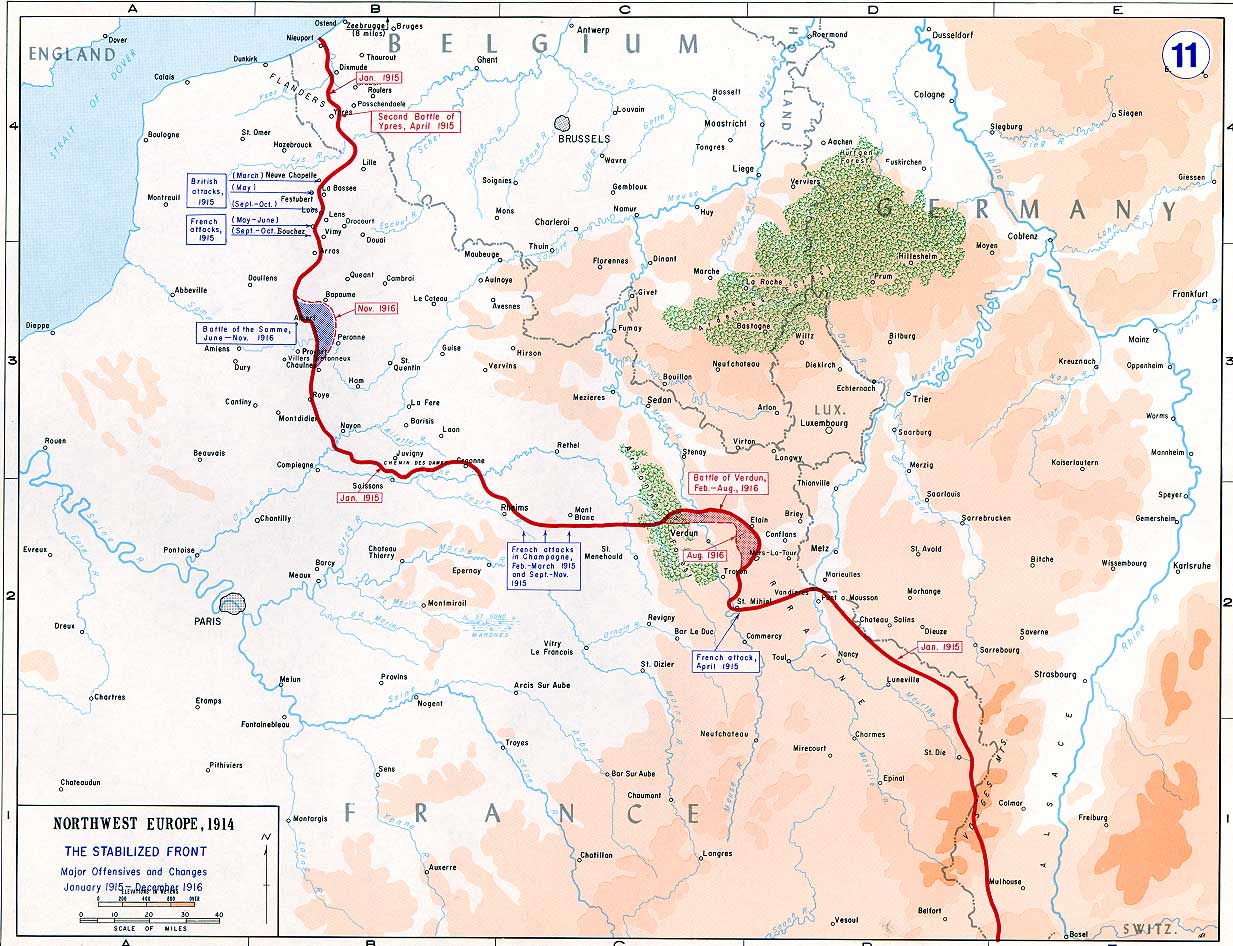
Sorry I couldn't think of a more intelligent name for this. In WWI, on the western front, where were there trenches? Did they cover the entire front line, from Switzerland to the Channel? How would trench warfare work in coastal, mountainous, or border areas?
The Trenches stretched almost uninterrupted from the Channel to the Swiss Frontier. On the northern end, barbed wire ran down to the beaches, but the Belgian Army's positions were largely behind the bank of the River Lys and the nearby Canals, so not necessarily trenches. Southwards, the lines in Flanders were largely above ground revetments, because the water table was too high to dig deeply. On the southern most end of the line, in the Vosges mountains, French positions were more akin to redoubts, fighting positions connected by trenches or paths to one another.
The Trenches ran pretty much straight following the River Lys, then bulged around Ypres (the infamous Salient), then ran almost diagonally southwestwards through Artois, dominated by the Notre Dame de Lorette Spur and the Vimy Ridge, then into the chalky, hilly terrain of the Picardy Plateau, where the Battle of the Somme was fought. It curved eastwards around Noyons, running across the Oise and then parallel to the Aisne, just below the Chemin Des Dames Ridge. It ran northwards through the Hills of Champagne, across the Meuse in a bulge around Verdun, then southwards down into the Argonne forest. It bulged around St. Mihiel, a German salient like the French one around Verdun, and then ran southwards following the Vosges mountains to the Swiss Frontier.
EDIT: here's a map
http://upload.wikimedia.org/wikipedia/commons/5/51/Western_front_1915-16.jpg
I'd also recommend having a look at this site which hosts images of original British trench maps, some of which can be overlayed on modern google maps.
Of note is the relative sophistication and complexity of the German trench lines and the simplicity of the British lines, reflecting the defensive and offensive postures of the two sides respectively.