Lately, there's been a lot of rhetoric saying that people in colonial american, during the medieval era, etc. lived about the same length as us, it's just that high infant mortality rates skewed this data. To what extent is this true?
I'll leave comparisons between current and historical life expectancy to the experts (and actually, this may be a question better suited to /r/AskAnthropology or /r/AskScience), but just want to point out that when people use the term 'life expectancy' it's typically shorthand for 'life expectancy at birth', a figure which is most definitely pulled down by infant mortality. Here are a few earlier posts; follow the link to Wikipedia for calculations and charts
I'm a 10 year old peasant in 18th century France. Both my parents die at the ripe old age of 30-- what happens to me then? - /u/edXcitizen87539319 explains the term
What was the average life expectancy like in the ancient world? What were the main factors that allowed us to live longer? - /u/a_guile explains the term
What was life expectancy really like in Medieval times if you survived infant mortality. - /u/fear_the_gnomes discusses factors affecting life expectancy in medieval France & Bavaria
What was the average human life expectancy throughout the ages? - a couple of comments on how life expectancy changes as one ages
List of historic life expectancies? - /u/alriclofgar looks at skeletal evidence from medieval England
I'm a wealthy, healthy Roman politician in 0 AD. What's the longest I could plausibly live? - several examples of elderly Romans, when, according to /u/Thundercat9, "life expectancy at birth" has been estimated to be 21
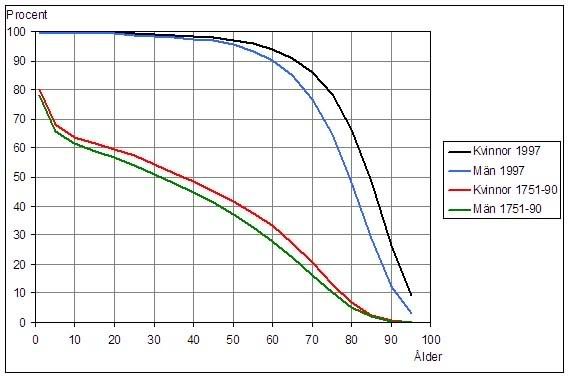
Here's a diagram made from the Swedish bureau of statistics data.
The lines show how large percentage of women (kvinnor) and men (män) are alive at any given age.
Here you can see that a large percentage of children die early - at age 10, less than 65% of people born are still alive.
However, if you did survive infancy, it was likely (about 50% chance) that you also surived until you were 60.
Source: "Befolkningsutvecklingen under 250 år" (Demografiska rapporter 1999:2)
tl;dr It's half true as there is a good concept behind the claim but it's taken too far.
Average age is greatly impacted by high infant mortality rates so the idea that "the average age a person would live to in say ancient Rome was 30" is a highly misleading idea. But it's not clear exactly what we want to measure when we say average age? If we want to exclude infant mortality what about early childhood deaths and do we care about the mean or the median age and who are we thinking about (since income differences would corropond to vastly different outcomes).
However common sense prevails: while the initial mean numbers don't do a good job at showing "real" average age of death, life expetency has been improving over time when he start at different starting points rather than childbirth.
e.g. found this chart which claims to be from the US census (and i have no reason to doubt it).
http://www.infoplease.com/ipa/A0005140.html
for example this shows a 20 year old white male in the US living 10 years longer in 2011 than in 1900
if that's true in 1900 i'm pretty sure it's true for centuries before as well
What's really wrong here is the idea that people died of old age at 30 or 40. People didn't age much faster in the past than they do now...true, there is wear and tear on the body from hard labor, and if you spend all your time out in the sun you may look older at a younger age. But in general, aging itself happened at the same rate.
However, you were more likely to die from some other reason. Not just as an infant, but as an adult as well. Injury and disease were less treatable and more likely to result in death, and those early deaths skew average lifespan downward.
I can't speak to colonial America or the middle ages, but this paper discusses mortality and provides interesting data on a variety of hunter-gatherers and agriculturalists, with a dataset from Sweden in the 1700's and chimpanzees as comparison. Scroll down a bit to see some good graphs if you don't want to read the whole thing. Key things to note are: high infant mortality, constant slow attrition among adults, and maximum lifespans not too different from today. I don't have the data, but I suspect that if you looked at adult attrition now, you'd find it was significantly lower than what is seen here.
It varies depending on the study you're looking at, and the time/place.
For the early middle ages, we rely entirely on archaeological remains to caclculate mortality rates. But in most cemeteries, especially in western europe, few infant remains survive. This is partly because infants' bones decompose more rapidly than those of adults, and partly because infants, when they do survive, are often found buried in shallower graves which are more easily destroyed by 1500 years of ploughing and errosion (while the deeper graves of adults are more likely to survive). But it mostly appears to be because infants weren't buried with adults - perhaps because they hadn't yet reached the age at which they counted as full members of the community, or because they were being buried in a special place reserved for infants' bodies.
But that means that mortality rates for the early middle ages don't usually include infant mortality. If they did, the average - which is usually in the 20s or 30s, depending on the community - would be even lower.
Much of the high mortality seems to have been caused by intense physical labor (being a poor farmer with bad nutrition on years when the crops are poor), dental infections, etc. the kinds of struggles experienced by all rural communities with poor access to outside resources and little to fall back on should something go wrong.
Another leading cause of lower average lifespans in earlier eras, as well as high infant and childhood mortality rates, was a higher rate of women dying in childbirth.
There are still parts of the world where 1 in every 7 or 8 women will die in childbirth. (Whereas, in places with better medicine it is more like 1 in 20,000.)
http://en.wikipedia.org/wiki/Maternal_death
High rates of women's mortality in childbirth would obviously lower the average life expectancy.