Hey! So, this is a topic I am very interested in, and will possibly be writing a paper on, though I have had a hard time finding good primary sources.
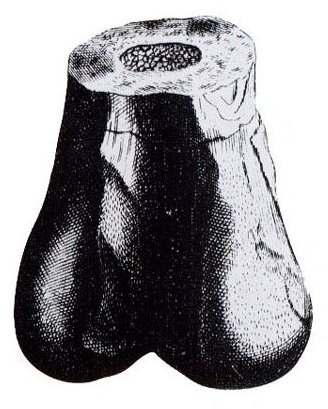
So, the first scientific illustration of a dinosaur fossil was published in 1676— just the fossilized end of an enormous femur— by a man named Robert Plot, in his book, Natural History of Oxfordshire. Darwin's Origin of Species was of course very far away, but the idea of extinction at all, much less evolution, had not yet been recognized. Most people were creationists who believed that all the animals currently on Earth were the same set of animals that had existed in the very first days of Earth's history.
So, Plot knew that the fossil had once belonged to a real animal, but his only options to choose from were all the animals that he knew existed in the world and had been to England. At first he thought it must have been a bone from an elephant brought over by the Romans, but when the size didn't match a live elephant he saw in captivity, he concluded it must have belonged to a giant human, like the biblical Goliath and other classical very large people.
It sounds a little silly, but all of his reasoning is very scientific and thought-out. His book is online here, and the dinosaur stuff starts on page 132. Here are some relevant quotations:
And that indeed there are stones thus naturally fashioned, must by no means be doubted... [but] none of them, as the judicious Charles Marquess of Ventimiglia well observed, [have] any signs of hollowness for the place of the marrow, much less of the marrow itself. Which has fully convinced me that this stone of ours was not so produced, it having those signs exquisitly expressed; but must have been a real bone, now petrified...
But against this opinion of its having been once a real bone, there lies a considerable objection, viz. that it will be hard to find an Animal proportionable to it, both horses and oxen falling much short of it... If so in probability it must have been the bone of some Elephant brought hither during the Government of the Romans in Britain.
But... there happily came to Oxford while I was writing of this, a living Elephant to be shewn publickly... with whose bones and teeth I compared ours; and found those of the Elephant not only of a different shape, but also incomparably bigger than ours, though the Beast were very young and not half grown. If then they are neither the bones of Horses, Oxen, nor Elephants, as I am strongly perswaded they are not, upon comparison, and from their like found it Churches: it remains, that (notwithstanding their extravagant magnitude) they must have been the bones of Men or Women. (pg 136)
I don't have any great sources for the realization and acceptance on the part of the greater scientific community that thousands of species of animals that had been created had been allowed by God to die out entirely, which I'm sure must have been a large paradigm shift. The next time period I've been looking into is the coining of the term "Dinosaur" by Sir Richard Owen in 1842 to describe 3 species of giant prehistoric reptile, Megalosaurus (Robert Plot's femur fossil probably belonged to one of these), Iguanodon, and Hylaeosaurus.
By this point however lots of other extinct animals were already known, and to be honest Dinosaurs weren't particularly special. For example, Plesiosaurus had been discovered in 1821, and caused a much greater stir in Victorian England for clearly being a giant, aquatic reptilian monster, unlike anything alive today— contrast this with Iguanodon, which was known only from a few bones and some teeth that made it seem basically like a giant iguana: cool, but not as alien as this. It also jumped into pop culture, making a spectacular appearance battling an Ichthyosaurus in Jules Verne's 1864 novel Journey to the Center of the Earth. Here's an 1858 watercolor of the two animals, done for a museum.
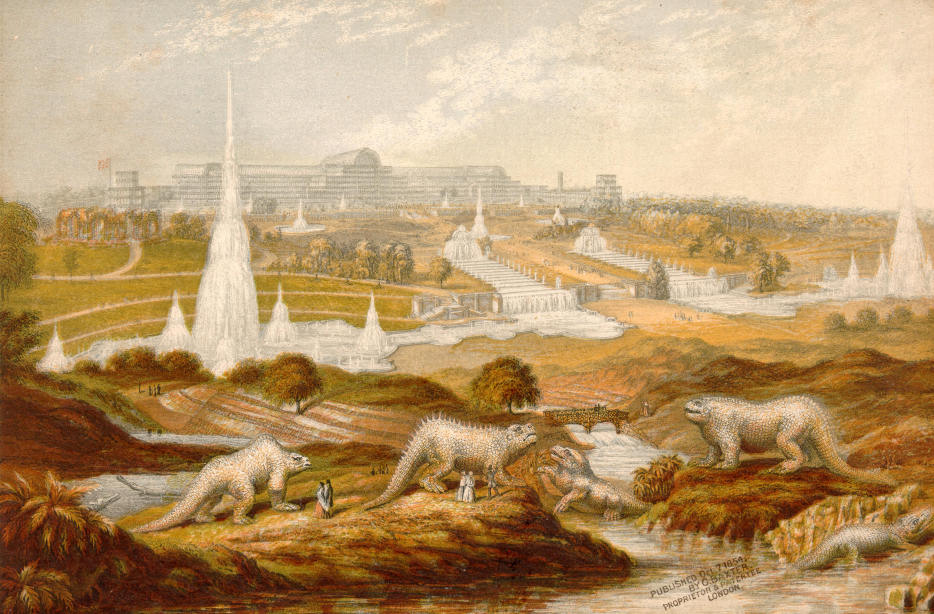
But, what really contributed to dinosaurs' popularity were the life-sized Crystal Palace Park dinosaurs, sculpted by Benjamin Waterhouse Hawkins under Richard Owen's direction from 1852-54, alongside many other extinct animals. The Crystal Palace was a fantastic new exhibition space in London that had held the Great Exhibition of 1851, something like a World's Fair, and in 1853 Owen hosted a New Year's Eve dinner party for some of the world's preeminent natural historians and scientists inside one of the Iguanodon sculptures. The sculptures were a popular attraction, and were featured on postcards.
Soon after, dramatic new discoveries of many more and much larger dinosaurs in North America, culminating with Tyrannosaurus rex, would really catapult dinosaurs into public awareness, and by the 20th century, popular culture. But I really need more information on the 1700s to fill in this answer. The jump from not believing any different past species could have existed in the 17th century to scientists like Lamarck trying to explain descent with modification in the 18th century is possibly the most interesting part of all this, and that's where I lack sources.
In the old chronicles we find that of Bernal Diaz del Castillo (l), who narrates that when the Spanish reached Tlaxcala on September 25, 1519, “during a conversation between Cortéz and Xicotonga (Xicoténcatl), the Indians said that their ancestors told them that a long time ago there were settlements of men and women who were very tall and with huge bones; that because they were very evil and of bad behavior, they killed them fighting with them, and those that remained died. And in order that we could see what enormous sized bodies they had, they brought a bone or leg bone of one of them, and it was very heavy and very large in height [compared to?] a man of average stature. And that leg bone was from the knee to the hip. I measured myself with it and it was as tall as I, although I am of average build. And they brought other pieces of bone like the first. Most were already [eaten? bare?] and hardened from the earth, and all of us marveled at seeing those leg bones, and we were certain that there had been giants in this country. And our Captain Cortez told us that he would be sending that great bone to Castile in order that His Majesty could see it, and so thus we sent it with the first products that went out.
Edward Drinker Cope and Othniel Charles Marsh were friends, naming species after each other and complimenting their works. But through competition, things got sour real fast. “They sometimes stooped to one team’s diggers throwing rocks at the other team’s.”
But through all the fighting, “over the next several years the two men between them increased the number of known dinosaur species in America from 9 to almost 150,” including “stegosaurus, brontosaurus, diplodocus, triceratops.”
Through all the discoveries, increased pressure and attention was put on the age of the Earth. Like I said, this wasn’t a new idea for discussion, but something spurred on by the discovery of dinosaurs.
Richard Owen, who xiaorobear mentioned, was responsible for a lot of early fossil work and famous for coining the word Dinosauria. But he was a bit of a dick.
Owen gained enough prominence from his discoveries and ideas, that he gained a position to act on his jealousy and pettiness. He stole ideas without attribution, claimed to hold titles and positions that he didn’t, cut other promising scientists off from access to research material, gathered votes to kick people off of councils, and unfairly removed his “rivals” names when they discovered new species. He got caught up in all this underhandedness and eventually was kicked off of various councils of the Royal Society, of which he was committee chairman. He would “never again do important research.”
As a result of his tarnished reputation, he focused his energy elsewhere. He became head of the natural history section of the British Museum. There he pushed for the expansion of the British Museum to include a larger selection of natural specimens. He was successful, and the Natural History Museum was born as the home for all the bones he loved. He also pushed for the museum to be open to everyone. Previously, museums were more like research collections, where you needed a written application to enter.
He even proposed, very radically, to put informative labels on each display so that people could appreciate what they were viewing. In this, somewhat unexpectedly, he was opposed by T. H. Huxley, who believed that museums should be primarily research institutes. By making the Natural History Museum an institution for everyone, Owen transformed our expectations of what museums are for.
So because of Owen’s love for paleontology, and as a result of the fossil hunting craze of the time, we now have museums around the world open to anyone with a ticket, instead of requiring a written application and interview.
Here's a book I read on the subject:
The Dinosaur Hunters: A True Story of Scientific Rivalry and the Discovery of the Prehistoric World by Deborah Cadbury (2001)
It's geared toward a popular audience, but is rigorous and far-reaching in its scope. It really opened my eyes to the world on the cusp of discovering the ancient age of the Earth.
The book follows the lives and careers of three individuals who labored on the cutting edge of this radical new field -- though only one of them secured a legacy and international prestige among the scientific community. Richard Owen was this fortunate individual, and as u/rkiga aptly described him, he was a "bit of a dick." Gideon Mantell was a country doctor who dedicated the precious spare time he had to discovering prehistoric fossils and writing papers and books on the subject. His life is tragic and he dies bitter and relatively unrecognized for his years of labor. However, his life is not nearly as tragic the third subject of this book: Mary Anning. She was a poor British girl who earned money for her single mother by scouring the rocky shores near her home for fossils. She would discover a near-complete Ichthyosaurus, a Plesiosaurus and a pterodactyl, among many other lesser specimens. However, Mary had to sell them off to collectors (who would flock to her home to see and study her specimens, and who would go on to fame and fortune), while she continued her work and educating herself in various scientific fields in order to better her standing -- though to no avail, as women could not address the Royal Society and she was too destitute to fund her own enterprises.
The most fascinating aspect of the book, to me, was an exploration on how the discovery of prehistoric life -- teamed with the recognition of the Deep Time as developed by James Hutton in determining the age of the Earth -- revolutionized people's perception of the world.
Consider:
In the 1830s, Charles Lyell popularizes the work of James Hutton in establishing a geological age of the Earth, known as Deep Time. As a friend of Hutton's remarked, "the mind seemed to grow giddy by looking so far into the abyss of time."
Beginning in 1815, discoveries of Dinosaur fossils became increasingly prevalent. The term "Dinosaur" was coined in 1842. And in 1854, Dinosaur sculptures were displayed in the Crystal Palace for all the public to see, forcibly asserting the notion that another race of lifeforms had once dominated our world, and that they were great and terrible reptiles.
Charles Darwin publishes his On the Origin of Species in 1859
On top of all this, in the field of Astronomy: around 1800, William and Caroline Herschel made observations of the stars, utilizing their own new designs for telescopes, showing the Milky Way was just one of a vast number of galaxies that were constantly being born, aging, and dying. As Holmes writes, the Milky Way "cannot last forever," and "our solar system, our planet, and hence our whole civilization would have an ultimate and unavoidable end."
The entire world of science and knowledge seemed in flux. And the discovery of dinosaurs was yet another example of this -- an especially illustrative and colorful example, at that.
Sources:
The Dinosaur Hunters: A True Story of Scientific Rivalry and the Discovery of the Prehistoric World
The Age of Wonder: How the Romantic Generation Discovered the Beauty and Terror of Science
Here is an older thread on the topic:
We're Dino bones ever presented as evidence of Dragons or perhaps Demons?